
Algae and total organic carbon removal in desalination plants

- 1. Introduction
- 2. Pretreatment of seawater with algae and total organic carbon (TOC).
- Treatment of wastewater with high phosphorus and TOC content by DAF and MBR.
- 4. Summary
Harmful algal blooms and presence of total organic carbon (TOC)
Certain environmental conditions, such as warm weather, favor the growth of algae in surface water bodies.
Other times algae are produced by inadequate management of wastewater discharged into the environment. Algae grow with the presence of nutrients (nitrogen and phosphorus), and with the right levels of light, pH and temperature. As the concentration of phosphorus in a body of water increases, so does the growth of algae.
Controlling harmful algal blooms is a major environmental challenge. It is essential to reduce the concentration of phosphorus, as it is the main factor contributing to the problem. On the other hand, measures must also be taken to eliminate growing colonies.

There are chemical additives that can be dispersed in a body of water to prevent algae growth, but this does not eliminate the floating green carpet of solids. It is more effective to physically remove them and reduce the concentration of phosphorus in the water. One process that works well in stopping algal blooms is flotation by aire flotation (DAF).
Total Organic Carbon (TOC) is a direct measure of the organic carbon present in a water sample, including both dissolved organic matter and suspended particulate matter. Unlike BOD and COD, TOC does not distinguish between biodegradable and non-biodegradable organic matter, it simply measures the total amount of organic carbon in a sample.
2. Seawater pretreatment in desalination plants
Adequate pretreatment is necessary in the seawater desalination process, as algae, TOC, hydrocarbons, oils and grease must be prevented from entering the desalination membranes.
Membrane systems used for seawater desalination are vulnerable to fouling and clogging caused by these contaminants, reducing their lifetime and performance. To avoid these problems, seawater must be treated prior to entering the reverse osmosis plant.
Disinfection, mechanical screening and pH adjustment
Disinfection by oxidation is applied to prevent biological growth that causes fouling of filters and membranes. Due to its low cost and effectiveness, the most commonly used oxidant is chlorine, but it is necessary to have a subsequent dechlorination process to avoid the presence of residual chlorine in the stream, since this oxidizing agent attacks the composition of the membranes. On the other hand, it should be taken into account that the reaction compounds (chloramines, trihalomethanes, etc.) are toxic at certain concentrations.
The screening process consists of placing a screen or grid in the seawater catchment line. Plants and other debris are retained in the screens and are removed using a rake or similar tools.
The pH of seawater is usually alkaline, but the performance of reverse osmosis membranes is optimal at low pH values. It is essential to maintain the pH of the water between 5.5 and 6.0, which is achieved by the addition of an acidifying reagent that prevents salt precipitation and also facilitates floc formation. Adjusting the pH is beneficial both for the elimination of algae and for the elimination of total organic carbon.
It is not recommended to work at a pH below 5.5, as the cells rupture and release intracellular substances that can remain in the membranes and even leak with the permeate.
Coagulation and flocculation
The main purpose of the coagulation and flocculation process is to remove turbidity and suspended solids. During this process a coagulant is added to the water to neutralize the polarity of the electrically charged particles (colloids). The type of coagulant and its optimum amount are evaluated by carrying out a jar-test on the water. The most commonly used coagulants are aluminum compounds, ferric salts (ferric sulfate, ferric chloride) and aluminum salts (PAC and alumina sulfate).
The algae cells must be completely destabilized to allow the treatment to reach its maximum efficiency. This is achieved with the proper dosage of coagulant and flocculant, along with the pH adjustment that is optimal for the coagulant dosage that has been made.
Dissolved Air Flotation (DAF)
During the flotation stage, particles, algae cells, oils and fats are floated and removed. The flocs produced in the coagulation-flocculation stage are also removed.
DAF equipment has gained popularity in desalination processes to produce potable water, as it reduces space requirements and lowers operating and maintenance costs, while improving purification results.
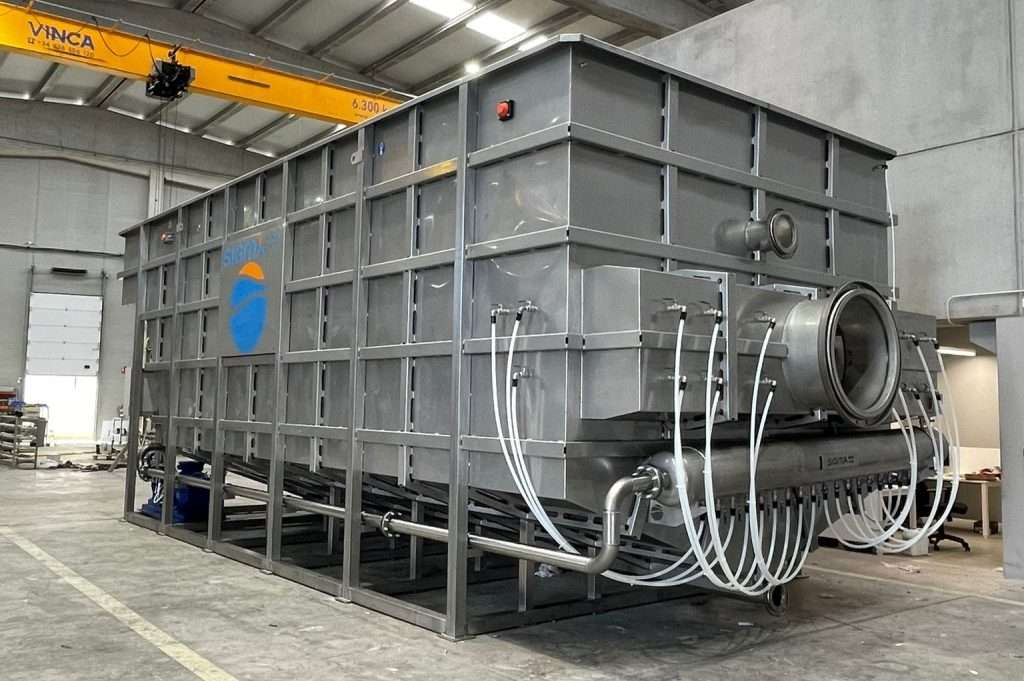
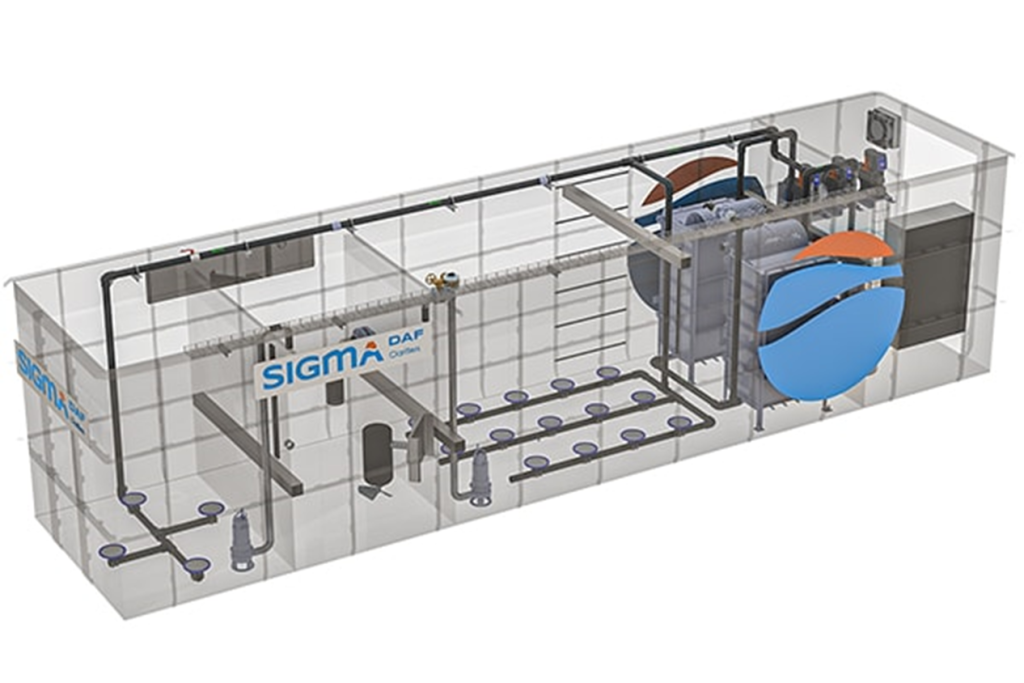
At SIGMADAF we have developed specific DAF equipment for this application (SEADAF), which combines the principles of flotation and dissolved air sedimentation with an optimal equipment design.
The materials used for the construction of this equipment must withstand the high corrosion of seawater salts (basically NaCl), so polypropylene is usually used for tank construction and coatings, and AISI316L stainless steel for the metal parts. These materials guarantee a long life for these DAF systems.
Algae removal efficiency with a system that includes coagulation-flocculation, pH adjustment, DAF system and gravity filtration exceeds 99%. If an ultrafiltration (UF) membrane system is available as a complement, the efficiency approaches 100%.
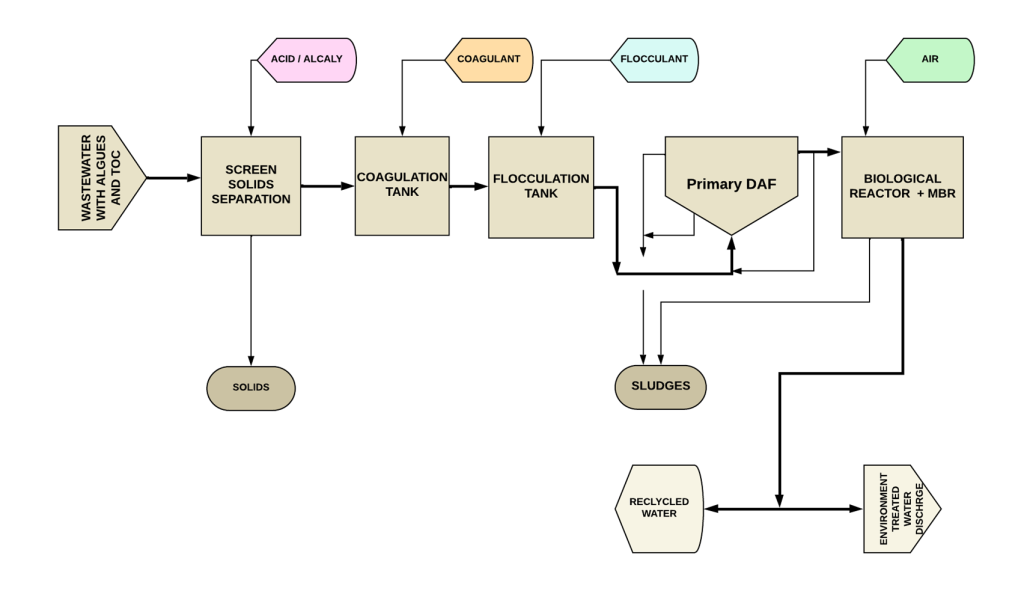
Treatment of water with high phosphorus and total organic carbon content by means of DAF and MBR.
As mentioned at the beginning of this article, it is necessary to avoid the discharge of phosphorus into the environment, as this contributes to the uncontrolled growth of algae colonies.
It is common to encounter wastewater with a high phosphorus content, either in colloidal form or in solution, as well as a high TOC concentration. This usually occurs in urban wastewater and in water from farms.
A coagulation/flocculation process with pH adjustment and the addition of Ca(OH)2 is necessary to properly treat the effluent if phosphorus remains in solution.
The pre-treated wastewater is conveyed to secondary treatment, which consists of a biological oxidation system with air and a separation of sludge and suspended solids.
Membrane bioreactors (MBRs) offer high efficiency for treating low to medium flow rates with high TOC concentrations. An MBR reactor consists of an aerobic bioreactor with aeration equipment and a set of ultrafiltration (UF) membranes where the biomass is separated and recirculated.
Because the biomass is completely retained in the membrane and reintroduced into the reactor, very high concentrations are achieved inside the reactor (5 times higher than in conventional systems).
These results are obtained with short residence times, an extraordinary degradation capacity, a minimum space requirement and a remarkable quality of the treated effluent.
Another advantage derived from the higher biomass concentration is the possibility of buffering the impacts of the pollutant load without damaging it. Short fluctuations of up to 10 g/l BOD at the reactor inlet have hardly any influence on the process. This buffering capacity ensures a uniform quality of the treated effluent.
In an MBR system it is possible to reach 200 mg O2/l/h oxygenation rate, a value much higher than that obtained in conventional reactors. Through the total suspension of the microorganisms (no floc formation) a large surface area is obtained, which allows the oxygen flowing in the medium to be absorbed by the microorganisms directly by the shortest route. This enables the bacteria to reach a high metabolic rate.
The mixing of the reactor volume is achieved in the aeration system by means of fine bubble diffusers. Of particular importance at this stage is the formation of small bubbles that are mixed with the entire volume.
In a submerged membrane system, the circulation of the reactor volume is carried out continuously through the ultrafiltration membrane chamber, which is attached to the aeration reactor. In this chamber, the UF membranes are either introduced directly into the biomass, or placed outside in suitable containers and pumped in between. The most commonly used option is membrane packages submerged in a tank.
MBR systems are an improved version of activated sludge systems, combining the biological degradation process with solid/liquid separation by membrane filtration. MBR systems are one of the most efficient technologies for the treatment of wastewater with high phosphorus and TOC loads.
4. Summary
Excess nutrients (especially phosphorus) and TOC contained in some wastewater or seawater can be a source of major problems for the environment, causing eutrophication in wastewater, which leads to anoxia and the death of aquatic animals and plants, and the clogging of reverse osmosis membranes in the case of desalination plants.
This article proposes treatment solutions using technologies and equipment available to SIGMADAF (DAF / SEADAF / SMBR), which have proven to be very efficient in the presence of these problematic pollutants.
These technologies are intended for the following purposes:
- Reduced energy, labor, reagents and equipment costs.
- High debugging performance
- Small footprint
- Simplicity in operation and maintenance
- Reduced energy, labor, reagents and equipment costs.
Bibliography and consultations
https://www.frcsystems.com/es/algae-removal-using-dissolved-air-flotation-daf/
Are you interested in this solution?
BASIC INFORMATION CLAUSE
DATA CONTROLLER: SIGMADAF CLARIFIERS, S.L. PURPOSE: To respond to the user’s request. LEGAL BASIS: Consent of the data subject. DISCLOSURES: No disclosures are anticipated, except where required by law or court order. RIGHTS: Access, rectification, erasure, objection, restriction, data portability, and withdrawal of consent. If you believe that the processing of your data does not comply with the regulations, you may contact the Supervisory Authority (www.aepd.es). ADDITIONAL INFORMATION: For more information, please see our privacy policy.