
Treatment of Dyeing and Finishing Effluents in the Textile Industry

- 1. Wastewater Generation in Dyeing and Finishing in the Textile Industry
- 2. Characteristics of the effluents generated in the dyeing and finishing processes
- 3. Treatment line for dyeing and finishing wastewater
- 4. Conclusion
1. Wastewater Generation in Dyeing and Finishing in the Textile Industry
Dyeing and finishing plants in the textile industry add color, texture, and functional properties to materials, fibers, and fabrics through a series of physical and chemical processes, including:
1. Fabric Preparation: Operations such as degreasing, scouring, and bleaching are performed to remove natural impurities (fats, waxes, pectins) and residues from the spinning process. Detergents, alkalis, and oxidizing agents are used for this purpose.
The effluents from these processes have a high pH and a significant concentration of total suspended solids (TSS). Traces of oxidizing agents such as H₂O₂ may be present in the bleaching process.
2. Dyeing: This is the stage in which color is applied to the fabric using dyes and chemical auxiliaries. Large amounts of water are required for the dye baths and rinses. The resulting effluents are intensely colored due to dye leaching, have high salinity, high COD, and fluctuating pH levels. They also contain other contaminants such as dispersants, fixatives, and, in some cases, traces of metals.
Dyes are the most polluting waste products, as they have a significant impact on the environment:
- They reduce oxygen in water bodies by blocking light, causing septic conditions.
- They are mutagens and carcinogens in animals and humans.
- They are toxic to plants as they inhibit photosynthesis.
- High levels of TDS cause an increase in salinity, altering the natural pH of the water.
3. Printing: Printing involves applying designs or patterns using dyes. It includes fixation and subsequent washing steps. The washing steps following printing generate effluents containing pigments, thickeners, binders, and solvents. These effluents have high levels of organic matter, color, and suspended solids, as well as compounds that are difficult to degrade biologically.
4. Finishing: This process imparts specific properties such as softness or water resistance. Resins, softeners, and other finishing agents are used, followed by drying and heat curing stages.
The effluents produced during the finishing process contain resins, softeners, silicones, and waterproofing agents, as well as synthetic organic compounds and traces of catalysts, which result in a high COD, in addition to the presence of residual color.

2. Characteristics of theeffluents generated in dyeing and finishing processes
The effluents from these plants are characterized by:
- High organic load (COD and BOD), often poorly biodegradable
- Hair Coloring
- Variable pH
- Dissolved salts
- Suspended solids
- Resistant organic compounds
- Presence of heavy metals and toxic compounds.
These effluents cause environmental and operational problems, both in the receiving environments and in the treatment systems.
- Problems resulting from changes in pH and salinity.
- The presence of intense color reduces light penetration at discharge points, affecting photosynthesis and aquatic ecosystems.
- High organic loading (COD/BOD) consumes dissolved oxygen, which can lead to anoxic conditions, eutrophication, and wildlife mortality.
- Some of the dyes and chemicals used in these processes are toxic or not readily biodegradable.
Effluents from dyeing and finishing processes in the textile industry vary greatly in composition, with ranges as shown in the following table:
| PARAMETER | UNIT | CONCENTRATION |
|---|---|---|
| pH | - | 6–11 |
| Temperature | ºC | 25–45 |
| COD | mg/l | 800 – 3,000 |
| DBO5 | mg/l | 200–800 |
| SST | mg/l | 100 – 600 |
| TDS | mg/l | 1,500 – 8,000 |
| Oils and fats | mg/l | 10 - 100 |
| Chlorides | mg/l | 300 – 2,000 |
| Sulfates | mg/l | 200 – 1,500 |
| Metals | mg/l | 1 – 10 |
| Surfactants | mg/l | 5 – 50 |
| Total Nitrogen | mg/l | 10 - 50 |
| Total Phosphorus | mg/l | 2 – 15 |
Water consumption in the textile industry is estimated to be between 80 and 150 liters per kilogram of processed fabric. The amount of water used in garment manufacturing varies depending on the type of fibers (cotton, wool, nylon, polyester, etc.) and the machinery used in each process.
Industrial wastewater contains a large amount of non-biodegradable chemicals that persist in the environment, especially in aquatic environments. The pigments used are highly polluting substances, as they are manufactured to be highly durable and resistant to biological degradation.
3. Treatment line for dyeing and finishing wastewater
Wastewater from textile dyeing and finishing plants is treated to remove color, organic matter, suspended solids, and other contaminants that exceed the limits set by current wastewater discharge regulations (N, P, metals, etc.).
The most common treatment process for this wastewater consists of the following stages:
3.1. Pretreatment
- Grates and screens for retaining coarse solids.
- A homogenization tank that evens out the flow rate and pollutant load and allows for pH adjustment.
3.2. Physicochemical Treatment
- Coagulation-flocculation using Al and Fe salts and polymers (polyelectrolytes).
- Dissolved Air Flotation (DAF) for separating solids.

3.3. Chemical Oxidation
Sometimes, chemical oxidation processes using oxidizing reagents (ozone, peroxide, Fenton) and suitable catalysts (Fe, Cu) are used to degrade recalcitrant organic compounds, such as dyes and pigments. This reduces the length of the resulting chains and makes them more biodegradable, which facilitates biological action in the subsequent treatment.
| OXIDATION TECHNOLOGY | PERFORMANCE |
|---|---|
| TiO2/UV/H2O2 | Color removal of 65–100%. 60% TOC removal. |
| Ozonation O3 | Removal of >95% of color. Removal of >60% of COD. |
| H₂O₂in subcritical water (150–200°C) | Complete removal of color and COD |
| OHP withH₂O₂and catalysts (Fe, Cu) | Complete removal of color and COD at 104ºC |
| Fenton Process (Fe(II) + H2O2) | Removes >96% of color. Removes 40% of TOC. |
| Electro-Fenton | Complete removal of color. Removal of 89% of COD. |
| Electrochemical oxidation (electrolytic cell) | Removal of >95% of color. Removal of >95% of COD.3. |
3.4. Biological Treatment
Membrane bioreactors (MBRs) are commonly used because of their high efficiency in reducing total suspended solids and color. They may include anoxic/aerobic zones to remove nitrogen and potassium if these exceed discharge limits.

3.5. Tertiary treatment (if necessary)
Tertiary treatment is necessary if water is to be reused or when discharge regulations are very strict. The most commonly used technologies are:
- Adsorption with activated carbon (FCA)
- Semipermeable membranes (nanofiltration or reverse osmosis)
- Final Disinfection (O3,Cl2O2, UV Radiation)
3.6. Sludge Management
Sludge from primary and biological treatment is dewatered in a filter press to reduce the cost of transportation and landfill disposal, and is managed as waste.
Sometimes, the waste produced contains pigments that can be recovered and reused.
Diagram of a wastewater treatment plant for dyeing and finishing in the textile industry
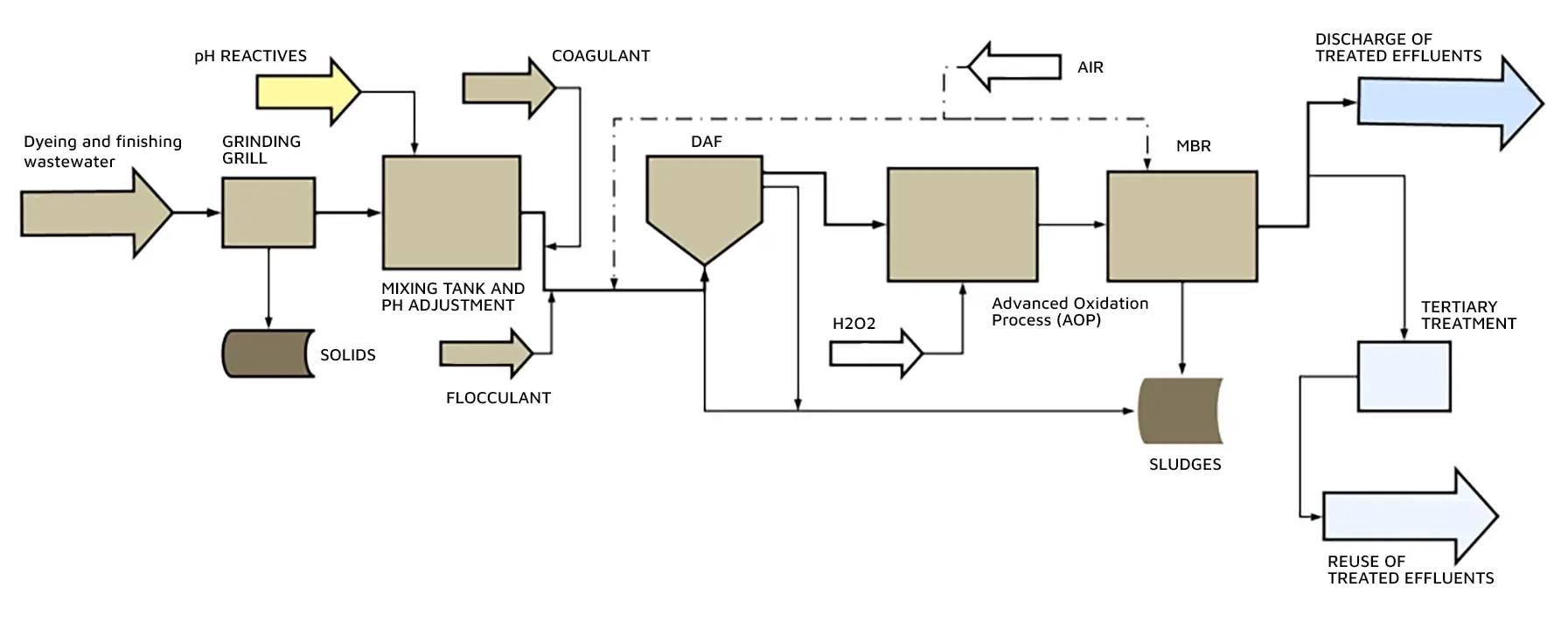
A properly designed and sized plant must meet the following objectives:
- Adapt the wastewater to the discharge limits.
- Reuse water in various textile manufacturing processes (washing, dyeing, heat treatment), as well as in cleaning, irrigation, and other operations.
- Recover raw materials dissolved in wastewater, such as pigments or dyes (possible in the management of separated sludge).
- Reduce operating costs of the production process.
- To reduce the environmental impact of business activities.
4. Conclusions
Textile dyeing and finishing processes generate wastewater with high organic load, intense color, salinity, complex chemical compounds, and significant variability. These effluents contain variable pH levels, suspended solids, surfactants, salts, and, in some cases, heavy metals and recalcitrant substances.
Its environmental impact includes oxygen depletion in receiving waters, toxicity to aquatic life, and problems for wastewater treatment systems.
A combined treatment regimen is used, which includes:
- Pre-treatment (screening and homogenization with pH adjustment)
- Physicochemical treatment (coagulation-flocculation and dissolved air flotation (DAF)).
- Sometimes, when COD is resistant to biological treatment, advanced oxidation processes are used as a preliminary step.
- Membrane bioreactor (MBR) treatment to reduce organic matter and, when necessary, tertiary treatments such as filtration or membrane filtration. The goal is to remove color, solids, and contaminants; comply with discharge regulations; and, in many cases, facilitate water reuse.
Bibliography and consultations
Are you interested in this solution?
BASIC INFORMATION CLAUSE
DATA CONTROLLER: SIGMADAF CLARIFIERS, S.L. PURPOSE: To respond to the user’s request. LEGAL BASIS: Consent of the data subject. DISCLOSURES: No disclosures are anticipated, except where required by law or court order. RIGHTS: Access, rectification, erasure, objection, restriction, data portability, and withdrawal of consent. If you believe that the processing of your data does not comply with the regulations, you may contact the Supervisory Authority (www.aepd.es). ADDITIONAL INFORMATION: For more information, please see our privacy policy.