
Expansion and improvement of wastewater treatment plants (WWTP)

- 1. Obsolete wastewater treatment plants
- 2. Expansion of wastewater treatment plants (WWTP).
- 3. Expansion of the WWTP of a poultry slaughterhouse with precooked poultry products.
- 4. Conclusions
1. Obsolete wastewater treatment plants
Many of the wastewater treatment plants (WWTPs) built in the past decades for the management of industrial effluents with a high pollution load have become obsolete due to various factors:
- Growth in the productive capacity of these industries.
- They have been limited by water shortages and drought episodes.
- Administrations are imposing stricter limits on COD, BOD5, suspended solids, total nitrogen, phosphorus, heavy metals and other parameters.
For these reasons, tertiary treatment or plant expansions are often required to allow for safe discharge or reuse of the water.
When considering the expansion or remodeling of a WWTP, the following should be considered:
- Reduction of required equipment. An example is the possible elimination of sludge thickening equipment, since DAF systems produce more concentrated sludge.
- Reduction of energy consumption, prioritizing efficient technologies.
- Reduction of the space required for expansion, since the new equipment is smaller in size.
- Reduction of sludge production by optimizing sludge loading conditions and sludge age, as well as increasing sludge concentration by other mechanical drying processes.
- Reuse of treated effluents in auxiliary processes (washing, cooling towers), service water, or irrigation, thus reducing the consumption of mains water.
2. Expansion of wastewater treatment plants (WWTP).
When a WWTP becomes too small, different types of problems are observed:
- Foul odors
- Maintenance difficulties due to operating at the limit
- Increased sludge generation
- Possible increase in landfill tax
- Non-compliance with discharge regulations.
One of the main challenges when dealing with the expansion of a WWTP is the limited availability of space. Often, it is necessary to reinforce or add new equipment to the effluent treatment system, while facing significant increases in sludge production. In addition, many of these facilities operate with technologies that have become obsolete compared to the more efficient and compact solutions being manufactured today.
In many cases, the total replacement of a WWTP with a new plant is unfeasible, both because of the high cost involved and the lack of sufficient space to build a new facility while the current one is still operational. Therefore, a more realistic alternative is the progressive modernization by upgrading or replacing key units within the existing system, with the aim of increasing its capacity, efficiency and adaptability to new regulatory and operational requirements.
In other cases, the technologies used are not capable of achieving the required quality in the treated water, especially when it is to be discharged into public watercourses.
Un ejemplo claro es el cumplimiento de los límites de DQO y Nitrógeno cuando se emplean decantadores secundarios en tratamientos biológicos o reactores SBR, los cuales no alcanzan los rendimientos esperados en la separación de sólidos. Esta falta de rendimiento se puede deber al dimensionamiento insuficiente del elemento, o a las características de los sólidos que no tienen el índice de sedimentación (IVL o índice volumétrico de lodos) adecuado para su separación por decantación (IVL < 100).
In order to carry out these expansions and improvements, a number of strategies are usually followed:
In primary treatment (physicochemical)
Increasingly, the substitution of g separation systems is becoming more and more common.r(coalescing plates or density separators) and primary decantation systems by dissolved air flotation equipment (DAF), or by CAF systems (cavitation induced air flotation).
This equipment allows a more efficient separation of colloidal material, suspended solids, oils and fats, and part of the organic matter, thus reducing the pollutant load that reaches the subsequent biological treatment. Their compact design, modularity, automation and reliability make them ideal for integration into existing treatment lines.
A DAF system system supersaturates air, which is then released in small bubbles inside the float, which adhere to the suspended solids, dragging them to the surface, where they are extracted by a mechanical sweeping system. In the case of CAF, the bubbles are created by cavitation, being generated in a turbine by rotation.

A DAF system can also be used to replace secondary settling, which occurs after a biological process. This combination of biological reactor + DAF is known as FBR (Flotation Bioreactor).
In this scenario, the DAF systems allow to reduce the size occupied by the reactor when working at higher loads, with biomass concentrations (MLSS) in the range of 5 - 6 g/l, much higher than the 3 - 4 g/l of the reactors with secondary settling tank.
In addition, DAF systems produce sludge with high dry matter concentrations (between 3 and 4%), while sedimentation barely reaches 1% dry matter. Thanks to DAF systems, intermediate sludge thickening equipment is no longer necessary, resulting in significant space savings and a reduction in equipment and pumps.
The main advantages of dissolved air flotation equipment are:
- Replacement of primary decanters in industries with fats and oils (slaughterhouses, dairies, precooked foods, etc.).
- Improved solids removal performance and COD reduction in plants with hydraulic or organic overload.
- Optimization of the subsequent biological treatment load (40-60% reduction in COD and suspended solids).
- High separation efficiency (>90% TSS, >80% COD).
- Reduction of biological sludge volume.
- Easy installation and quick start-up.
If sludge production has grown since the construction of the WWTP, the advantages and disadvantages of each of the mechanical dewatering processes (centrifuge, belt filter, filter press, etc.) must be taken into account. Filter presses are the ones that obtain the highest sludge dryness (30 - 40%).
In secondary treatment (Biological)
Depending on the composition of the effluent, it may be necessary to reinforce the nitrification-denitrification process. For this purpose, anoxic and extended aeration zones can be expanded, or specific technologies such as MBBR reactors can be incorporated. MBBR reactors (Moving Bed Biofilm Reactor). These systems integrate multiple stages of biological treatment through the use of mobile supports ("carriers") that favor the development of attached biomass. This configuration optimizes nitrogen removal and allows biological oxidation to be carried out in a smaller volume, thus increasing process efficiency and reducing the space required.
There may be occasions when high organic loads invite the installation of an anaerobic system upstream of the aerobic system, thereby improving biological performance, producing biogas, and drastically reducing sludge production.
There are also discharges that are resistant or refractory to biological degradation, as is the case with certain organic compounds in the textile, paper, chemical, pharmaceutical or cosmetics industries. In these cases, advanced chemical oxidation systems (OAPs) can be installed to break the organic compound chains into more biodegradable ones. The most common technologies apply energetic oxidizing reagents such as ozone (O₃), peroxides (H2O2), chlorine in dioxide form (ClO2) or peroxide (Cl2O3), UV catalysts. This process is followed by multilayer medium filtration (MMF) and granular activated carbon (GAC).
Membrane bioreactors are an excellent option to enhance and improve a conventional biological treatment. An MBR system combines biological treatment with membrane filtration (microfiltration or ultrafiltration), allowing the removal of suspended solids, organic matter, nitrogen and phosphorus. Membrane bioreactors produce treated water of superior quality, which in many cases can be reused. In addition, their small size saves space in the plant.
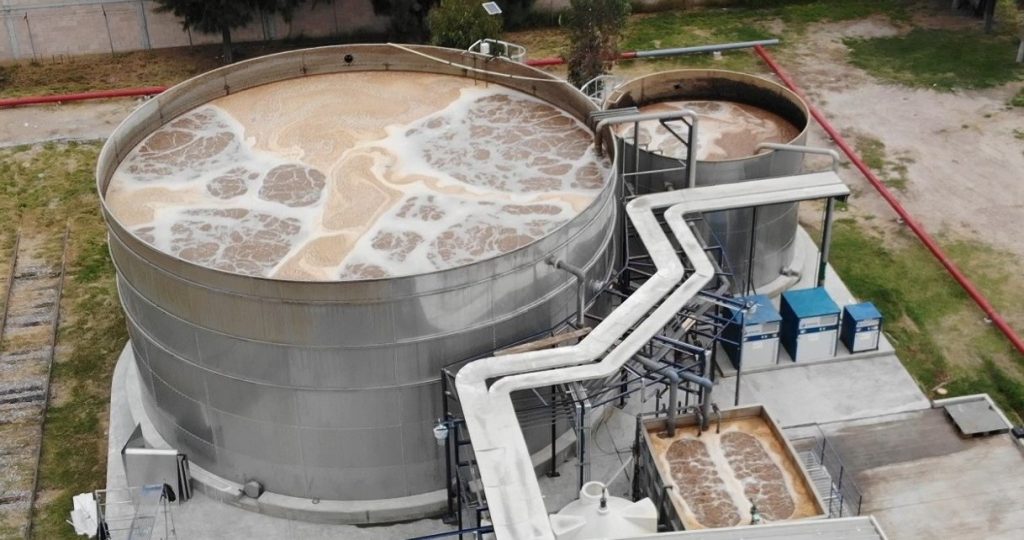
The advantages main systems MBR are :
- Replacement or extension of conventional biological treatments without the need for clarifiers or thickeners.
- Production of high quality water for reuse (irrigation, cooling towers, industrial processes).
- Higher biomass concentration (MLSS 8 - 12 g/l), reducing reactor volume.
- Calidad de efluente excelente (SS <1 mg/l, turbidez <0,2 NTU).
- Increased capacity to absorb pollutant load peaks, which is common in industrial plants.
- Robust and compact equipment that guarantees reliable and continuous treatment.
- Less generation of excess sludge from the biological process.
- Carbon footprint reduction.
- Automated and stable operation.
Optionally, MBR systems can be integrated with tertiary disinfection or reverse osmosis systems for direct reuse of treated water.
3. Expansion of the WWTP of a poultry slaughterhouse with precooked poultry.
Poultry slaughterhouses with pre-cooking lines generate wastewater with a high organic load and a significant presence of fats, proteins, oils, blood, seasonings and additives.
Traditional facilities are often insufficient to meet the required discharge limits, especially for COD, total suspended solids and fats.
We present the example of a poultry slaughterhouse with additional production of pre-cooked products, which has a WWTP with discharge to a public waterway. This facility has the following treatment line:
- Primary treatment with primary settling
- Conventional activated sludge biological treatment.
- Mechanical sludge drying by centrifuge.
The following table shows the basic composition of the effluents generated in this industry:
| PARAMETER | UNIT | CONCENTRATION |
|---|---|---|
| pH | - | 6,5-8 |
| COD | mg/l | 4.000-10.000 |
| SST | mg/l | 2.000-4.000 |
| Oils and Fats | mg/l | 500-1.500 |
| Total nitrogen | mg/l | 80-150 |
This wastewater combines wastewater from slaughtering (blood, viscera), scalding and plucking, tray washing, cooking, stuffing and equipment cleaning.
The installation consists of the following treatment stages:
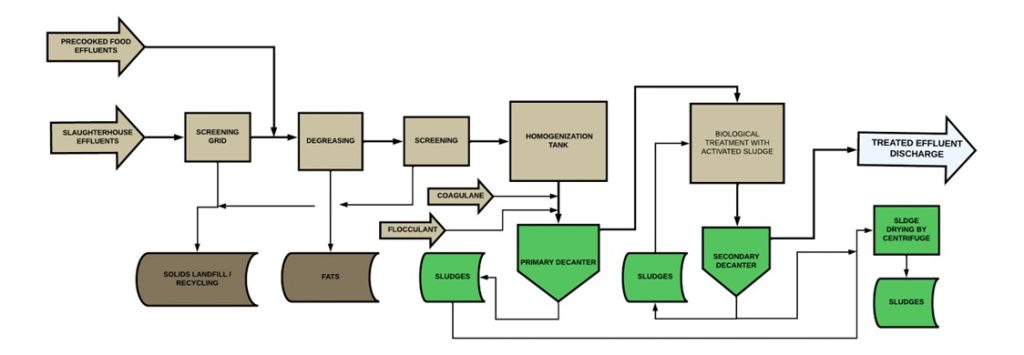
In this case, which can be considered as very frequent, the following action is proposed:
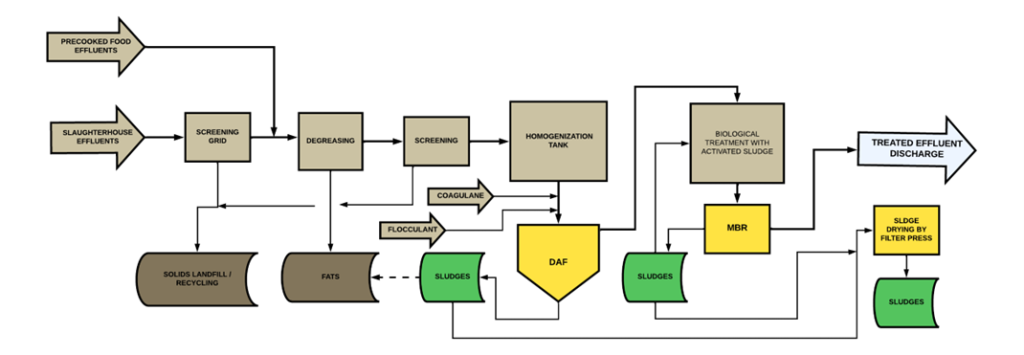
In the physical-chemical treatment , the primary decanter is replaced by dissolved air flotation equipment. The objective is to eliminate most of the solids, grease and part of the COD to reduce the load that will enter the biological treatment.
The DAF system configuration consists of:
- Coagulant and flocculant dosing equipment, which are injected into a flocculating coil for proper reaction.
- DAF equipment with air diffusion system, surface extraction of sludge by means of a mechanical sweeper and automatic bottom purge.
- Pressurization system with water recirculation pump, pressurized air saturation, and aeration with depressurization and distribution of air bubbles in the float tank.
The yields obtained by the WWTP after this modification are as follows:
- TSS: >90% reduction
- COD: 40-60% reduction
- Fats: elimination >90%.
In the secondary treatment, it is proposed to remodel the conventional activated sludge biological reactor to convert it into an MBR system with membranes submerged in an annex tank.
The objective is to oxidize the organic matter that escapes from the DAF and eliminate nitrogen, obtaining a clarified effluent, free of solids and suitable for reuse.
The proposed configuration for the membrane bioreactor is as follows:
An annex tank arrangement containing flat, submerged microfiltration membranes, with equipment for recirculation, air cleaning, chemical washing and sludge extraction.
After this remodeling, the basic characteristics of the treated water are:
| PARAMETER | UNIT | DISCHARGE LIMIT (*) | TREATED EFFLUENT |
|---|---|---|---|
| COD | mg/l | 125-150 | ≤ 50 |
| SST | mg/l | 35-60 | ≤ 5 |
| Oils and Fats | mg/l | 10-25 | ≤ 10 |
| N - NH4+ | mg/l | 15-35 | ≤ 10 |
(*) The limits for discharge into public watercourses depend on the river basin and the specific discharge authorization.
With these results, we can observe the following improvements after the WWTP modernization:
- Overall reduction of COD > 95%, TSS > 98%.
- Effluent suitable for reuse in services, irrigation.
- Reduction in the order of
- Compliance with discharge regulations and savings in discharge fees.
- Absence of bad odors.
- Reduction of surface area compared to conventional systems.
- Stable, automatable operation and less sensitive to varying loads
Other potential improvements for the WWTP under analysis are detailed below:
- Installation of a UV disinfection or chlorination system for water reuse in cleaning operations.
- Anaerobic digestion of sludge to obtain biogas for energy recovery.
- Online monitoring of COD, NTK, flux, membrane pressure and dissolved oxygen.
- Replacement of the sludge centrifuge with a filter press to increase the solids content (dryness) of the sludge to 25-30%.
After these modifications, the treatment line would be as follows:
Vacuum evaporation is more appropriate when the waste is to be valorized, or when a high concentration of the waste is required due to its hazardousness or complexity. In these cases, the initial investment and the high energy consumption can be amortized.
Belt filters and centrifuges are best suited for high flows of simple sludge such as from municipal wastewater treatment plants. They provide an adjusted sludge concentration for standard landfills, and at relatively low installation and operating costs.
4. Conclusions
Industrial growth and product diversification often mean an increase in both flow rates and pollutant load to be treated by plants. This overload can overwhelm existing WWTPs, compromising treatment efficiency and compliance with discharge limits.
Increasing regulatory requirements and commitments to sustainability are driving the modernization of numerous industrial wastewater treatment plants. In this context, the incorporation of advanced technologies such as dissolved air flotation (DAF) systems and membrane bioreactors (MBR) allows not only to significantly improve the quality of the final effluent, but also to optimize the operation, reduce the spatial footprint of the facility and facilitate the reuse of treated water.
Conventional treatment systems, based on primary decanters, traditional biological reactors and secondary clarifiers, are in many cases insufficient or inefficient to meet new demands. The modernization of industrial WWTPs, including technologies such as DAF and MBR systems, makes it possible to meet the current challenges of water treatment:
- Reduce operating costs.
- Expand treatment capacity.
- Improves plant performance.
Bibliography and consultations
- Metcalf & Eddy (2020), Wastewater Engineering: Treatment and Resource Recovery.
- Judd, S. (2011), The MBR Book: Principles and Applications of Membrane Bioreactors for Water and Wastewater Treatment..
- Capodaglio, A. G. (2019), Advanced Wastewater Treatment.
- Efficient and durable dissolved air flotation units
- CAF cavitation air flotation system for sewage water
- FBR bioflotation: Biological reactor + DAF clarification
- Filter press for sludge dewatering
- MBR System - Membrane Bioreactors for Wastewater
- PFL Flocculator for coagulation-flocculation - SIGMADAF
Are you interested in this solution?
BASIC INFORMATION CLAUSE
DATA CONTROLLER: SIGMADAF CLARIFIERS, S.L. PURPOSE: To respond to the user’s request. LEGAL BASIS: Consent of the data subject. DISCLOSURES: No disclosures are anticipated, except where required by law or court order. RIGHTS: Access, rectification, erasure, objection, restriction, data portability, and withdrawal of consent. If you believe that the processing of your data does not comply with the regulations, you may contact the Supervisory Authority (www.aepd.es). ADDITIONAL INFORMATION: For more information, please see our privacy policy.