
Seawater pretreatment in SWRO desalination plants

- 1. Algae proliferation in seawater desalination plants using reverse osmosis.
- 2. Seawater pretreatment in desalination plants
- DAF technology as a key part in the pretreatment of desalination plants.
- Glossary
- 5. References
1. Algae proliferation in seawater desalination plants using reverse osmosis.
The distribution of water on our planet is not uniform.
- 97% of the water is in the oceans.
- 3% is freshwater at the surface.
The 3% of freshwater is distributed as follows:
- 69% belongs to water ice in glaciers.
- Thirty percent is groundwater.
- Less than 1% of the water is found in lakes, swamps and rivers.
Due to rapid population growth and increasing water consumption, there is an urgent need for alternative sources of fresh water. Seawater treatment by desalination is one of the most common solutions to obtain drinking water and water for industrial use.
Seaweeds play a crucial role in the marine food web by converting carbon dioxide (CO2) into biomass, which serves as the basis for the food chain.
Algal blooms are common phenomena in marine areas. When these blooms are harmful, they can have a critical impact on marine ecosystems and human use of ocean resources.
Harmful algal blooms (HBA) can occur in any coastal area and negatively affect SWRO plants. The organic matter released by the algae during these blooms causes fouling of the reverse osmosis membranes, hindering the operation and maintenance of these facilities.
Reverse osmosis membranes are designed to remove dissolved components in water, specifically inorganic ions.
Reverse osmosis is the most efficient technology for seawater desalination, but it is also vulnerable to membrane fouling and clogging, which is caused by particulate deposition and the growth of bacteria and other microorganisms that form a biofilm on the membrane surface, resulting in:
- An increase in hydraulic resistance.
- A significant increase in transmembrane pressure.
- A significant decrease in flow.
These adverse effects reduce membrane life and the duration of filtration cycles, negatively affecting its performance.
Algae by-products and their toxins can also enter the water supply pipeline network, thus affecting the quality of the water in the network and generating serious technical and health problems.
How to protect a seawater desalination plant from fouling and blockage?
Membrane systems used for seawater desalination are vulnerable to fouling and clogging, which reduces membrane life and performance. In addition, algae by-products and their toxins can also enter the water supply network, thus affecting the quality of the mains water and generating enormous technical and health problems. To avoid these problems, it is advisable to pre-treat seawater prior to reverse osmosis.
The most efficient and reliable pretreatment consists of a combination of a coagulation-flocculation process, followed by clarification by a dissolved air flotation (DAF) system.
Coagulation-flocculation is necessary to improve the hydraulic performance of subsequent flotation and filtration systems.
Dissolved air flotation (DAF) is carried out before sending the seawater to the reverse osmosis plant (SWRO).
Although less common, some desalination plants apply advanced filtration techniques such as microfiltration (MF) and ultrafiltration (UF) membranes during the pretreatment phase.
This pre-treatment removes organic matter and suspended material present in the seawater. The efficiency of this process protects the reverse osmosis membranes against fouling and blockage, thus optimizing the performance of the desalination plant.
This pre-treatment process keeps the membranes in good condition for a longer time, so it is not necessary to clean the membranes as often. This is important, as it is preferable to avoid frequent chemical cleaning.
The presence of harmful algal blooms (HAB) in seawater desalination by reverse osmosis presents the following challenges:
- Apply pretreatment to ensure that desalination by reverse osmosis effectively removes algal toxins from seawater.
- Overcome operational challenges caused by the presence of total suspended solids and organic load associated with algal biomass in the raw water.
1.1. Distribution of harmful algae blooms (HAB)
Harmful algal blooms are distributed along the land coast and have severely affected desalination plants around the world.


2. Seawater pretreatment in desalination plants
Membrane technology is the most efficient technology for removing algae, bacteria, viruses and other microorganisms present in water. However, it is a process that is severely affected by fouling problems, so pretreatment is absolutely necessary for membrane technologies to be efficient.
2.1 Conventional pretreatment configuration
The conventional pretreatment process is classified into two modalities: physical and chemical.
- In the physical process, particulate material is mechanically screened through screens and filters.
- The chemical process consists of the addition of scale inhibitors, such as oxidizers, pH adjustment chemicals, coagulants, flocculants and disinfectants.
The contaminants to be retained in pretreatment are:
- Particles and suspended matter.
- Microbial contaminants.
- Algae and AOM.
- Dissolved organic matter.
The conventional treatment can be adapted to the specific needs of each project by modifying any of the steps described.

Disinfection, mechanical screening and pH adjustment
Chlorination disinfection is applied to prevent biological growth that causes fouling of filters and membranes. It is necessary to have a subsequent dechlorination process to avoid the presence of residual chlorine in the stream.
The screening process uses screens to retain floating objects, plants and other large debris, preventing them from entering the pretreatment equipment and causing damage or blockages. The various debris that has been retained on the screens is removed by a mechanical rake installed on the screens.
The pH of seawater is always alkaline due to the presence of salts, which cause scale formation on reverse osmosis membranes. Adjusting the pH is also beneficial for the removal of algae and total organic carbon (TOC).
The performance of reverse osmosis membranes is optimal at low pH values, so it is necessary to maintain the pH of the water between 5.5 and 6.0 by adding sulfuric acid, or another type of acidifier that optimizes floc formation. It is not recommended to work at a pH below 5.5, since the cells break and release intracellular substances that may not be completely eliminated during the pretreatment phase.
Coagulation and flocculation
The main objective of the coagulation and flocculation process is the removal of turbidity and solids. For this purpose, a coagulant is added to the water which neutralizes the negatively charged particles. The type of coagulant and its optimum amount are decided by carrying out a jar-test on the water. The most commonly used coagulants are aluminum compounds and ferric salts, such as ferric sulfate and ferric chloride. The coagulation and flocculation process removes colloidal impurities, suspended particles, algae, AOMs and some bacteria from seawater.
The algae cells must be completely destabilized to allow the treatment to reach its maximum efficiency. This is done with the proper dosage of coagulant and flocculant, along with pH adjustment (for a given coagulant dosage, there is a pH optimum at which algae removal performance is at its maximum).

Dissolved air flotation
A DAF system separates particles, algae cells, oil and grease that cannot be removed by sedimentation. The flocs produced in the coagulation-flocculation stage are also removed.
In seawater desalination plants, DAF systems are constantly exposed to salty atmospheres, high humidity, and harsh operating conditions.
SIGMADAF's carbon steel-lined DAF systems are specifically designed to ensure reliability and optimal long-term performance under severe operating conditions, delivering excellent performance in the separation of suspended solids.
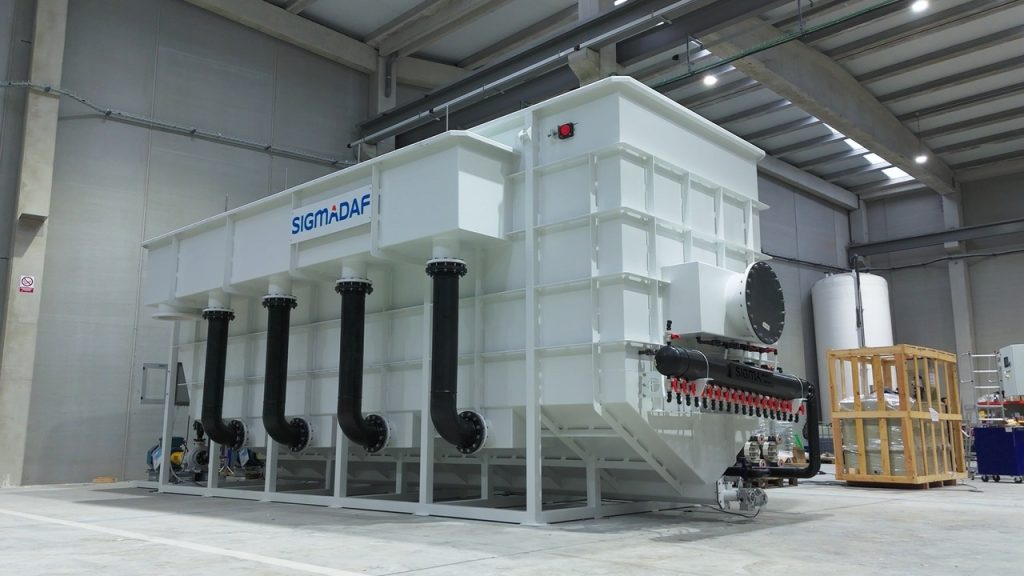
The unit's tank is constructed of coated carbon steel, while the rest of the components are made of superduplex stainless steel.
In addition, our DAF equipment for seawater desalination plants is treated with high-performance coating systems certified for marine environments. Before the coating is applied, all units undergo a surface treatment process, ensuring optimal adhesion and long-term corrosion protection.
Filtration
This process removes suspended particles that were not removed during dissolved air flotation.
The most common types of filters are gravity filters (sand, or sand plus anthracite) and filter presses.
Gravity filters are used for large and medium capacity desalination plants because they offer better economic performance. The gravity filtration system removes clay, colloidal silica, precipitated metal hydroxides, humic and fulvic acids, algae and bacteria.
Addition of antiscalant
Precipitation of salts and minerals from seawater on the surface of the reverse osmosis membrane can reduce its performance and decrease water recovery.
Sulfuric acid added to adjust the pH can also control scaling caused by calcium carbonate. Recently, certain polymers have also begun to be used as antifouling agents.
Decoration
When chlorine is used as a disinfectant, the residual chlorine present in the feed water has the potential to damage reverse osmosis membranes. The most common agent used for the dechlorination process is sodium bisulfite, or activated carbon.
2.2 Advanced pretreatment settings
Some desalination plants have used microfiltration (MF) and/or ultrafiltration (UF) membranes as a stand-alone pretreatment process. This process is known as advanced pretreatment, but it has proven not to be an effective solution, as fouling affects all types of membranes.
Advanced pretreatment can be part of conventional pretreatment, but it cannot be a stand-alone pretreatment. It has been shown that a combination of conventional pretreatment and advanced pretreatment can provide a cost-effective solution for freshwater production in seawater desalination processes.

An industrial-scale pilot plant located in Barcelona performed a comparison between a dual media filter (DMF) and ultrafiltration membranes as part of the pretreatment after DAF equipment.

Ultrafiltration membranes show excellent stability and offer high permeate quality. The combination of a DAF unit followed by a UF membrane separates almost 100% of the algae contamination and a large fraction of the bacterial content.
This is a clear example of how the combination of conventional and advanced pretreatment technologies offers excellent results in seawater pretreatment.
2.3. Conclusions regarding seawater pretreatment in desalination plants
The most important advantage of the conventional pretreatment process is that it is a proven process that can be optimized by advanced technologies in each of its stages. The system removes both organic matter and suspended material from the treated seawater.
Conventional pretreatment can be adapted by changing or adding steps such as UF/MF membrane filtration.
Recently, research has focused on making conventional seawater pretreatment more effective with the following variations:
- Alterations in seawater catchment points.
- Introduction of DAF technology for the flotation process.
- Dynamic backwashing/cleaning processes for filters or membranes
- Modified chemical dosages to the system.
3. Dissolved air flotation for seawater pretreatment in SWRO plants.
The seawater pretreatment system that has demonstrated the greatest effectiveness, reliability and cost efficiency is as follows:
- Coagulation-flocculation and pH adjustment.
- Peroxidation.
- Dissolved air flotation (DAF).
- Gravity filtration.
This combination of processes removes grease, oils, suspended solids, turbidity, color, some bacteria, algae, iron, manganese, phosphorus and total organic carbon.
Algae removal efficiencies range from 99% to 99.9%, even during severe harmful algal bloom events.
Dissolved air flotation is applied to particles whose density is less than that of the liquid in which they are found. During the process, coagulated particles, such as algae, adhere to the bubbles produced inside the DAF system and float to the top of the water column, where they are removed mechanically or hydraulically.
In desalination plants producing potable water, the current trend is the development of DAF systems with dense microbubble beds and high flow capacity. This process offers the following advantages:
- Reduces space requirements.
- Reduces operating costs.
- Reduces maintenance costs.
- Improves purification results.
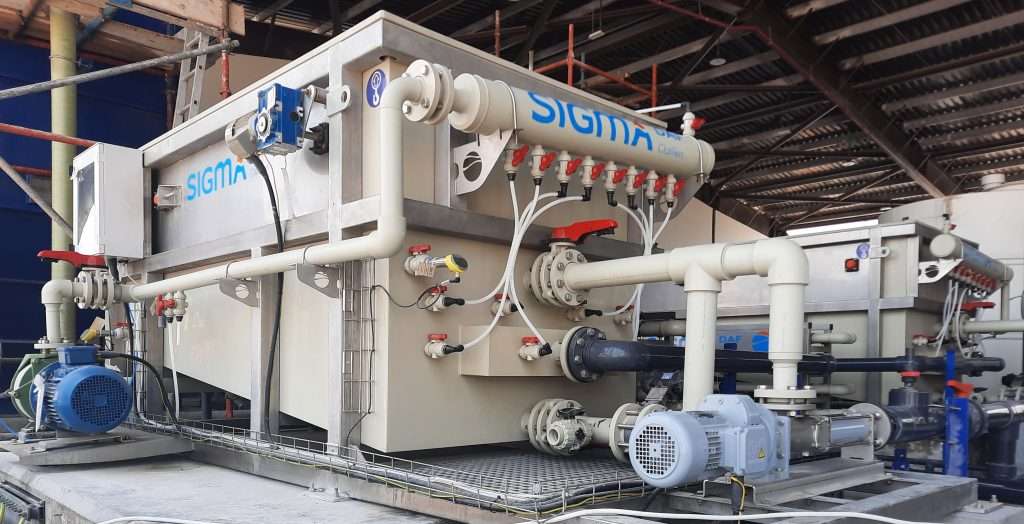
DAF systems manufactured by SIGMADAF offer the following advantages:
- Improved quality of treated water.
- Fast start-up.
- High-speed operation.
- Thicker sludge (less sludge production).
- Footprint reduced.
- Easy to operate.
- Ability to protect seawater treatment plants from damage caused by HABs.
Table 2. Comparative algae removal efficiencies using various treatment lines under optimized conditions. Ref: Mouchet and Bonnelye 1998.
Tabla 3. Eficiencias de eliminación de Sigma DAF modelo FPAC-CW®. La unidad incluye ajuste de pH, sistema de coagulación-floculación más sistema DAF, que se muestra en la Figura 12 (a). La calidad del agua utilizada para esta estimación es: Tipo de afluente: agua de mar más agua de río; caudal = 10500 m3 / h dividido en tres líneas de operación de 3500 m3 / h promedio cada una; sólidos totales disueltos <40000 mg / L; pH = 8.2-8.3, temperatura = 17-39ºC; algas: 5 Mcélulas / L; sólidos suspendidos totales <200 mg / L; turbidez = 5-30 NTU; aceite y grasa <3 mg / L.
| Parameter | Disposal efficiency |
|---|---|
| Total suspended solids | 95% |
| Oils and fats | 98% |
| Algae | 98% |
| Concentration of the floated sludge | > 2% |
Tabla 4. Eficiencias de eliminación de Sigma DAF modelo FPHF®, que se muestran en la Figura 12 (b). El proceso instalado también incluye ajuste de pH, sistema de coagulación-floculación más sistema DAF. La calidad del agua utilizada para esta estimación es: Tipo de afluente: agua de mar; caudal = 832 m3 / h dividido en dos líneas de operación de 416 m3 / h promedio cada una; sólidos suspendidos totales <50 mg / L; pH = 8.0, temperatura = <34.6ºC; algas <100000 células / ml; aceite y grasa <3 mg / L.
| Parameter | Effluent value |
|---|---|
| Total suspended solids | < 10 ppm |
| Turbidity | < 5 NTU |
| Total organic carbon | < 7 ppm |
| Algae removal | > 98% |
| Oil and grease removal | > 90% |
Due to the buoyant nature of algae, DAF systems are increasingly used in seawater pretreatment. The high algae removal rates achieved with a DAF system prevent fouling and blockage of the reverse osmosis membranes, avoiding complete plant shutdown during harmful algal bloom events.
Reverse osmosis membranes are very sensitive to fouling caused by
- Colloids.
- Inorganic incrustations.
- Development of biofilms.
- Etc.
With an open seawater intake the membranes would be exposed to different types of contamination: algae, precipitated metals, organic matter, hydrocarbons, particles, turbidity, etc.
Pretreatment must be designed to deal with the worst-case scenario and still provide consistent quality in the water entering the RO units, even when harmful algal blooms are occurring. Pretreatment must also help to reduce the costs of cleaning the RO membranes.
The severe harmful algal bloom event that occurred in the Gulf of Oman during 2008 and 2009 led to the closure of several desalination plants in the region, which precipitated the search for new seawater pretreatment solutions, most notably dissolved air flotation.
DAF technology is regularly applied in new SWRO plants in the Persian Gulf:
- At the Al-Dur plant, a pilot plant equipped with a DAF system plus coagulation-flocculation before the GMF filter media was installed. This process eliminates more than 99% of algae cells.
- The Al-Shuwaik desalination plant in Kuwait is equipped with DAF equipment and UF membranes as pretreatment. This plant consistently obtains optimum quality feedwater, even in deteriorated conditions during algae bloom events.
- The Fujairah plant expansion incorporates DAF technology as an essential part of the pretreatment scheme.
For a correct and optimal design of the seawater pretreatment plant it is necessary to carry out a jar-test analysis with seawater samples covering the whole range of quality that can be expected: from less concentrated seawater to the worst case scenario given by episodes of harmful algal blooms.
SIGMADAF performs these analyses as well as the design and manufacture of DAF systems and coagulation-flocculation units.
Glossary
AOM: algal organic matter: organic matter generated by algae
DAF: dissolved air flotation: dissolved air flotation
DMF: dual media filter: dual filter media
GMF: granular media filters:granular media filters
HAB: Harmful algal bloom: harmful algal blooms
MF: microfiltration: microfiltration
RO: reverse osmosis: Reverse osmosis
SWRO: sea water reverse osmosis: reverse osmosis for sea water
TOC: total organic carbon
UF: ultrafiltration: ultrafiltration
5. References
- Alshahri A., Fortunato L., Zaouri N., Chaffour N., Leiknes T. (2021) Role of dissolved air flotation (DAF) and liquid ferrate on mitigation of algal organic matter (AOM) during algal bloom events in RO desalination. Separation and Purification Technology. 256, 117795.
- Anderson D., Boerlage S., Dixon M. (2017) Harmful Algal Blooms (HABs) and Desalination: A Guide to Impacts, Monitoring and Management. Manuals and Guides 78, Intergovernmental Oceanographic Commission. UNESCO 2017.
- Babel S., Takizawa S. (2011) Chemical pretreatment for reduction of membrane fouling caused by algae. Desalination. 274, 171-176,
- Bonnelye V., Sanz M.A., Durand J., Plasse L., Gueguen F., Mazounie P (2004) Reverse osmosis on open intake seawater: pre-treatment strategy. Desalination. 167, 191 - 200.
- Bui T, Nam S, Han M (2015) Micro-bubble flotation of freshwater algae: a comparative study of differing shapes and sizes. Separation Science and Technology.
- Caron D., Garneau M., Seubert E., Howard M., Darjany L., Schnetzer A., Cetinic I., Filteau G., Lauri P., Jones B., Trussell S. (2010) Harmful algae and their potential impacts on desalination operations off southern California. Water Research. 44, 385 - 416.
- Cha G., Choi S., Lee H., Kim K., Ahn S., Hong S. (2020) Improving energy efficiency of pretreatment for seawater desalination during blooms using a novel meshed tube filtration process. Desalination. 486, 114477.
- Crossley I., Valade M. (2006) A review of the technological developments of dissolved air flotation. Journal of Water Supply: Research and Technology - AQUA. 55(7 - 8), 479-491,.
- Gaid K., Treal Y. (2007) Le dessalament des eaux par osmose inverse: l'expérience de Véolia Water. Desalination. 203, 1-14.
- Guastalli A., Simon F.X., Penru Y., Kerchove A., Llorens J., Baig S. (2013). Comparison of DMF and UF pre-treatments for particulate material and dissolved organic matter removal in SWRO desalination. Desalination. 322, 144-150.
- Haarhoff J, Edzwald J (2013) Adapting dissolved air flotation for the clarification of seawater. Desalination. 311, 90-94.
- Hoffmann L. (1996) Geographic distribution of freshwater blue-green algae. Hydrobiologia. 336, 33-40.
- Huang W., Chu H., Dong B., Hu M., Yu Y. (2015) A membrane combined process to cope with algae blooms in water. Desalination. 355, 99-109.
- Kavitha J., Rajalakshmi M., Phani A.R., Padaki M. (2019) Pretreatment processes for seawater reverse osmosis desalination systems - A review. Journal of Water Process Engineering. 32, 100926.
- Kim S.H., Min C.S., Lee S. (2011) Application of dissolved air flotation as pretreatment of seawater desalination. Desalination and Water Treatment. 33, 261-266.
- Kwon B., Park N., Cho J. (2005) Effect of algae on fouling and efficiency of UF membranes. Slip. 179, 203-214.
- Liang H., Gong W., Li G. (2008) Performance evaluation of water treatment ultrafiltration pilot plants treating algae-rich reservoir water. Desalination. 221, 345-350.
- Mouchet P., Bonnelye V. (1998) Solving algae problems: French expertise and world-wide applications. J Water SRT - Aqua. 47(3), 125-141.
- Peleka E., Matis K. (2008). Applications of flotation as a pretreatment process during desalination. Desalination. 222, 1-8.
- Shen Q., Zhu J., Cheng L., Zhang J., Zhang Z., Xu X. (2011) Enhanced algae removal by drinking water treatment of chlorination coupled with coagulation. Desalination. 271, 236-240.
- Shutova Y., Karna B., Hambly A., Lau B., Henderson R., Le-Clech P. (2016) Enhancing organic matter removal in desalination pretreatment systems by application of dissolved air flotation. Desalination. 283, 12-21.
- Tapia-Silva F., Hernández-Cervantes O., Vilchis-Alfaro M., Senties A., Dreckmann K. (2015) Mapping of algal richness using spatial data interpolation. The International Archives of the Photogrammetry, Remote Sensing and Spatial Information Sciences, Volume XL-7/W3. 36th International Symposium on Remote Sensing of Environment, 11-15 May 2015, Berlin, Germany.
- Villacorte L., Tabatabai S., Anderson D., Amy G., Schippers J., Kennedy M. (2015) Seawater reverse osmosis desalination and (harmful) algal blooms. Desalination. 360, 61-80.
- Zhu I., Bates B. (2012) Seawater Desalination Pretreatment for Harmful Algae Blooms Using Dissolved-Air Flotation. IDA Journal.34-37.
- Zhu I., Bates B., Anderson D. (2014) Removal of Porocentrum minimum from seawater using dissolved air flotation. Journal of Applied Water Engineering and Research. 2(1), 47-56.
Are you interested in this solution?
BASIC INFORMATION CLAUSE
DATA CONTROLLER: SIGMADAF CLARIFIERS, S.L. PURPOSE: To respond to the user’s request. LEGAL BASIS: Consent of the data subject. DISCLOSURES: No disclosures are anticipated, except where required by law or court order. RIGHTS: Access, rectification, erasure, objection, restriction, data portability, and withdrawal of consent. If you believe that the processing of your data does not comply with the regulations, you may contact the Supervisory Authority (www.aepd.es). ADDITIONAL INFORMATION: For more information, please see our privacy policy.