
Sludge dewatering and drying systems

- 1. Sludge dewatering and sludge drying
- 2. Methods for the concentration of liquid waste
- 3. Comparison between sludge concentration and sludge drying process
- 4. Final considerations
1. Sludge dewatering and sludge drying
Industrial and urban effluents contain suspended solids of different nature and size. During the wastewater treatment process, these solids are separated from the water for subsequent management, which can be carried out by:
- Controlled discharge.
- Composting.
- Valorization as a by-product.
These solid wastes are in the form of sludge and are generated during the following processes:
- Solids separated in primary treatments, such as clarification by sedimentation or dissolved air flotation.
- Solids generated by the coagulation and flocculation of colloidal substances.
- Waste from biological digestion of dissolved organic matter, which can be carried out by aerobic or anaerobic bacteria.
The sludge resulting from solids separation usually has a low dry matter concentration, rarely exceeding 4-5 %.
Since the regulations prohibit the disposal of this sludge, it is necessary to dewater it to at least 30% dry matter. The dewatering process reduces the volume of the sludge, thus minimizing transportation and final management costs.
2. Selection of a process for the concentration of liquid waste
The choice of dehydration method depends on factors such as:
- Initial sludge concentration: Low concentration sludges, such as those produced in a secondary settling tank (less than 1 % DM), require an intermediate thickening process before dewatering. On the other hand, sludge generated by dissolved air flotation (DAF) reaches concentrations suitable for entry into the dewatering process without the need for additional treatment.
- Nature of the sludge: Dewatering a waste destined for landfill is not the same as dewatering a waste destined for landfill as another recoverable waste (compost or by-product). In the second case, a higher investment is justified both in the cost of the installation and in energy consumption.
- Space and environmental impact: The availability of space and the possible effects of the sludge produced (odors, vectors, seepage) determine the choice of system.
- Available energy: In industries with energy surpluses (such as steam or hot water), a thermal system may be more viable.
- Geographic location: Distances to landfills or local environmental restrictions also influence the selection of an option.
The most commonly used processes for sludge dewatering are of two types:
- Thermal drying.
- Mechanical drying.
2.1. Thermal Drying
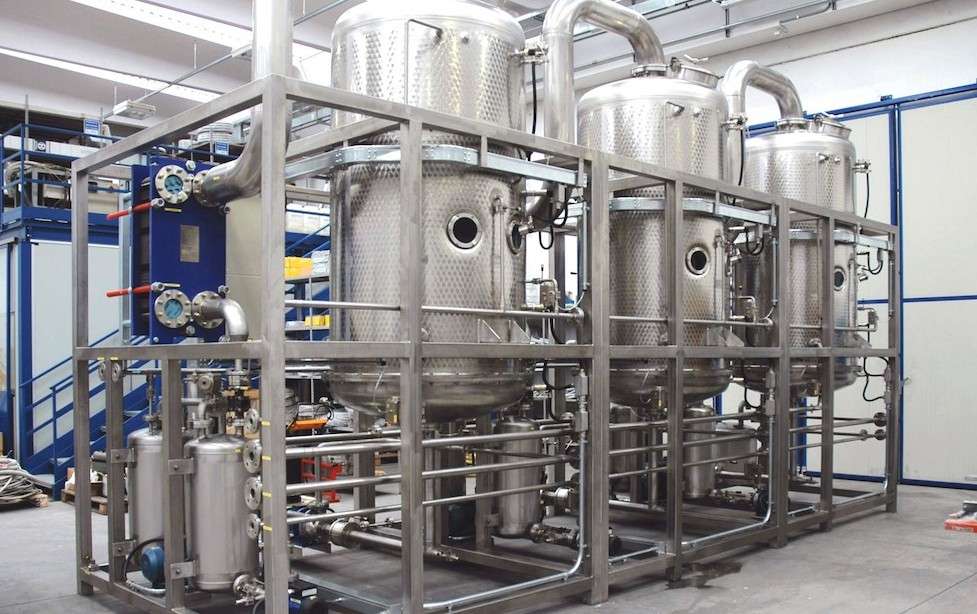
Vacuum evaporation
Highly efficient technique (>95 % volumetric reduction), based on liquid evaporation at low temperature (30-40 °C) under vacuum conditions. It allows the reuse of the condensed water and the safe management of the concentrated residue.
Advantages:
- High efficiency.
- Recovery of clean water and by-products.
- Waste reduction.
Disadvantages:
- High energy consumption.
- High initial investment
Other thermal technologies
There are other technologies such as rotary drums, thermal screws, or solar drying, which is a process in growing development.
This equipment is typically used in the following scenarios:
- When the solid waste obtained has an added value and can be reused as raw material or by-product.
- When the sludge contains a high concentration of hazardous contaminants and must be sent to special high-cost landfills.
Examples include: pharmaceuticals, electroplating, tanning, food, leachate treatment, etc.,
2.2. Mechanical Dehydration
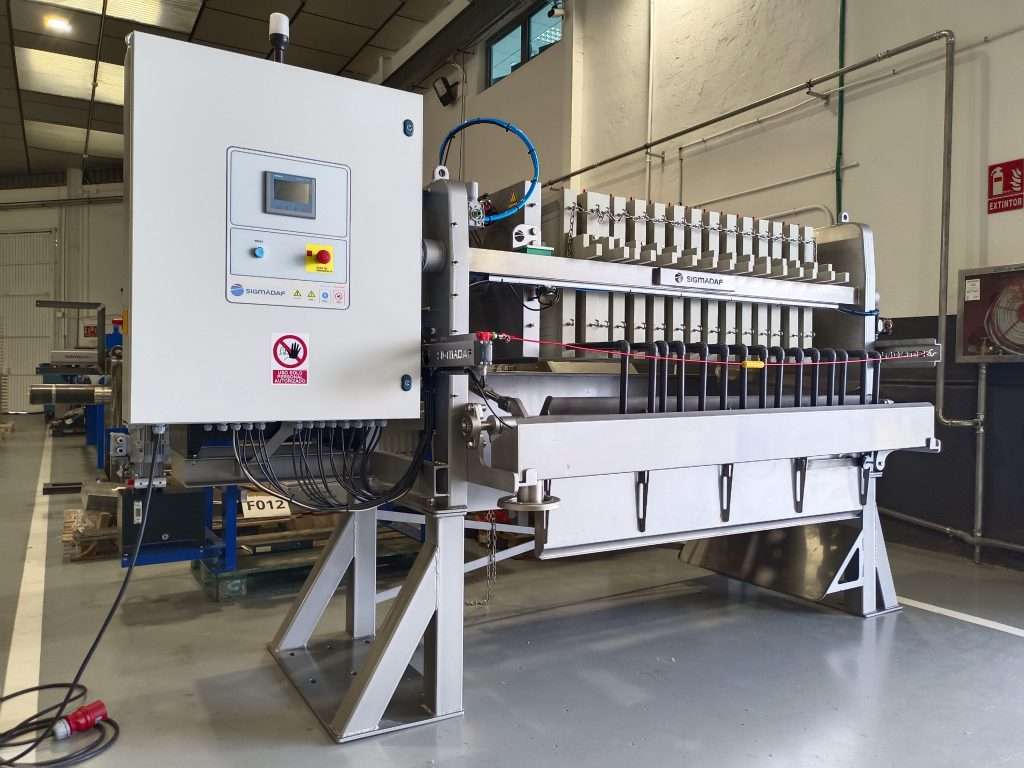
Filter press
Discontinuous system that generates very dry cakes by means of hydraulic pressure. Filter presses are widely used in industrial applications, water treatment and mining.
Advantages
- High dryness, between 35-50%.
- Low energy consumption.
- Manual and automatic options.
Disadvantages:
- Slow cycles.
- Requires pretreatment.
Band filter
A belt filter is a continuous process of lower cost and operational simplicity than a filter press. It is a technology widely used in the dewatering of organic sludge and urban wastewater treatment plants.
Advantages:
- Low cost.
- Continuous operation.
Disadvantages
- Lower yield.
- Sensitive to mud variations.
- Lower sludge dryness (15-25 % DM), which sometimes requires complementary treatments by means of one of the following processes: preliminary draining tables, subsequent thermal drying, etc.
Centrifugal decanter
It uses centrifugal force to separate solid and liquid phases. It is widely used for the separation of industrial oils and for the concentration of sludge from urban wastewater treatment plants.

Advantages:
- Compact.
- Quickly.
- Automatable.
Disadvantages:
- Medium/high energy consumption.
- High maintenance.
3. Comparison between sludge dewatering and drying processes
As we have just mentioned, thermal and mechanical systems are the most efficient for the dewatering of sludge from effluent treatment.
Below is a table comparing different processes for sludge dewatering and drying:
| Process | % DM | Energy consumption | Investment | Sludge | Maintenance cost | Filtering quality |
|---|---|---|---|---|---|---|
| Vacuum evaporation | ≥ 95 | High | High | Recyclable or toxic | Medium-High | High |
| Filter Press | 40 - 60 | Under | Mean | Thickened | Medium | Download |
| Band Filter | 20 - 30 | Very Low | Download | Urban Wastewater Treatment Plant | Under | Download |
| Centrifuge | 30 - 50 | Medium | Medium-High | Various | High | Download |
We note that the selection of the most appropriate process depends basically on the type of waste and its possible valorization or toxicity.
Mechanical drying by filter press offers high efficiency, since high dryness is achieved with low investment and installation costs, as well as low energy consumption and relatively easy maintenance.
Vacuum evaporation is more appropriate when the waste is to be valorized, or when a high concentration of the waste is required due to its hazardousness or complexity. In these cases, the initial investment and the high energy consumption can be amortized.
Belt filters and centrifuges are best suited for high flows of simple sludge such as from municipal wastewater treatment plants. They provide an adjusted sludge concentration for standard landfills, and at relatively low installation and operating costs.
4. Final considerations
Wastewater treatment generates low-concentration sludge that must be transformed into stable solid waste for handling and management. Administrations regulate their disposal according to their hazardousness and dryness, requiring a minimum of 30% dry matter.
Treatment plants usually incorporate drying systems (mechanical, thermal or combined) to meet these requirements. A combination of technologies is usually the most efficient option.
Some industries, instead of investing in these facilities, choose to send their liquid waste to external managers, which implies a higher cost per ton of sludge treated.
Are you interested in this solution?
BASIC INFORMATION CLAUSE
DATA CONTROLLER: SIGMADAF CLARIFIERS, S.L. PURPOSE: To respond to the user’s request. LEGAL BASIS: Consent of the data subject. DISCLOSURES: No disclosures are anticipated, except where required by law or court order. RIGHTS: Access, rectification, erasure, objection, restriction, data portability, and withdrawal of consent. If you believe that the processing of your data does not comply with the regulations, you may contact the Supervisory Authority (www.aepd.es). ADDITIONAL INFORMATION: For more information, please see our privacy policy.