
Phosphorus removal from wastewater by dissolved air flotation

- 1. BOD in wastewater treatment
- 2. Phosphorus in wastewater
- 3. Phosphorus effluent treatment systems
- 4. Effluent treatment with phosphorus by DAF flotation.
- 5. Summary
1. Introduction
Phosphorus is an essential element for life, both for lower organisms and for those with more complex structures. Its role in biology is fundamental, since it intervenes in the formation of multiple constituents of cells, such as:
- The cytoplasmic membrane, as well as the DNA.
- Enzymes called transferases: ADP (adenoxine diphosphate) and ATP (adenoxine triphosphate), which have the property of storing or returning energy, passing from one form to another.
- Polyphosphate kinase enzymes, which can store or restore polyphosphates.
The absence of phosphorus limits the growth of planktonic algae, especially in some types, such as "blue-green" algae, which are capable of fixing atmospheric nitrogen.
Phosphorus is an essential nutrient for microorganisms that degrade organic matter in wastewater. However, phosphorus can also cause eutrophication, which is the deterioration of surface water quality due to excess algae. Phosphorus is found in wastewater in the form of phosphates, which are highly reactive compounds.
In addition, phosphorus contamination has significant economic implications, since it affects the normal development of different professional activities, in addition to increasing the costs of water treatment for drinking water purification.
It is crucial, therefore, that actions are put in place to reduce the presence of phosphorus in our wastewater.
Main phosphorus compounds
| P compounds | Formula | Sample preparation | Test cuvettes | Process instrument | Result Identification + Field of Application |
|---|---|---|---|---|---|
| Orthophosphate | PO43- | Filter | LCK049* LCK349* LCK348* LCK350* LCK350* | PHOSPHAX se (vanadate-molyb-date method) | - Ortho PO4-P(e.g. waste water: control of P precipitation) - Ortho PO4 (e.g. drinking water and boiler water) |
| Polyphosphates | PO4-PO4-PO4- | Homogenization, digestion | |||
| Organic phosphorus compounds | R-PO4 | Homogenization, digestion | |||
| Total load (orthophosphate+polyphosphates+ organic phosphorus compounds) | PO4 total | Homogenization, digestion | LCK349* LCK348* LCK350* LCK350* | PHOSPHAX sigma (molybdenum blue method according to EN 1189) | P total = PO4-P total (e.g. wastewater: limit value control) PO4 total (e.g. drinking water and boiler water) |
Important: In wastewater analysis, the PO4 concentration is always expressed in terms of the phosphorus content of the phosphate! That is, the result is given as PO4-P(conversion factor: PO4-P x 3.07- PO4). The limit values defined in the applicable legislation, e.g. the limit value at the outlet of a D.A.R.S., are expressed in the unit P total = PO4-P total.
*) LCK348, 349 and 350: Molybdenum blue method according to EN 1189; LCK049: Vanadate-molybdate method
2. Phosphorus in wastewater
Phosphorus pollution in wastewater is a serious problem. It is a chemical element necessary for life, but in excess it can have harmful effects. It has the ability to facilitate excessive algae growth, known as eutrophication. This phenomenon obstructs the sunlight necessary for the growth of other aquatic plants and, as they decompose, the algae formed deplete the oxygen dissolved in the water, causing the death of fish and other aquatic organisms.
Phosphorus reaches wastewater mainly in two ways:
- Through the direct discharge of phosphate detergents and fertilizers
- As a natural consequence of soil weathering and erosion.
However, it is in wastewater treatment plants that the problem is most acute, as they are often not equipped to effectively remove phosphorus, releasing it into the environment in dangerous quantities.
Phosphorus can contaminate groundwater and surface water, which are often used as sources of drinking water. Ingestion of phosphorus-contaminated water can cause health problems in humans, such as kidney damage and osteoporosis. Phosphorus can also accumulate in sediments at the bottom of water sources, where it can be released back into the water under certain conditions. This means that phosphorus can continue to cause water quality problems long after it has been discharged,
It is estimated that about 85% of the phosphorus discharged into the environment comes from the UWWW (urban wastewater) collector network. Agriculture is responsible for the remaining 15%, but its influence is relatively small because, unlike nitrates, phosphorus is well absorbed and stored in the soil. Phosphorus occurs as phosphate in the following forms:
- Soluble orthophosphates: These are easily precipitated and can come directly from the effluent, or as a result of degradation in the treatment process of organic or inorganic polyphosphates.
- Polyphosphates: They can be organic or inorganic. They can degrade into orthophosphates or remain inert.
Presence of phosphorus
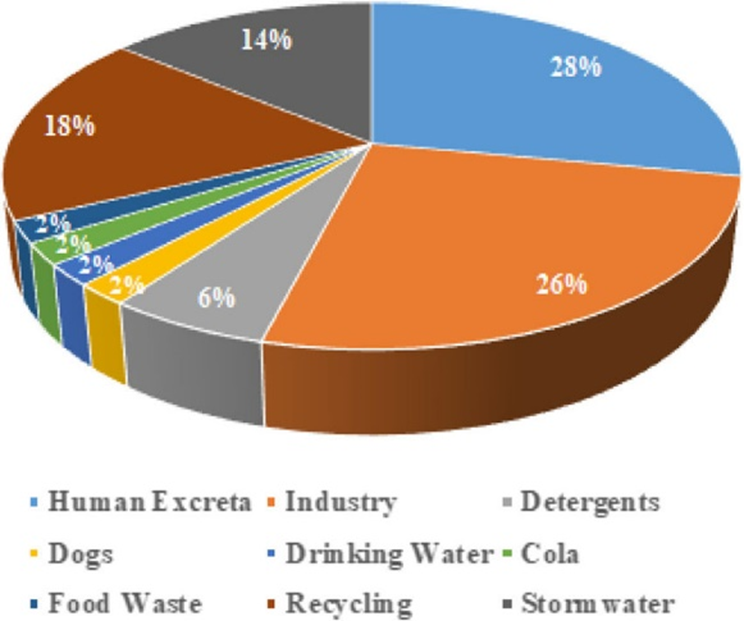
They may also be in solution or in more or less sedimentable suspension. The relationship between these various forms is highly variable, and it is not possible to provide very specific data:
- In a crude ARU, orthophosphates can represent 15-35% of the total phosphates.
- In decanted ARUs, the proportion increases by 5% to 10%.
- In an ARU with secondary (biological) treatment, the orthophosphate fraction can reach 50% or even 90%.
If we compare the inorganic and organic forms, the latter would represent about 30%.
Only a small fraction of phosphates (mostly of organic origin) is sedimentable. This fraction is usually estimated to be between 5 and 15% of the total. In a first estimation, we can consider 10% as a reasonable value.
Phosphorus cycle
The phosphorus cycle is a biogeochemical process that occurs in ecosystems and describes how this compound moves.
- Organisms take up the element in the form of phosphates.
- Both soil and living organisms interact (plants, animals and humans) and much of the phosphate is also washed into marine waters, being absorbed by birds, fish and algae.
- The proportion of phosphorus in matter is of small concentrations, but it plays an indispensable role for life.
- The biogeochemical cycle of phosphorus is mobile throughout the biosphere. This encompasses all ecosystems, both terrestrial and aquatic. The cycle is responsible for meeting the most important cellular needs of each organism.

3. Phosphorus effluent treatment systems
The process of phosphorus removal from wastewater is generally carried out by physicochemical, biological or a combination of both.
There are several systems for removing phosphorus and its compounds from wastewater. These are the three most common separation systems:
- As settleable DM: Removed by primary clarification.
- As colloidal MS: In this case, flocculation is required for its elimination, either naturally with the activated sludge (simultaneous dephosphatization), or caused by the dosing of coagulant and flocculant reagents (pre- or post-dephosphatization).
- As a soluble DM: An aluminum salt, iron salt or lime is added to the phosphorus-containing solution to produce an insoluble compound (metal phosphates or phosphate/calcium formations), producing a precipitation of phosphorus in the form of a salt. Since it is impractical to make pH corrections, it is necessary to supply a dose of trivalent salt above the theoretical molar ratio 1/1.
3.1 Physicochemical treatment
Insoluble metallic phosphorus salts sediment with difficulty, so it is necessary to flocculate with an excess of coagulant, and also to add an organic polymer as a flocculation coadjuvant. This operation is also necessary to eliminate the phosphorus compounds present in colloidal form. The most efficient technology is dissolved air flotation (DAF), given the low sedimentability of the flocs formed.
3.2 Biological treatment
This process employs microorganisms that are capable of accumulating excess phosphorus. In this process, the bacteria feed on the phosphorus present in the water, incorporating it into their cells. When these bacteria die and settle, the phosphorus will be contained in the resulting sludge and can be easily removed.
SIGMADAF has technologies that allow the biological treatment of effluents containing excess phosphorus. The MBBR (Moving Bed Biological Treatment) allows the treatment of these effluents by means of specific fillers and selective conditions. This technology has a maximum performance with a minimum footprint and a significant reduction in operating costs (energy, sludge management, etc.).
3.3 Combined method
It is usually the most efficient. In this case, first a physicochemical treatment is performed to remove most of the phosphorus, and then biological treatment is applied for the remaining levels.
SIGMADAF combines DAF, MBBR and MBR technologies to obtain the best treatment results for wastewater with high phosphorus content.
Ultimately, the choice of the most appropriate method for phosphorus removal will depend on factors such as the amount of phosphorus present, the resources available, and the environmental regulations in force.
4. Treatment of effluents containing phosphorus by dissolved air flotation.
The most suitable process for separating phosphates in suspension is flotation using DAF systems. This is due to the low density of the floc obtained after chemical conditioning of the effluent, which is carried out with specific coagulants and flocculants.
SIGMADAF has DAF systems for the separation of phosphorus and other pollutants. These systems are composed of a coil mixing system (PFL), followed by a dissolved air float (DAF).
PFL flocculators flocculators are characterized by the "in-line process" principle. The various processes occurring in this equipment (coagulation, flocculation, demulsification, precipitation and pH control) take place under very controlled and well-defined conditions, so that the effluent can be easily clarified afterwards in the DAF system.
Flotation assembly PFL - DAF
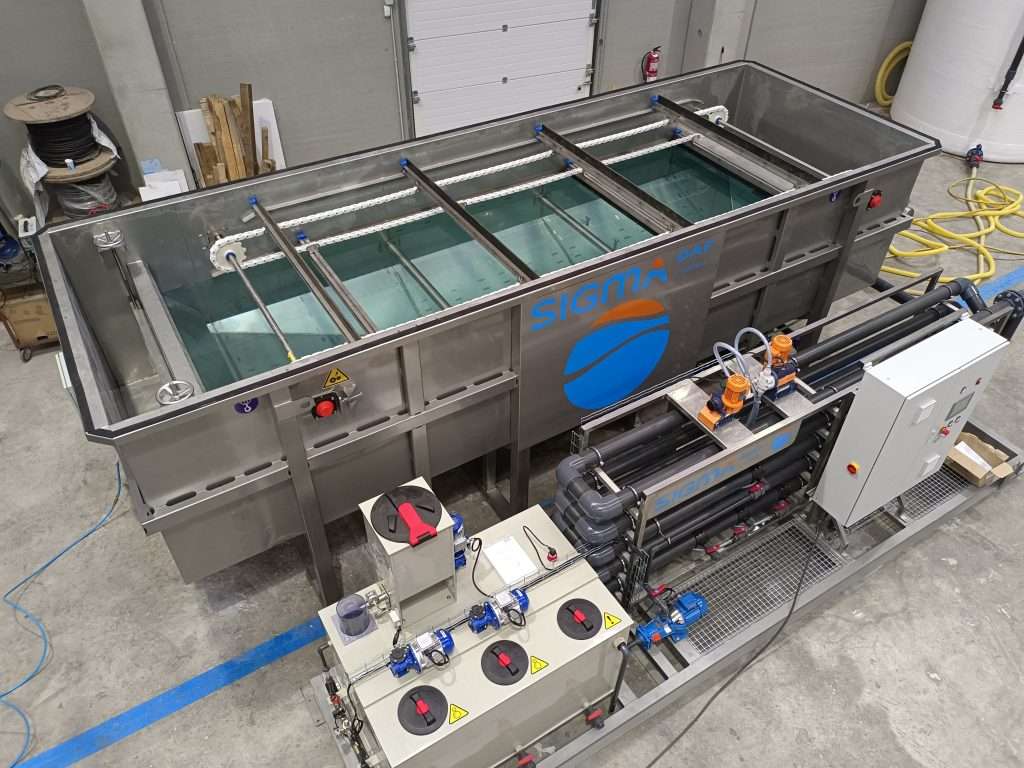
Dissolved air flotation is an ideal technology for effective separation of solids, oils, grease and flocs from wastewater.
The conditioned wastewater is pumped from the coagulation-flocculation system to the DAF unit, where coagulants, polyelectrolytes and pH adjustment products are dosed for effective floc formation. In the case of soluble phosphorus, lime can also be added.
DAF systems are specially designed to treat wastewater containing low buoyancy solids that require a large surface area for separation. The pressurized air supplied is necessary to improve particle flotation when the specific gravity of the particles is affected by a mixture of emulsions, oils and solids.
A recirculation pump redirects part of the clarified water to the outlet of the DAF unit, where a pressurization/saturation system is located. The recirculated water is pressurized by the pump to approximately 6 bar and mixed with air. Under these pressure conditions, the air is dissolved in the water.
Depressurization takes place inside the DAF unit, which generates micro air bubbles between 3 and 50 microns in diameter, which dissolve and allow the elimination of solids and flocs that have no tendency to float. The bubbles quickly adhere to the suspended flocs, which rise to the surface, where they float as they lose bulk density.
This mixture of water and depressurized air bubbles is homogeneously distributed in the inlet compartment of the DAF unit under laminar conditions. On the other hand, the floated particles are conveyed directly to the skimming system, located at the top of the unit, where they are removed by a system of skimmers.
The settleable matter descends to the sediment compartment, located at the bottom of the DAF unit, and is discharged through the sludge extraction system.
Once the foam has formed on the surface, it is mechanically removed from the treated water. Phosphates and other contaminants are concentrated in the foam, allowing it to be recovered or safely disposed of according to local legal requirements.
The clarified water leaves the DAF unit through an adjustable supernatant system.
DAF phosphate separation scheme

5. Summary
Phosphorus in wastewater is a serious problem that requires priority attention. This element, although essential for life, in large quantities can cause damage to aquatic ecosystems and contribute to harmful algal blooms (eutrophication). Wastewater treatment is therefore of utmost importance to reduce the amount of phosphorus released into the environment.
In this article, reference has been made to the various techniques used to remove phosphorus from wastewater, including physical, chemical and biological processes. Although each has its advantages and disadvantages, it is evident that the combination of these techniques provides the greatest efficiency in the removal of this pollutant.
In summary, treatment of wastewater with excess phosphate by DAF is an effective technique to reduce the levels of this pollutant, thus contributing to environmental protection and compliance with water quality regulations.
Proper wastewater management and regulation also play a crucial role in preventing phosphorus pollution. In this regard, it is important that governments and relevant organizations establish and enforce the necessary regulations for wastewater treatment.
Finally, each of us has a role to play in reducing phosphorus pollution. Through the responsible use of phosphorus-containing products, such as detergents and fertilizers, we can help minimize the release of phosphorus into the environment. Therefore, it is imperative that we all become aware of the seriousness of this problem and work together to protect our precious aquatic resources.
Bibliography and consultations
Phosphorus removal in wastewater (usal.es)
Phosphorus in Wastewater: Environmental Impact and Treatment Methods | Water Institute
Are you interested in this solution?
BASIC INFORMATION CLAUSE
DATA CONTROLLER: SIGMADAF CLARIFIERS, S.L. PURPOSE: To respond to the user’s request. LEGAL BASIS: Consent of the data subject. DISCLOSURES: No disclosures are anticipated, except where required by law or court order. RIGHTS: Access, rectification, erasure, objection, restriction, data portability, and withdrawal of consent. If you believe that the processing of your data does not comply with the regulations, you may contact the Supervisory Authority (www.aepd.es). ADDITIONAL INFORMATION: For more information, please see our privacy policy.