
Coagulation and flocculation in wastewater treatment

1. Introduction to the coagulation and flocculation process
Wastewater usually contains solid particles of various sizes and origins that contribute to its contamination. These solids can be organic or inorganic, and their size can vary from fractions of a micron to millimeters. They are known as Total Suspended Solids (TSS) and their presence can cause blockages and damage to the facilities through which the effluent flows. When they are organic in nature, they can also produce biofilms, and be sources of fermentation and infections.
Just as it is common to find fecal remains, detergents and other domestic effluents in urban wastewater, industrial wastewater usually contains pollutants from product washing, production residues, circuit and installation washing, chemical products, etc.
Total suspended solids correspond to undissolved solids that remain dispersed in the fluid and do not tend to settle. They occur in the form of suspension or in colloidal form, due to their electrical charge. Their concentration is measured in mg/l (ppm).
| Features | Suspensions | Dissolutions | Colloids |
|---|---|---|---|
| Particle size | ≥1000nm | 0.1 - 1 nm | 1 - 1000 nm |
| Presents sedimentation | Yes | No | No |
| Visibility | Translucent or opaque | Transparent | Opaque or transparent |
| Separation by filtration | Yes | No | No |
| Tyndall effect | Not applicable | No | Yes |
| Present phases | 2 | 1 | 2 |
In a solution the whole fluid is homogeneous and the dissolved solids cannot be distinguished, whereas in a suspension the solids are evident, filterable and tend to settle out. In a colloidal dispersion, the solids are not filterable and are only visible to the naked eye by the Tyndall effect.
The Tyndall effect is a visual technique for detecting light scattering by colloidal particles. If a colloidal solution is illuminated with a beam of light, the particles scatter the light and make the mixture appear cloudy or opaque.

Tyndall effect
2. What is colloidal matter?
Colloid formation occurs because suspended micro solids within aqueous solutions cannot be separated by sedimentation and filtration. It is a delicate balance between electrostatic forces, particle size and environmental conditions. These factors determine the stability and properties of colloids in solution. It is a complex process that depends on:
Particle size: Colloidal particles have a size between the largest particles and the smallest molecules. Size influences the stability of the colloid. Smaller particles tend to form more stable colloids.
- Electric charge: Colloidal particles have an electric charge on their surface due to adsorption of ions. Electrostatic repulsion between charged particles of the same sign prevents them from aggregating. The surface charge can be modified by the addition of electrolytes or surfactants.
- Nature of the solvent: The polarity of the solvent affects colloid formation. In polar solvents such as water, colloidal particles tend to disperse more easily.
- Temperature: Temperature affects the solubility and stability of colloids. Some colloids may coagulate or precipitate at extreme temperatures.
- Nature of the particles: Colloidal particles can be organic or inorganic. The presence of functional groups on the particles also influences colloid formation.
- Agitation and mixing: Mechanical agitation promotes particle dispersion and colloid formation. Proper mixing is essential to achieve uniform distribution.
Many colloids are formed due to peptization or deflocculation. This is a chemical process by which a precipitate is converted into a colloid by stirring it with an electrolyte called a peptizing agent. This phenomenon occurs when colloidal particles have electric charges of the same sign, which repel each other. This is caused by the addition of an electrolyte to the system (e.g., a concentrated NaCl solution).
Peptization negatively affects the processes of sedimentation and filtration of suspended solids in wastewater.
The measurement of surface electric charges on colloidal particles is essential to understand their behavior and stability. In the following, we present the most commonly used methods to evaluate these charges:
- Tyndall effect: As we have indicated in the previous point, it is a phenomenon that can be seen with the naked eye by refraction of light in the particles.
- Zeta potential: Zeta potential is a quantitative measure of the electrical charge in the electrical double layer around colloidal particles. It is measured by techniques such as electrophoresis or atomic force microscopy. Electrophoresis involves applying an electric field to a colloidal solution and measuring the rate of particle movement. The Zeta potential is calculated from this velocity using devices called zetameters. This measurement takes into account the pH of the medium, which for natural waters ranges from -14 to -30 mV at pH 5 to 8. The more negative this value (mV), the higher the electrical charge of the particles. Atomic force microscopy makes it possible to visualize and measure the repulsive or attractive forces between colloidal particles on a solid surface.
- Turbidity: This is the only continuous measurement. It is usually expressed in NTU (Nephelometric Turbidity Unit) and a correlation can be established with the TSS concentration, although it is always necessary to obtain values in the laboratory to establish the mathematical correlation. Instruments called turbidity meters are used to measure this parameter.
- Surface conductance: Surface conductance also provides information about electrical charges. It is based on the distribution of ions in the electric double layer and evaluates how it affects the electric field. If the conductance is high, the Zeta potential is underestimated.
- Electric double layer analysis: The electric double layer is the region around a colloidal particle where electric charges interact with the surrounding medium. Its study provides information about surface charges.
3. Coagulation and flocculation process of the colloidal material
Coagulation and flocculation are essential processes in wastewater treatment, as they allow the separation of colloidal and smaller suspended solids.
Coagulation is the process by which colloidal particles present in water are destabilized. This is achieved by neutralizing the electrical charges on the surface of these particles.
This neutralization is achieved by coagulating agents, which are generally positively charged metal salts. Common examples of coagulants are aluminum sulfate, poly aluminum chloride (PAC), ferric sulfate and ferric chloride.
This process is carried out in a chamber with rapid agitation (approx. 1500 rpm), with sabre-type propellers, and with a residence time of about 3 - 5 minutes.
The pH is important to verify a good coagulation. The ideal pH depends on the type of coagulant to be used. For pH tending to acidity, FeCl3 is usually used, while for pH tending to alkalinity, aluminum salts of the PAC type are used, and for neutral pH, Al2(SO4)3 is usually used.
After coagulation, the destabilized colloidal particles clump together and form small flocs that still tend to remain in suspension. To agglutinate them into larger, easily separable flocs, flocculants (polyelectrolytes), which are long-chain, high-molecular-weight polymers, are added. These flocculants act as a network and gather the clots into larger groups, which are separable by decantation, flotation or filtration.
Pin floc, also known as "pin-point floc", can sometimes form. This is a phenomenon that occurs in the context of wastewater treatment and activated sludge processes and is characterized by the formation of small flocs with a pin-point structure. These flocs are fragile and present the following problems:
- They have difficulty settling and settling to the bottom of the tank or clarifier.
- Difficulty in separating from the liquid sinus and forming a dense mantle in a float.
- tend to break down if leaked tend to break down
- The treated effluent may appear cloudy due to the presence of these solids.
These pinflocs are usually generated in old sludge or in some industrial discharges with dispersant characteristics. They also tend to appear during the start-up of effluent treatment facilities and disappear as soon as flocculation is stabilized.

Colloidal micelles are closely related to coagulation and flocculation processes in wastewater treatment.
Colloidal micelles are aggregates of molecules with a hydrophilic and a hydrophobic (amphiphilic) part, which form in aqueous solutions. These micelles have a spherical or cylindrical structure, where the hydrophilic heads are on the surface and the hydrophobic tails are clustered inside. Micelles can transport and hold in suspension water-insoluble substances, such as fats and oils, and even increase the solubility of certain unwanted contaminants. Colloidal micelles can also be destabilized by coagulants, since the hydrophilic heads of the micelles can interact with the ions of the coagulant.
During flocculation, colloidal micelles can be adsorbed on the surface of the flocs formed. This contributes to the stability of these flocs and facilitates their retention in filtration or sedimentation processes.
Colloidal micelles are aggregates of amphiphilic molecules whose stability depends on the electrical charges on their surface. To measure the stability of these micelles, the particle-liquid interface is measured with the Z potential, which is proportional to the stability of the colloid.
Coagulation and flocculation tests
The "jar-test" is the most widely used test for the determination and adjustment of coagulant and flocculant reagents to be dosed in water. It has the advantage of being carried out in a portable apparatus that can be used at the point of discharge. It is a fundamental technique in water treatment in general and wastewater treatment in particular.
The test is performed on laboratory equipment containing beakers. Each beaker represents a stage of the water treatment process. During a "jar-test", different doses of coagulants and flocculants are added to the beakers to simulate actual treatment conditions.
Jar-test procedure
Depending on the coagulant to be dosed, the pH of the effluent is adjusted and the agitator is started to homogenize it.
Next, the selected reagent is added, starting with small doses, which can be increased until the presence of small flocs is observed. The agitation is carried out at a fast speed.
Then the selected flocculant is dosed, which can be cationic, anionic or non-ionic, depending on the expected polarity in the set of coagulates obtained. The flocculants must be very diluted (approx. 0.1%) due to their high viscosity and low dosage.
It is usual to provide more coagulant (10 - 20 ppm) than flocculants (0.5 - 2 ppm).
In flocculation, agitation must be slow to avoid breaking the flocs formed.
The consistency and density of the flocs formed, which will settle to the bottom of the vessel, will be observed.

Jar test kit for coagulation and flocculation tests
It is normal to perform several tests with different coagulants and flocculants to optimize the process.
The appearance of the floc formed can give us an idea of the best separation process to apply. If the floc is dense and precipitates easily, decantation may be the most suitable process, while if it has difficulty in precipitating or is very spongy or greasy, flotation would be the most suitable technology. In any case, this is only a first indication to be taken into account when defining the most suitable treatment line.
4. Colloid separation by DAF flotation
A Dissolved Air Flotation System (DAF) is a highly efficient technology for the treatment of wastewater with the presence of colloids, once coagulated and flocculated. is a highly efficient technology for the treatment of wastewater containing colloids, once coagulated and flocculated.
DAF is a clarification process that uses micro air bubbles to separate colloidal particles and suspended solids from water. It is based on the ability of the air bubbles to attach to the micro-solids particles and lift them to the surface, forming a floating foam. A DAF system is especially effective in removing oil, grease, suspended solids and flocculated matter.

In a DAF float, contaminated water is introduced into a flotation tank, into which microbubbles of pre-pressurized air are injected. These microbubbles expand within the liquid and adhere to the colloidal particles, which float to the surface and form a layer of foam that is drawn into a hopper by a mechanical sweeping system.
Compared to the conventional sedimentation process, clarification by means of a DAF float offers important advantages, such as a very high removal of total suspended solids, oils and fats (≥95%), and an MS concentration in the sludge of the order of 3 - 4 %, compared to the 1 % usually achieved in the sedimentation process.
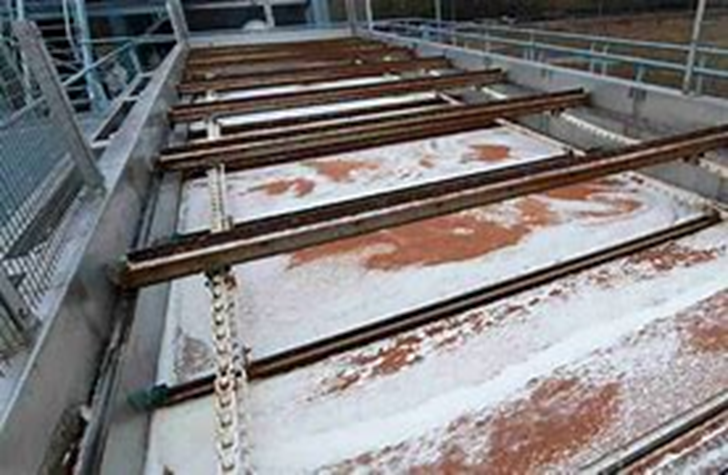
With the growing demand for processes that facilitate the reuse of wastewater, DAF technology has seen widespread adoption due to its effectiveness in clarifying water to be further treated by membrane filtration technologies.
The membrane filtration process is a physical method that allows the separation of molecules of different sizes and characteristics. It is based on the use of membranes with selective permeability to distribute components in two different streams. Transport across the membrane is effected by the action of a driving force, such as an electric potential, concentration or pressure gradient.
Some membrane separation operations include:
- Filtration: Uses membranes with pores of different sizes to separate particles according to their size.
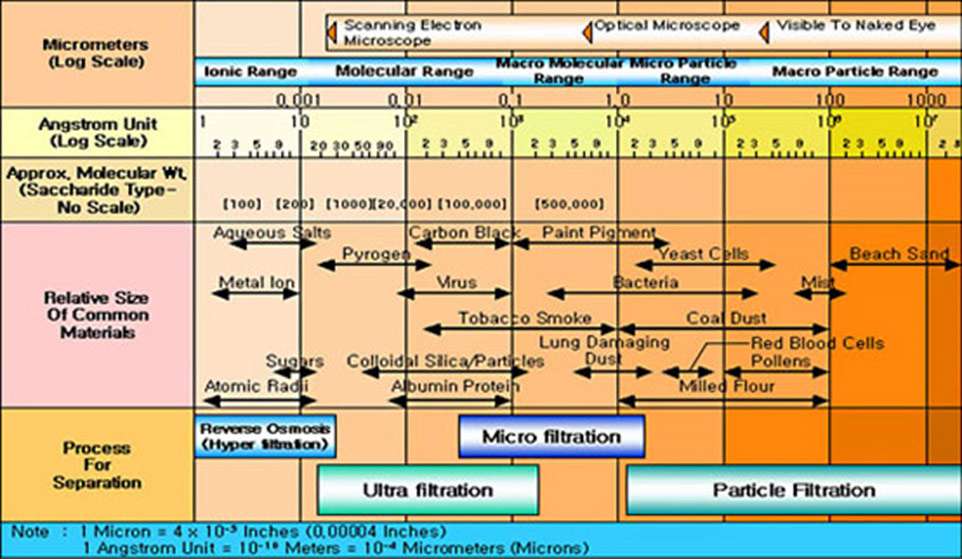
- Microfiltration (MF): It works at low pressure to separate high molecular weight particles, colloids in suspension or dissolved solids.
- Ultrafiltration (UF): Allows the separation of macromolecules and colloids.
- Dialysis: Uses semi-permeable membranes to remove unwanted substances from a solution.
The following graph shows the filtration ranges provided by the different types of membranes, as well as the negative influence of colloidal material, which causes fouling and clogging of the membranes.
The SDI (Silt Density Index) or FoulingIndex is used to measure the efficiency of a total suspended solids separation system. The calculation consists of passing a stream of the analyzed water through a filter of 0.45 microns and 47 mm in diameter, located inside a specific support, at a constant pressure (2.1 bar). In this test, the time taken to fill a 500 cc container, before and after passing water through the filter paper for 15 minutes, is measured.
Index SDI = (100 * (1 - (t1 / t2)) / T
Where t2= end time in seconds, t1= end time in seconds and T = measurement time in minutes.
An SDI value considered suitable for feeding UF membranes is 5 (approx. 1 NTU), while for NF and OI, values should not exceed SDI = 3 (approx. = 0.1 NTU). Special membranes (FR= Fouling resistance) are now available for wastewater that tolerate higher SDI values (approx. SDI = 4 - 5) and high dissolved COD concentrations.
5. Conclusion
Suspended solids (TSS) are the most common contaminants found in wastewater. Many of these solids are dispersed in colloidal form, so they do not precipitate and are not separated by simple filtration. In these cases it is necessary to resort to coagulation and flocculation processes in order to destabilize them and form floccules of adequate size and characteristics for their separation.
The technologies used to clarify wastewater are usually decantation and flotation. DAF flotation is more efficient than conventional sedimentation processes and requires less space for its implementation. The DM of the sludge separated by DAF is much higher than the DM obtained with sedimentation, so it is considered more suitable for reusing this wastewater, which must then be subjected to membrane treatment.
Bibliography and consultations
PPT - Paper PowerPoint Presentation, free download - ID:2632688 (slideserve.com)
What is the environmental impact of paper consumption - find out here (ecologiaverde.com)
Are you interested in this solution?
BASIC INFORMATION CLAUSE
DATA CONTROLLER: SIGMADAF CLARIFIERS, S.L. PURPOSE: To respond to the user’s request. LEGAL BASIS: Consent of the data subject. DISCLOSURES: No disclosures are anticipated, except where required by law or court order. RIGHTS: Access, rectification, erasure, objection, restriction, data portability, and withdrawal of consent. If you believe that the processing of your data does not comply with the regulations, you may contact the Supervisory Authority (www.aepd.es). ADDITIONAL INFORMATION: For more information, please see our privacy policy.