
DAF separators for fats, oil and grease (FOG) removal from wastewater

Oils and fats are some of the most common contaminants in wastewater generated in industrial processes. Their presence in wastewater can cause serious damage to the environment and human health, so it is essential to take the necessary measures to separate oils and fats from wastewater.
They also cause performance problems in wastewater treatment plants. On the one hand, they are usually viscous substances that adhere to the sieves, containers, pipes, mechanical elements and instruments through which the effluents circulate, which causes problems from the point of view of efficiency and maintenance, and on the other hand, they can cause anoxia in the oxidation tanks, making biological treatment of the effluents difficult, while at the same time they easily collapse the filter media (filters, membranes, etc.).
1. Wastewater treatment with oils and fats
Oils and greases (FOG) are often present in wastewater from various industries, such as food processing plants, petroleum refineries, or automotive repair facilities, to name a few, and are more difficult to biodegrade biologically than other materials present in wastewater.
If not previously removed, these oil and grease deposits can reduce the effectiveness of biological and membrane treatments, creating blockages, clogging and choking treatment systems, and reducing the sludge digestion capacity of microorganisms used in wastewater treatment processes.
DAF systems for the separation of fats, oil and grease from wastewater
DAF systems are an effective technology for the separation of oils and greases present in wastewater, especially those generated in industrial environments. These systems can treat large volumes of wastewater, while being easy to operate and requiring little maintenance.
One of the advantages of dissolved air flotation (DAF) is its ability to treat large volumes of wastewater in a short time, making it an ideal choice for facilities that generate large amounts of wastewater. In addition, DAF systems are also relatively easy to operate and maintain. They require minimal operator intervention and are automated, thus reducing the risk of human error.
Therefore, the most effective option is to separate the oils and greases through primary treatment by dissolved air flotation (DAF). After this primary treatment, the wastewater can be sent to other treatment equipment with guarantees that the secondary treatment process will not be compromised.

2. DAF and coagulation-flocculation systems for oil and grease separation in wastewater.
The most effective option is to separate oils and greases through primary treatment by dissolved air flotation (DAF). After this primary treatment, the wastewater can be sent to other treatment equipment with guarantees that the secondary treatment process will not be compromised.
Dissolved air flotation (DAF) systems use the principle of buoyancy for the separation of oil and grease from wastewater. The process is carried out by introducing micro air bubbles into the wastewater, which attach themselves to the oil and grease particles and float them to the surface; in this case these bubbles have sizes of ≤50 µm and are homogeneously distributed on the float.
Coagulation and flocculation are two chemical processes, which involve the addition of chemicals to wastewater. These reagents neutralize the charge of oil and grease particles, causing them to stick together and form larger lumps or flocs that can be removed from the water by flotation.
- Coagulation is the first step in the process in which a chemical coagulant is added to the wastewater, usually a metal salt such as aluminum sulfate (alum) or ferric chloride. The coagulant neutralizes the load of oil and grease particles, causing them to clump together and form small lumps (clots). Sometimes a pH adjustment is necessary for this and the subsequent process to work properly.
- Flocculation is the second step in the process in which a chemical flocculant, usually a high molecular weight polymer, is added to the wastewater. The flocculant acts as a binding agent, causing small lumps of oil and grease to stick together and form larger, heavier flocs that can be more easily removed from the water by DAF flotation. The flocs form a layer of foam or sludge on the surface of the water, which is extracted and removed from the system.
DAF separators are particularly effective for the treatment of industrial wastewater containing oils and greases, such as those generated in food processing plants, petrochemical plants and other manufacturing facilities. They are also useful for removing other types of contaminants, such as suspended solids, heavy metals and organic compounds.

Among the advantages of wastewater treatment by means of a DAF system, we highlight the following:
- High oil and grease removal efficiency from wastewater, typically on a scale of 90-99 %.
- It is a process that offers great versatility for treating a wide variety of wastewater types and concentrations. The process can be tailored to the specific characteristics of the wastewater, including pH, temperature and the type and concentration of contaminants present.
- The coagulation-flocculation process normally requires lower doses of chemicals than other treatment methods, which translates into lower chemical costs and less chemical waste production.
- The dissolved air flotation process also reduces the volume of sludge generated during the treatment process, which means lower sludge management and disposal costs, as well as less environmental impact.
- The operating costs of the coagulation-flocculation process combined with a DAF system are relatively low compared to other technologies. This can be especially advantageous for industries that generate large quantities of wastewater and need a cost-effective treatment option.
- DAF systems are relatively easy to operate and require minimal maintenance cost compared to other technologies. This can be a significant advantage for industries that need reliable treatment with low maintenance requirements.

The industries that benefit most from this process are the following:
- Food and beverage processing: Food processing industries, such as meat and dairy, generate large volumes of wastewater with a high load of oils and fats that require treatment.
- Oil refiningOil refineries generate large quantities of oily wastewater containing hydrocarbons that require treatment prior to discharge.
- Chemical manufacturing: Chemical manufacturing processes can generate wastewater containing a wide range of contaminants, including oils.
- Metallurgy: Metallurgical industries, such as metal machining and finishing, generate wastewater with high levels of oil that require effective separation treatment prior to discharge or reuse.
- Textile manufacturing: Textile manufacturing processes can generate oily wastewater containing a broad spectrum of contaminants.
- Pulp and paper manufacturing: Pulp and paper mills generate significant amounts of wastewater that may contain oils from their manufacturing processes.
- Automotive and aerospace manufacturing: Automotive manufacturing facilities generate oily wastewater from a variety of processes, such as parts cleaning and metalworking.
- Power generation: Power generation facilities, such as coal-fired power plants, may generate oily wastewater that requires treatment prior to discharge.
- Mining: The mining industry can generate oily wastewater from various processes, such as ore processing and equipment maintenance.
- Pharmaceutical industry.
- Plastics manufacturing.
- Manufacture of paints and coatings.
3. Separation of oils and fats by coalescence
Any industrial process that incorporates vegetable or animal products is likely to generate wastewater containing oils and fats. On the other hand, lubricants and other oils used for machinery and transportation also produce a high volume of process and washing wastewater. Oils and greases are in the form of long-chain macromolecules.
Depending on the type of oil, its origin (animal, vegetable or mineral) and its physicochemical characteristics, different separation technologies are applied. For less dense oils (approx. 0.8 kg/l), simple flotation systems by density difference, such as API separators, or coalescence plates (CPI) are usually used.
The phenomenon of coalescence is the property of things to coalesce or melt together to increase their size. In the case of oily effluents, coalescing plates or oil separators (CPI) are plastic fillers that allow the physical separation of hydrocarbons, fats and oils contained in wastewater streams.
The plates are arranged at a certain inclination to allow the liquid stream to flow through them, allowing the oily particles to be deposited on their walls, so that they coalesce by coalescence. Subsequently, the larger particles are dragged to the surface by the liquid current itself. The layer of surface foams and fats that forms is dragged or swept away by a mechanical system (skimmer).
When the oil and grease particles are in emulsion form, a chemical pretreatment is necessary consisting of the dosage of demulsifying reagents which are surface active compounds, which, when added to the emulsion, facilitate the coalescence of the oils and greases.
The removal efficiency is much higher when air is used for coalescence separation.
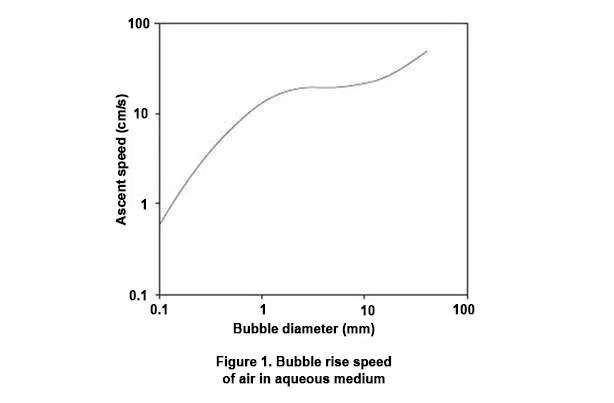
- Bubble size: For a correct separation by coalescence with air, the bubbles should be less than 2 mm in size. With smaller sizes, a better separation is achieved, but air must be added under pressure and then the mixture must be correctly decompressed to obtain micro bubbles ( ≤ 0.5 mm).
- Diffuser spacing: When the distance between diffusers is increased, the ability of bubbles produced by one diffuser to impact bubbles produced by another diffuser is reduced.
- Height of the water film: As the bubbles rise, they tend to form a column of air, the separation between them being very small, thus facilitating coalescence.
The following graph (Figure 1) shows the increase in the bubble rising velocity as the bubble size increases, which shows that the contact time is longer with smaller bubbles.
Depending on the amount of FOG present in the effluent to be treated, and its destination (secondary treatment, discharge, reuse), a cavitated air system (CAF) can be used.The CAF system uses a special agitator screw that produces a vortex and, therefore, a depression on the surface of the liquid, which reduces its surface tension.
This air in the form of bubbles is dispersed in the discharge stream, creating a separation of contaminants by loss of bulk density of the associated particles and thanks to the coalescence of oils and fats.
The CAF system is economical, both in terms of implementation and consumption of reagents and energy, and is easy to maintain. However, its oil and grease removal performance is in the order of 60 - 80% due to the irregularity, quantity and size of the air bubbles formed.
This system is usually used as pretreatment for a dissolved air flotation (DAF) system when there is a very high concentration of oils and greases, or when the concentration is medium or low and, due to the characteristics of the discharge, this first treatment stage is sufficient.
4. Other technologies used for oil and grease removal in wastewater.
In addition to the CPI, API, CAP and DAF, already discussed in this article, the following alternative systems should be mentioned:
- Gravity separation: Gravity separation is a technique that uses the difference in density between oil and water to separate them. The method is based on the fact that oil and grease are less dense than water and, when introduced into a tank or settling chamber, float to the surface while water, being heavier, sinks to the bottom. Once the oil and grease have separated, they can be removed from the surface using a skimming device.
- Filtration: Filtration is another method of physical separation used for the removal of oil and grease from wastewater. The method consists of passing the wastewater through a filter that traps the oil and grease and allows the water to flow out. The filter media used can be any material capable of trapping oil and grease, such as sand, activated carbon or polymeric fibers, but it tends to clog quickly and is difficult to clean.
- Chemical oxidation: Chemical oxidation is a technique that uses oxidizing agents, such as hydrogen peroxide, ozone or chlorine, to react with oil and grease, making them insoluble in water. The method is effective, but can be expensive and can generate by-products that require further treatment.
- Bioremediation is a process that consists of introducing microorganisms into wastewater capable of decomposing oils and fats. The microorganisms consume oils and fats as food, converting them into harmless by-products such as water and carbon dioxide.
- Bioaugmentation: consists of introducing specific strains of bacteria or other microorganisms specially designed to break down certain types of oils and fats. This method is effective for the treatment of wastewater containing specific types of contaminants.
5. Conclusion
The separation of oils and fats in wastewater is performed by the difference in density between these pollutants (less dense) and the water stream containing them.
These contaminants must be removed, as their presence is problematic for electromechanical equipment and purification processes.
Of the various existing techniques for this separation, dissolved air flotation (DAF) is the most efficient, although on certain occasions when there are high concentrations of these pollutants, it is advisable that they be preceded by other treatments to discharge them (CPI, CAF, etc.).
Additionally, if a more refined removal of oils and greases is required, complementary treatments must be installed to achieve the desired values, such as refining treatment with specific membranes.
Bibliography and texts consulted
Are you interested in this solution?
BASIC INFORMATION CLAUSE
DATA CONTROLLER: SIGMADAF CLARIFIERS, S.L. PURPOSE: To respond to the user’s request. LEGAL BASIS: Consent of the data subject. DISCLOSURES: No disclosures are anticipated, except where required by law or court order. RIGHTS: Access, rectification, erasure, objection, restriction, data portability, and withdrawal of consent. If you believe that the processing of your data does not comply with the regulations, you may contact the Supervisory Authority (www.aepd.es). ADDITIONAL INFORMATION: For more information, please see our privacy policy.