
Industrial wastewater treatment using the high-efficiency biological system FBR

- 1. Introduction: FBR biological wastewater treatment system
- Advantages of an FBR system
- 3. Success stories on wastewater treatment with FBR systems
- 3.1. Biological treatment of wastewater from the malt processing industry using an FBR system
- 3.2. FBR biological treatment of wastewater from the dairy industry
- 3.3. FBR biological treatment of wastewater from food processing industry
- Complete RANC + FBR treatment of wastewater from the food processing industry.
- 3.5. Installation of a SIGMA DAF clarifier as part of an FBR process in the treatment of meat industry wastewater.
- 3.6. Complete treatment of wastewater from the meat industry using a SIGMA FBR biological system.
1. Introduction: FBR biological wastewater treatment system
The FBR (flotation bioreactor) system is a biological wastewater treatment system that allows the continuous and compact removal of pollutants.
These space-saving systems are more efficient at removing organic compounds and other biodegradable contaminants and generate less sludge than conventional activated sludge systems.
The wastewater, previously treated by screening and removal of fats and oils, is introduced into a biological aeration reactor, where the contaminants in the water are brought into contact with microorganisms that degrade them in the presence of oxygen.
Oxygen is introduced through aeration systems such as fine bubble diffusers, coarse bubble diffusers, JET systems, etc. Control of oxygen concentration and temperature within the reactor is essential to provide the microorganisms with optimal conditions for contaminant removal.


As a result of the biological reactions carried out inside the reactor, contaminants are transformed into carbon dioxide, water and biomass cell growth. A pump drives the mixture of sludge and treated water to the next clarification system.
The clarification system of an FBR is specially designed to separate the biomass from the treated water. For this purpose, a dissolved air flotation system is used to carry out this separation, generally assisted and optimized by the use of polyelectrolyte.
Request a quote
Do you need a quote for an FBR wastewater treatment system?
Please leave us your contact information so we can contact a sales representative.
Bringing the sludge into contact with a polyelectrolyte in a flocculation unit favors the formation of biomass flocs that will be easily separated in the DAF unit.
Clarification using DAF equipment allows obtaining a much higher concentration of separated sludge than with conventional settlers, and can reach a dry matter content of up to 5%.

Inside a DAF unit, micro-bubbles of between 30-50 microns in diameter are generated, which adhere to the biomass flocs causing them to rise to the surface of the DAF unit, where they are separated by a skimmer system.
The settleable matter flows down to the sediment compartment at the bottom of the DAF unit and is discharged through the sludge extraction system. The biological sludge is partly recirculated back into the biological reactor and partly purged. Since this sludge is highly concentrated, it is possible to achieve very high biomass concentrations inside the reactor, which results in higher degradation efficiencies of the pollutant load.
The DAF equipment produces perfectly clarified water that can be discharged in compliance with the discharge requirements.
Part of the sludge will not be discharged, but will be recirculated to the biological reactor to maintain a stable biomass concentration, while another part will be extracted as a blowdown.
With the FBR systems designed and manufactured by SIGMADAF, the discharge limits established by the laws in force can be efficiently reached.
Advantages of an FBR system
- Continuous flow and quality of the clarified water effluent.
- High process reliability and stability, as the DAF system is robust to variations in sludge quality.
- They are compact systems and the reactor size is smaller than if a conventional activated sludge system of the same capacity is applied, since the achievable biomass concentration inside the reactor is much higher.
- A DAF unit is smaller than a conventional settler and involves less construction and site modifications.
- Sludge obtained from a DAF system has between 3% and 5% dry matter, which is a much higher concentration than that obtained in conventional settlers. The sludge volume is smaller, which translates into savings in management and dewatering treatment costs.
- They have numerous industrial applications: meat and slaughterhouses, food processing, fish processing, dairy, juice and sweetened beverage production, confectionery and bakery, textile and dyeing, oils and chemicals, pharmaceuticals, etc.
3. Successful cases of wastewater treatment with FBR systems
The following are six success stories in which excellent results have been obtained in the treatment of industrial wastewater with FBR systems.
3.1. Biological treatment of wastewater from the malt processing industry using an FBR system

Year: 2011
Project location: Cargill facilities in Villaverde, Madrid.
Objectives: - Comply with legal discharge requirements. Possibility of adapting the installation to changing needs derived from the expansion of the manufacturing plant.
Equipment installed: a screening and homogenization system; an aerobic reactor with JET aeration systems and nutrient dosing system; a SIGMA PFL coagulation-flocculation system with polyelectrolyte dosing system; a DAF clarification system with SIGMA DAF FPAC-120 equipment; complete sludge treatment with thickening tank and centrifugal decanter; instrumentation, control systems and automation of the entire process.
Capacity: 1000 m3/day.
| COD | DBO5 | NTK | Total phosphorus |
|---|---|---|---|
| 4000 mg/L | 2000 mg/L | 100 mg/L | 20 mg/L |
| COD removal | BOD5 removal | Elimination of TKN | Total phosphorus removal |
|---|---|---|---|
| > 75% | > 75% | > 50% | > 50% |
Scenario
Cargill is a world leader in the production of food, agricultural products and services, with malt processing being one of its specialties. The malt processing industry uses large quantities of water for the washing and processing of its intermediate and final products. These waters are characterized by a high biodegradability, which allows the application of biological treatments with high efficiency.
SIGMADAF designed and installed a complete plant for the treatment of wastewater produced at the malt processing plant in Villaverde, Madrid. The plant consists of the following processes:
- An aerated biological system for the elimination of organic load and nutrients.
- At the outlet of the biological reactor, a sludge separation system is installed for coagulation-flocculation and clarification by DAF flotation.
With this equipment, sludge with a dry solids content 3 to 4 times higher than any conventional activated sludge and sedimentation system is achieved.
After passing the effluent through the SIGMA DAF FPAC-120 flotation equipment, it is obtained:
- A perfectly clarified water that can be discharged in compliance with discharge requirements.
- A sludge that is partly recirculated to the biological reactor to maintain a stable biomass concentration and partly extracted as a blowdown.
The addition of polyelectrolyte to the clarification system allows the generation of easily separable biomass flocs, in addition to providing a high biomass concentration inside the reactor, which allows obtaining a higher yield than that offered by other suspended biomass biological systems.
In addition, SIGMADAF designs and installs the treatment of sludge generated by dewatering with a centrifugal decanter.
Process diagram
3.2. FBR biological treatment of wastewater from the dairy industry

Year: 2009
Project location: HELADOS ESTIU S.A. facilities in Ribarroja, Valencia.
Objectives: Elimination of the organic load coming from the pre-treatment phase for the subsequent discharge of the effluent to the sewer.
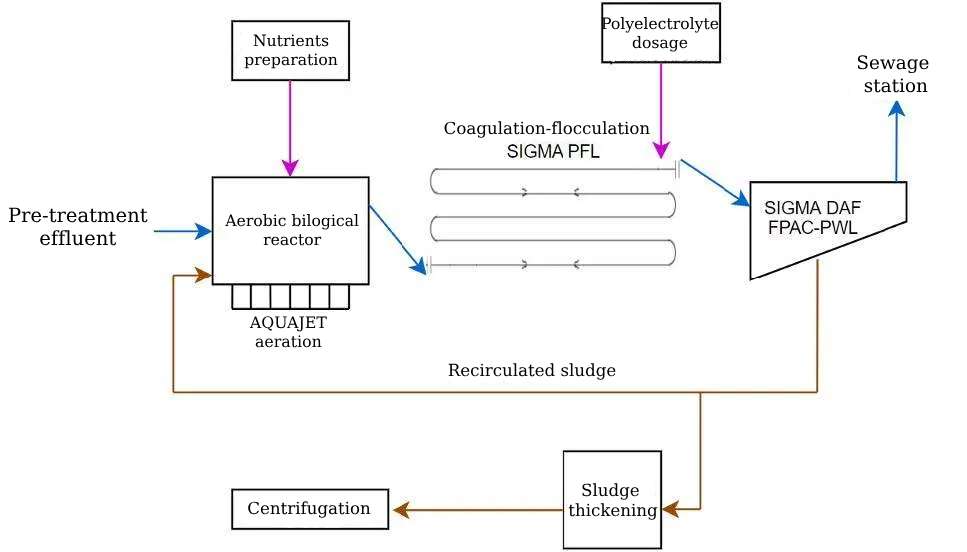
Equipment installed: homogenization and aeration tank (biological); AQUAJET aeration-recirculation system for the biological treatment tank; SIGMA PFL in-line flocculation system; SIGMA DAF FPAC-PWL dissolved air flotation system; sludge thickening and dewatering tank by means of a centrifugal decanter; chemical and nutrient dosing equipment; control and automation equipment.
Capacity: 1000 m3/day.
| COD | DBO5 |
|---|---|
| 4500 mg/L | 2500 mg/L |
| COD removal | Dry matter concentration of the centrifuged sludge |
|---|---|
| 90% | > 50% |
Scenario
Helados ESTIU S.A. is an ice cream producer. Its wastewater contains a very high mass load. The facility already has a pre-treatment, but the customer wants to add a biological treatment for the removal of the organic load and to comply with the discharge limits to the general collector.
SIGMA designed and installed an FBR process, which includes an aeration reactor in which organic matter is transformed into microbial flocs by adsorption and agglomeration, and a DAF equipment to separate the biomass by flocculation and secondary clarification. With this special equipment, sludge with a dry solids content 3 or 4 times higher than any conventional system is obtained.
The SIGMA DAF FPAC-PWL flotation system is a modular system that is easy to expand and highly adaptable to different biomass concentrations.
SIGMA also installed a complete sludge treatment process: thickening and dewatering in a centrifugal decanter.
Process diagram

3.3. FBR biological treatment of wastewater from food processing industry

Year: 2010
Project location: Tostaderos Sol de Alba S.A. facilities.
Objectives: Installation of a biological and clarification treatment following the existing pre-treatment, in order to comply with the discharge limits.
Equipment installed: homogenization and aeration tank (biological); MTJET aeration-recirculation system for the biological treatment tank; SIGMA DAF FPAC-PWL-35 flotation system; nutrient and polyelectrolyte dosing equipment; control and automation equipment.
Capacity: 430 m3/day.
| COD | DBO5 | Total nitrogen |
|---|---|---|
| 4000 mg/L | 1000 mg/L | 60 mg/L |
| COD removal | BOD5 removal | Total nitrogen removal |
|---|---|---|
| > 60% | > 88% | > 56% |
Scenario
In the facilities of Tostaderos Sol de Alba S.A., where the production of fried corn is carried out, there is a pre-treatment of the wastewater that is insufficient to meet the discharge requirements. An FBR type biological treatment is designed and installed, fed by the effluent of this pre-treatment.
Complete RANC + FBR treatment of wastewater from the food processing industry.

Year: 2016
Project location: Factory of Congelados de Navarra in Fustiñana, Navarra.
Objectives: Installation of a complete wastewater treatment system for the vegetable processing units that allows compliance with discharge requirements.
Flexible treatment that adapts to the high variability and seasonality of wastewater, both in terms of flow rate and organic load.
Equipment installed: pumping, screening and sand separation systems; homogenization tank; SIGMA RANC anaerobic reactor; gas filter; SIGMA BIODAF-FPBC-PWF clarifier; aerobic activated sludge reactor; SIGMA BIODAF 200-TWIN final clarifier; SIGMA PFL flocculation systems; sludge treatment system by dewatering with centrifugal decanter. Control and automation systems.
Capacity: 1300 m3/day.
| COD | DBO5 | SST | N-NTK |
|---|---|---|---|
| 15000 mg/L | 8000 mg/L | 2000 mg/L | 175 mg/L |
| COD removal | Elimination of SST | Elimination of N-NTK |
|---|---|---|
| > 96% | > 97% | > 91% |
Scenario
Congelados de Navarra S.A. is a company dedicated to the processing of vegetables for subsequent freezing. The wastewater has a high load of biodegradable organic compounds, so a complete biological treatment plant is designed and installed to reach the discharge limits.
Two biological processes are installed in series: an anaerobic digestion with a SIGMA RANC reactor and a SIGMA FBR aerobic treatment. The plant also includes a gas filtration line and a complete sludge treatment. Given the seasonal nature of vegetable production, the plant is robust but flexible and can adapt to changes in production both in flow rate and in the nature of the water (from processing of a wide variety of vegetables: cauliflower, broccoli, rice, potato, peas, carrots, etc.).
The RANC anaerobic digestion process consists of an upflow contact reactor, where the elimination of organic compounds is carried out under anaerobic conditions, transforming COD and BOD5 mainly into biogas and generating very little sludge. The anaerobic sludge is separated by flotation clarification in a SIGMA BIODAF-FPBC-PWF system. The biogas generated is treated in a filter to remove hydrogen sulfide.
The FBR (flotation bio-reactor) process consists of an aeration reactor where biological treatment is carried out in the presence of oxygen. This biological process transforms the organic matter that was not removed in the anaerobic reactor into microbial flocs by adsorption and agglomeration. These biomass flocs are separated by coagulation, flocculation and secondary clarification by DAF flotation in a SIGMA BIODAF 200-TWIN equipment.
The flotation clarification equipment of the SIGMA BIODAF range is special equipment that is more reliable in the case of spongy sludge with low sedimentation velocity.
The sludge generated in both clarification processes is treated jointly by dewatering in a centrifugal decanter.
3.5. Installation of a SIGMA DAF clarifier as part of an FBR process in the treatment of meat industry wastewater.
Year: 2019
Project location: Cárnicas Medina in Valencia.
Objectives: Installation of a secondary clarification system after the existing biological treatment.
Equipment installed: SIGMA PFL-180 in-line coagulation-flocculation system, DAF FPAC160/200 system.
Capacity: 200 m3/day
| SST | Oils and grease |
|---|---|
| 4500 mg/L | 500 mg/L |
| Elimination of SST | Oil and grease removal |
|---|---|
| 90% | 90% |
Scenario
Cárnicas Medina is a leading company in the meat sector. Its facilities in Valencia have a wastewater treatment plant using biological treatment and require the installation of secondary clarification equipment.
The FBR ('flotation bio-reactor') process consists of a biological reactor, already existing in the plant, in which the removal of organic matter is carried out, followed by a combined coagulation-flocculation process followed by clarification.
Coagulation-flocculation is carried out in a SIGMA PFL-180 unit, which incorporates coagulant to group the biomass generated in the biological reactor, and flocculant (polyelectrolyte) to form larger flocs with these biomass agglomerates.
Clarification by means of a DAF system allows the separation of the flocs formed.
DAF systems are introduced to separate oils, fats, greases, solids and flocs that do not have sufficient buoyancy to float. They also offer a great result when a mixture of emulsified fats, oils and solids affect the gravity of the contaminants.
The size of the air bubbles is between 30 and 50 microns, which allows the bubbles to easily adhere to particles of the same size or larger.
Our DAF systems are flexible, highly reliable and robust, allowing them to be easily adapted to possible fluctuations in wastewater production and plant operation.
Process diagram

3.6. Complete treatment of wastewater from the meat industry using a SIGMA FBR biological system.

Year: 2018
Project location: Beef slaughterhouse of the meat company Vall d'en Bas, in Sant Privat d'en Bas, Girona.
Objectives: Compliance with current discharge regulations and adaptation to possible future modifications of the slaughterhouse.
Equipment installed: SIGMA ACAF-025 solids screen, oil and grease separator, anoxic-aerobic reactor with diffusers, SIGMA PFL-020 in-line flocculation system, SIGMA BIODAF FPAC 50 secondary flotation clarifier, thickener and centrifugal decanter for sludge treatment, complete control and maneuvering systems.
Capacity: 150 m3/day
| COD | NTK | NH4+ | SST | Oils and fats |
|---|---|---|---|---|
| 6000 mg/L | 500 mg/L | 175 mg/L | 2000 mg/L | 500 mg/L |
| COD | NTK | NH4+ | SST | Oils and fats |
|---|---|---|---|---|
| > 75% | > 82% | > 65% | > 85% | > 96% |
Scenario
Cárniques Vall d'en Bas is a leading company in the meat sector. Its beef slaughterhouse requires a complete wastewater treatment. The main objective is compliance with discharge limits for the discharge of treated water.
A pretreatment is installed consisting of a screening system, followed by a primary clarifier using SIGMA ACAF-25 induced air cavitation flotation. In this pre-treatment, larger solids, oil and grease are removed.
Secondary treatment is carried out in an FBR biological system, which consists of an anoxic-aerobic reactor with prolonged aeration of activated sludge. This biological process removes organic matter through biological reactions with biomass. During this process, microbial flocs are generated by adsorption and agglomeration. These biomass flocs are subsequently separated by coagulation, flocculation and secondary clarification by DAF flotation.
Coagulation-flocculation is carried out in a SIGMA PFL-020 unit, which incorporates coagulant to group the biomass generated and flocculant (polyelectrolyte) to agglomerate these biomass agglomerates into larger flocs.
Secondary clarification by dissolved air flotation allows the separation of flocs formed by dissolved air micro-bubbles. This process is carried out in a SIGMA BIODAF FPAC-50.
The flotation clarification equipment of the SIGMA BIODAF range is special equipment that offers greater reliability against spongy sludge with low sedimentation velocity, such as those typically generated in industrial wastewater treatment.
The sludge generated in both clarifications is treated jointly by thickening and dewatering in a centrifugal decanter type equipment. Dewatered sludge of 20% dry matter is obtained.
Process diagram

Are you interested in this solution?
BASIC INFORMATION CLAUSE
DATA CONTROLLER: SIGMADAF CLARIFIERS, S.L. PURPOSE: To respond to the user’s request. LEGAL BASIS: Consent of the data subject. DISCLOSURES: No disclosures are anticipated, except where required by law or court order. RIGHTS: Access, rectification, erasure, objection, restriction, data portability, and withdrawal of consent. If you believe that the processing of your data does not comply with the regulations, you may contact the Supervisory Authority (www.aepd.es). ADDITIONAL INFORMATION: For more information, please see our privacy policy.