
Groundwater treatment and purification

- Introduction to groundwater
- 2. Definition of aquifer and types of aquifers
- 3. Groundwater contamination
- 4. Groundwater quality monitoring
- 5. Groundwater treatment process
- 6. Summary
Introduction to groundwater
Groundwater is water found below the earth's surface, in porous soils or in the hollows of rock formations. An accumulation of groundwater is considered an aquifer when it can provide a sufficient quantity of water for human consumption. The water table is the depth at which these spaces in which rocks contain water are found.
Rainwater percolates through the soil until it reaches the rocky material that contains it. This flow slowly moves to lower levels, due to gravity, and eventually reaches streams, lakes and oceans.
It is common to think that groundwater is always present filling cavities and circulating through galleries; however, this is not always the case, as it can be found occupying the interstices of the rocky or sedimentary substratum, which retain it like a sponge. The only significant exception is offered by soluble rocks, such as limestones, since they are susceptible to the process called karstification, in which water excavates chasms, caverns and other circulation routes.
Groundwater is normally drawn from the surface by pumping units, although it can also emerge naturally through springs and seepage, forming reservoirs such as oases, swamps or lakes. On the other hand, groundwater is also extracted through the construction of wells for use in agriculture, industry and human consumption.
Groundwater accounts for about 30% of all the freshwater available on the planet, and its volume is greater than the mass of water retained in lakes or rivers, although less than that accumulated in glaciers.
Groundwater supplies a third of the world's population, but is difficult to manage due to its high pollution load, which is caused by human activity (agriculture, industry, hydrocarbons, waste, etc.), and the mineral content of the subsoil (fluoride, arsenic, iron, etc.).
The reuse of this water, both as drinking water and for industrial or agricultural use, requires specific treatments according to each aquifer, which requires a complete analysis and monitoring, since there are variations depending on rainfall, location and type of terrain.
2. Definition of aquifer and types of aquifers
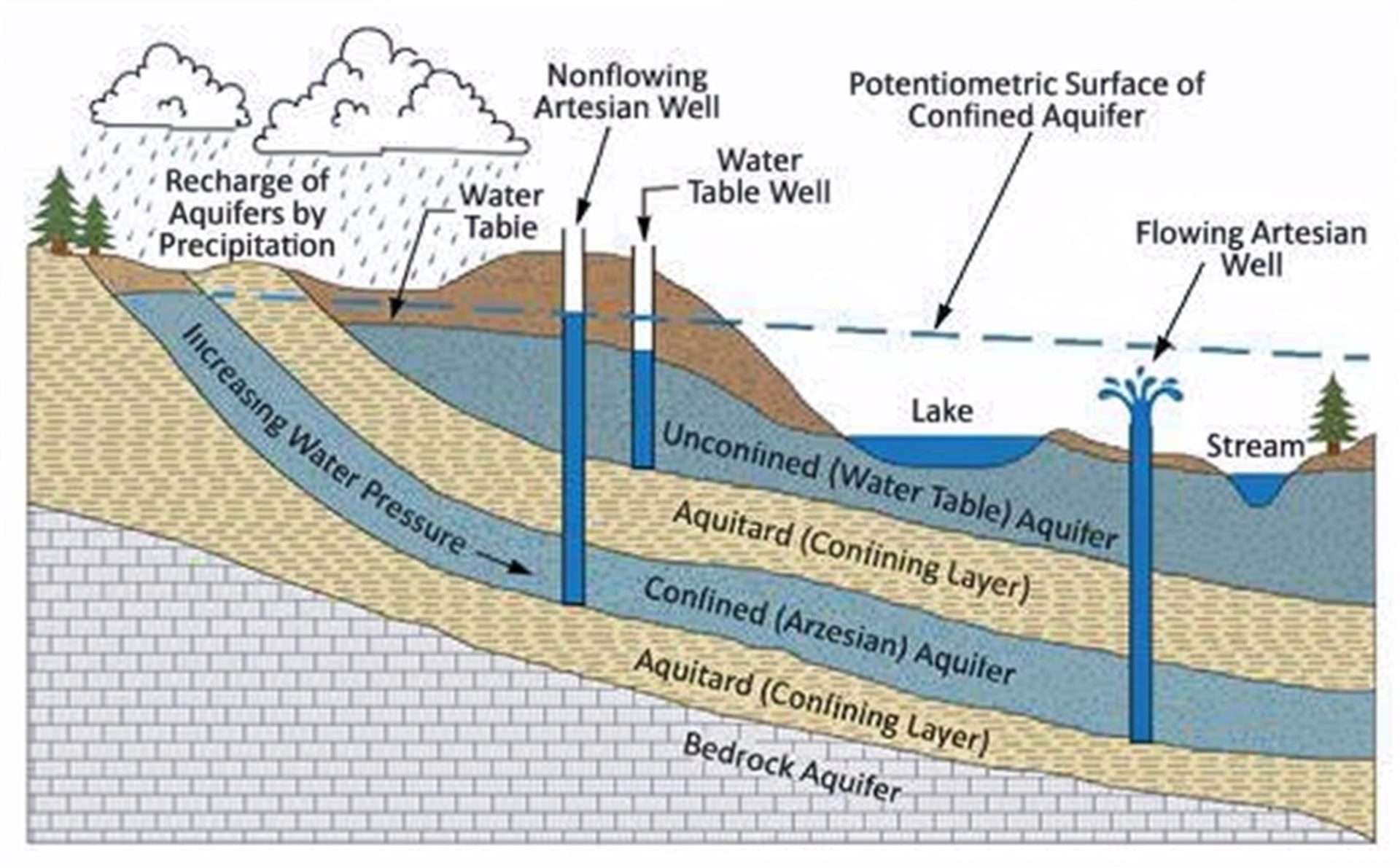
An aquifer is an accumulation of water in the pores or crevices of a permeable rock mass that allows its circulation. The aquifer consists of one or more subsurface layers of rock, or other geologic strata that have sufficient porosity and permeability to allow water to flow.
An aquifer is basically composed of two zones:
- Saturation zone, which is the zone above the impermeable layer, where water completely fills the pores of the rocks. The upper limit of this zone, which separates it from the vadose or aeration zone, is the water table and varies according to circumstances. The saturation zone descends in dry periods, when the aquifer does not recharge or recharges at a slower rate than its discharge, and rises in wet periods.
- Aeration or vadose zone, which is the space between the water table and the surface, where not all pores are filled with water.
Depending on their structure, a distinction can be made between free aquifers and confined aquifers.
- Captive or confined aquifers: are those formations in which the groundwater is enclosed between two impermeable layers and is subjected to a pressure higher than atmospheric pressure. It only receives rainwater through a zone in which there are permeable materials.
- Semi-confined aquifers: An aquifer is called semi-confined when the overlying soil stratum has a significantly lower permeability than the aquifer itself, but is not impermeable, so that this type of aquifer can be discharged and recharged through this stratum.
Aquifers can also be classified according to their composition or texture:
- Porous aquifers. In these aquifers, groundwater is embedded within pores that are intercommunicated with each other, which hinders the internal transmission of water. As an example, we have the sand and gravel formations of the alluvium, where the clays have maximum porosity and storage, but no transmission or permeability.
Fissural aquifers. These are those in which the water is located over fissures or diaclases, also intercommunicated and distributed in such a way that the internal water flows behave in a heterogeneous manner.
Coastal aquifers
Coastal aquifers can also be free, confined or semi-confined. What differentiates them is the presence of fluids with two different densities: freshwater and saltwater, the former having a lower density.
This difference in density means that the fresh water is superimposed on the salt water in the coastal zone. The salt water enters the continent in the form of a salt wedge that deepens as it enters the continent.
The coastal aquifer basin is also fed by precipitation, or through groundwater flow from other basins. Water outflows occur through evapotranspiration, evaporation and subsurface outflow to the sea.
Aquifer recharge
Groundwater is normally renewed by active recharge processes from the surface, so the time required to completely renew a reservoir can be very long. In some cases the renewal is interrupted by the impermeability of the upper geological formations, or by climatic circumstances of drought.
Recharge can be direct or indirect depending on whether rainwater directly accesses the groundwater upwelling, or whether precipitation must pass through the different soil layers before being integrated into the groundwater.
Precipitation water (rain, snow,...) can have different destinations once it reaches the ground:
- Runoff is the part that runs off the surface of the land forming streams and rivers.
- Another part of the water evaporates from the surface layers of the soil, or passes into the atmosphere with the transpiration of organisms, especially plants.
- Finally, another part infiltrates into the ground and becomes groundwater.
The proportion of infiltration to total precipitation depends on several factors:
- Lithology, which refers to the nature of the geological material that comes to the surface, is influenced by its permeability, which depends on the porosity, cracking and mineralogy of the substrate.
- Another factor affecting infiltration is a more or less steep slope.
- The presence of dense vegetation has a complex influence. On the one hand, it reduces the water reaching the soil, but on the other hand, the roots are more permeable and the dripping of the water present in the vegetation extends the effect of precipitation over time.
The speed at which water moves depends on the volume of the interstices (porosity) and the degree of intercommunication between them. If the pores are sufficiently wide, part of the water flows freely through them driven by gravity, but another part remains fixed by capillary forces, or by the interaction between water and mineral molecules,
Drying and overexploitation
Wells can dry up if the water table drops below its initial depth, which occasionally occurs in drought years. The recharge regime can be altered by other causes, such as:
- Reforestation, which favors infiltration over runoff, but even more favors evaporation.
- An increase in the extension of impervious pavements, as occurs in urban and industrial areas.
The lowering of the average water table occurs whenever there is a continuous abstraction of water in the aquifer. However, this drawdown does not mean that the aquifer is overexploited. Overexploitation occurs when total water withdrawals exceed recharge.
3. Groundwater contamination
Groundwater tends to be fresh and potable, as groundwater circulation has the capacity to purify the water of particulate matter and contaminating organisms. However, water can reach the aquifer contaminated for various reasons:
- Agricultural activity, which causes the infiltration of nitrates and other highly soluble chemical fertilizers.
- Discharges of factory effluents.
- Poor management of urban solid waste.
- Chemical products from household use.
- Water storage tanks, septic tanks and waste dumps.
- Natural factors. For example, when aquifers are too rich in dissolved salts, or when natural erosion of certain rock formations occurs.
The contaminants most frequently found in groundwater are:
- Industrial organic compounds such as solvents, pesticides, paints, varnishes, etc.
- Fuels such as hydrocarbons.
- Nitrates from different sources: fertilizers, improperly functioning septic tanks, unsealed solid waste retention ponds, or infiltration of untreated sewage.
Contamination can remain in groundwater for long periods of time due to the following reasons:
- Its low renewal rate.
- His long time of residence.
- It cannot be easily treated due to its difficult access.
In very localized areas of contamination, the pump-and-treat technique can be applied, which consists of extracting water from the aquifer, treating it appropriately, and injecting it back into the aquifer.

Groundwater in coastal areas can become contaminated by mixing with seawater. This happens when the extraction rate is too high, as this makes it easier for seawater to enter freshwater aquifers. This problem can be addressed by changing the location of wells, or by digging other wells that keep saltwater away from the freshwater aquifer. In any case, as long as extraction exceeds freshwater recharge, saltwater contamination remains a possibility.
Main sources of groundwater contamination
| Source of contamination | Type of pollutant |
|---|---|
| Agricultural activity | Nitrates, ammonia, pesticides, fecal microorganisms |
| On-site sanitation | Nitrates, fecal microorganisms, trace amounts of synthetic hydrocarbons |
| Gas Stations and Workshops | Benzene, other aromatic hydrocarbons, phenols, some halogenated hydrocarbons |
| Final deposit of solid waste | Ammonium, salinity, some halogenated hydrocarbons, heavy metals, etc. |
| Metallurgical industries | Trichloroethylene, tetrachloroethylene, other halogenated hydrocarbons, heavy metals, phenols, cyanide, etc. |
| Painting and enameling workshops | Alkalobenzenes, tetrachloroethylene, other halogenated hydrocarbons, metals, certain aromatic hydrocarbons |
| Timber industry | Pentachlorophenol, some aromatic hydrocarbons |
| Dry cleaners | Trichloroethylene, tetrachloroethylene |
| Pesticide manufacturing | some halogenated hydrocarbons, phenols, arsenic. heavy metals |
| Domestic sludge landfills | Nitrates,lead,zinc,various halogenated hydrocarbons |
| Spills from tannery manufacturing | Chromium, salinity, certain halogenated hydrocarbons, phenols |
| Exploitation+oil/gas extraction | Salinity (sodium chloride), aromatic hydrocarbons |
| Coal and metal mines | Acidity, various heavy metals, iron, sulphates |
4. Groundwater quality monitoring
The control of water quality in aquifers requires preventive measures to protect the physicochemical characteristics of groundwater and return it to its original state in the event of contamination.
Groundwater treatment presents some specific challenges, including:
- High extraction rates, typically tens of cubic meters per hour.
- Relatively low concentrations of contaminants.
- Wide variety of contaminants present.
- Very strict limits for treated water quality.
- Need to operate continuously, 24/7.
Although groundwater is partially purified by filtering through the soil layers, its treatment can be complicated if it is contaminated with colloidal or dissolved substances, both organic and inorganic (such as hydrocarbons, harmful salts such as nitrates, metals such as iron or toxic elements such as arsenic). For this reason, it is necessary to carry out detailed analyses to identify the contaminants present and to design a specific treatment based on the results obtained.
A very useful tool for this are risk maps. In 2016, a group of researchers developed the Groundwater Assessment Platform (GAP)where experts from all over the world can use and visualize their analytical data to produce risk maps of specific areas. The GAP platform also serves as a discussion forum for knowledge exchange, contributing to the development of better methods for the removal of harmful substances from drinking water.
5. Groundwater treatment process
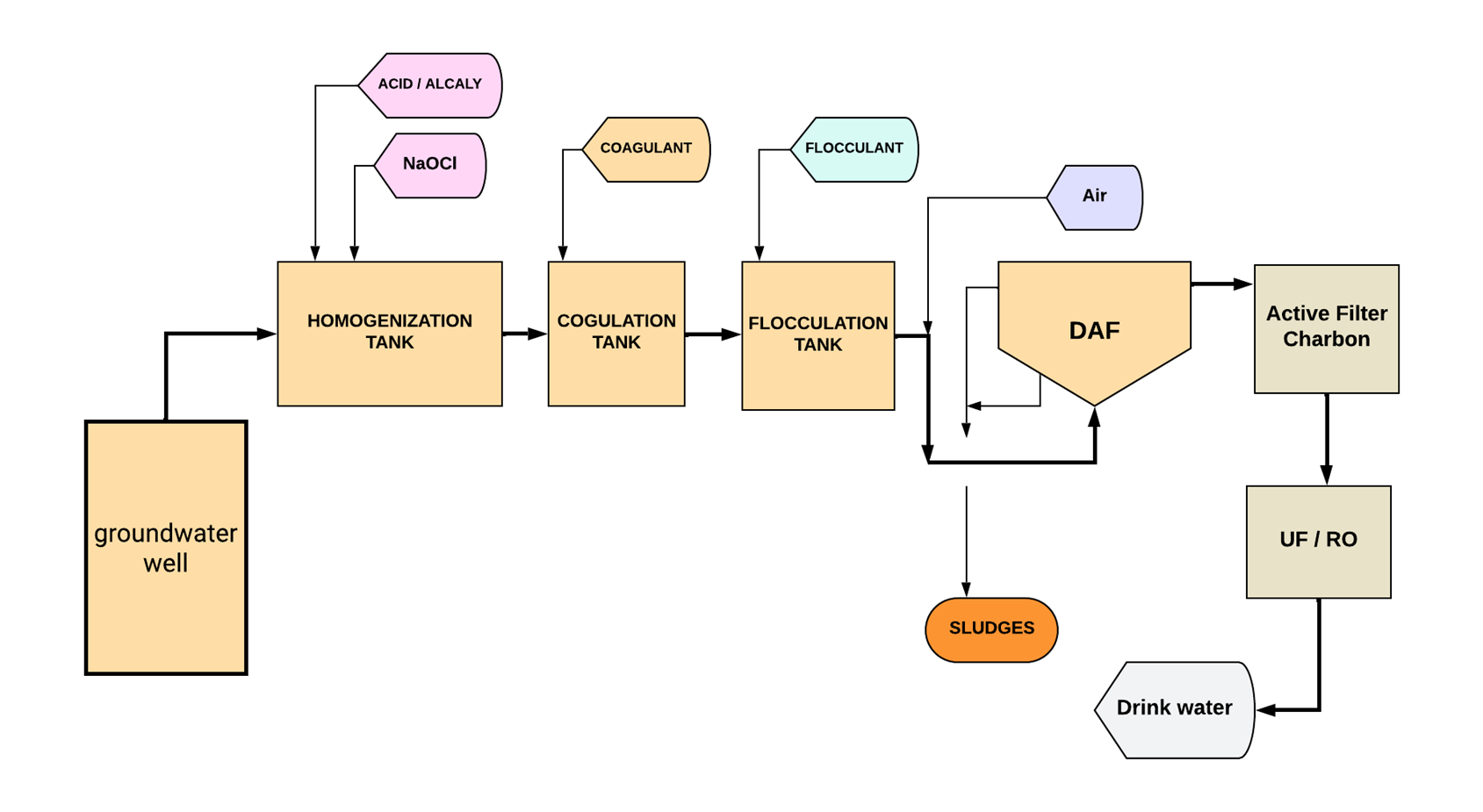
There is no single treatment for all groundwater. Depending on its origin and destination, a specific treatment line is defined, which may include the following steps:
5.1 Primary treatment
The objective of primary treatment is the removal of suspended materials, such as microsolids and colloids.
Depending on the contaminants detected, it may be necessary to add an oxidizer, such as sodium hypochlorite (NaOCl), which facilitates the removal of metals such as iron, in addition to adjusting the pH if the water is very acidic or alkaline.
The oxidizer also helps to eliminate viruses and bacteria, ensuring the microbiological safety of the water, which is especially important when drinking or high quality water is desired.
Coagulation and flocculation of colloids are fundamental processes to ensure the separation of these particles by sedimentation or dissolved air flotation.
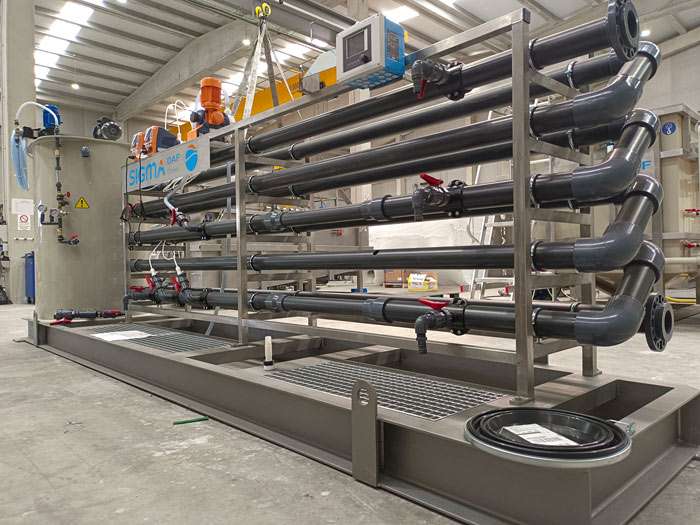
Dissolved Air Flotation (DAF) is an excellent option because it offers the following advantages:
- It is the most efficient technology for separating solids, fats, oils, grease, hydrocarbons and the flocs formed in the coagulation-flocculation process.
- Sludge generated in a DAF system has a higher dry matter concentration than sludge generated by conventional sedimentation.
- The added air facilitates the elimination of volatile compounds present in the water.
5.2 Secondary treatment
In many cases, primary treatment is sufficient to obtain water that is suitable for reuse in applications that do not require maximum quality, for example:
- Water for irrigation.
- Water for industrial washing.
- Firefighting systems.
- Street cleaning.
- Sanitary water.
If high quality water is to be obtained for industrial processes or even for human consumption, it will be necessary to complement primary treatment with secondary and even tertiary treatment. The technologies used will depend on the degree of contamination of the aquifer. The most common processes for groundwater treatment include:
- Filters with sand beds, activated carbon or mixed beds.
- Ultrafiltration (UF) or reverse osmosis (RO) membrane filtration systems.
For water intended for human consumption, post-treatment is usually necessary to remove excess CO2 and add salts to balance the low salinity of the water, making it suitable for human consumption.
In more demanding cases, such as the treatment of demineralized or ultrapure water, ion exchange (IX) systems are used, including selective resin beds and the electrodeionization process (EDI).
6. Summary
Approximately one-third of the planet's freshwater lies beneath the earth's surface and is known as groundwater. Reservoirs of this water, called aquifers, can be mobile or static. Thanks to natural filtration through layers of sand, gravel and rocks, these waters tend to purify themselves during their circulation.
Groundwater may emerge in the form of wetlands, marshes and artesian wells due to natural pressure, or be extracted by pumping.
However, human activity introduces significant contaminants into aquifers, mainly through agriculture (fertilizers and pesticides), industrial activity and domestic waste, which seep into the ground.
In order to treat and use groundwater, a thorough analysis is necessary to identify the contaminants present and design the appropriate treatment according to the intended use of the water.
Dissolved air flotation (DAF) is a widely used technology to remove metals, colloids, floating materials (such as hydrocarbons and colloids), part of the organic matter and volatile compounds. SIGMADAF has experience, resources and a wide range of equipment for the specific treatment of each type of groundwater.
Bibliography and consultations
Characteristics of groundwater treatment plants | 2024 (cesuma.mx)
Groundwater Treatment: Process and Stages - Full Review
What is groundwater? | International Groundwater Resources Assessment Centre (un-igrac.org)
Groundwater quality: control and 3 different uses (rs-ingenieria.es)
Are you interested in this solution?
BASIC INFORMATION CLAUSE
DATA CONTROLLER: SIGMADAF CLARIFIERS, S.L. PURPOSE: To respond to the user’s request. LEGAL BASIS: Consent of the data subject. DISCLOSURES: No disclosures are anticipated, except where required by law or court order. RIGHTS: Access, rectification, erasure, objection, restriction, data portability, and withdrawal of consent. If you believe that the processing of your data does not comply with the regulations, you may contact the Supervisory Authority (www.aepd.es). ADDITIONAL INFORMATION: For more information, please see our privacy policy.