
Biological wastewater treatment for malt processing
Project location: Cargill facilities in Villaverde, Madrid.
Objectives: Compliance with legal discharge requirements. Possibility of adaptation to future needs and expansion of the manufacturing plant.
Capacity: 1000 m3/day.
Scenario
Cargill is a world leader in the production of food, agricultural products and services. Within the food sector, malt processing is one of its specialties. The malt processing industry uses large quantities of water for the washing and processing of its intermediate and final products, enabling it to obtain optimum qualities. These waters are characterized by a high biodegradability, which allows the application of biological treatments with very high efficiency.
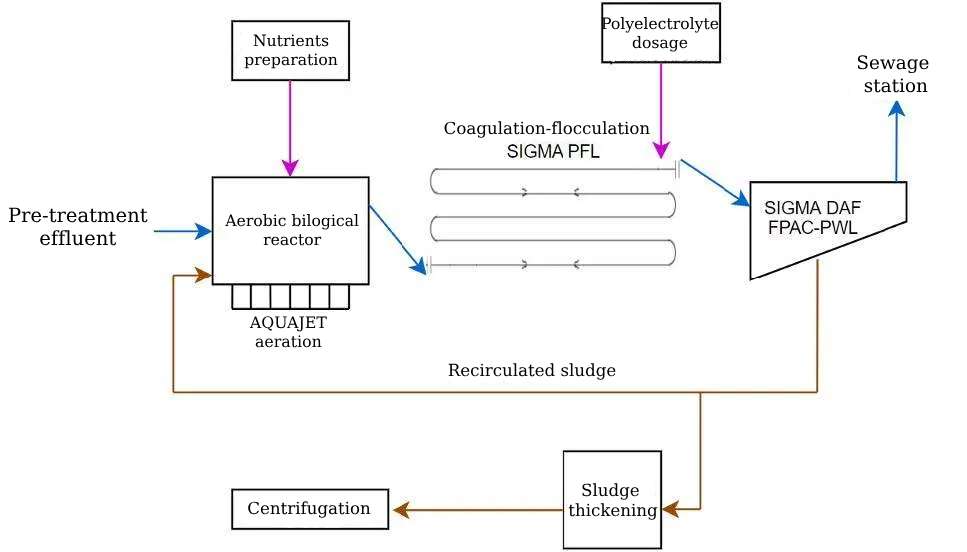
SIGMADAF designed and installed a complete plant for the treatment of wastewater from the malt processing factory in Villaverde, Madrid, by means of an aerated biological system for the removal of organic load and nutrients. At the outlet of the biological reactor, a sludge separation system by coagulation-flocculation and clarification by DAF flotation is installed. This system is called 'flotation biological reactor' or FBR. SIGMA is a specialist in the design, installation, commissioning and monitoring of FBR treatment systems.
The FBR process consists of an aeration reactor where the biological treatment is carried out (this biological process consists of the transformation of the organic matter contained in the wastewater to be treated into microbial flocs by adsorption and agglomeration) and a separation of the biomass by flocculation and secondary clarification by DAF flocculation (in this process biomass flocs are formed and separated by flotation with micro air bubbles in a DAF FPAC-120 equipment. With this special equipment, sludge with a dry solids content 3 or 4 times higher than any conventional activated sludge and sedimentation system is obtained).
In the SIGMA DAF FPAC-120 flotation equipment, a perfectly clarified water is obtained that can be discharged in compliance with the discharge requirements and a sludge that is partly recirculated to the biological reactor to maintain a stable biomass concentration and partly extracted as a purge. The addition of polyelectrolyte to the clarification system allows the generation of easily separable biomass flocs, in addition to providing a high biomass concentration inside the reactor and therefore a higher yield than in other suspended biomass biological systems.
In addition, SIGMA designs and installs the treatment of sludge generated by dewatering with a centrifugal decanter.
Water characteristics
| VDQO | DBO5 | NTK | Total phosphorus |
|---|---|---|---|
| 4000 mg/L | 2000 mg/L | 100 mg/L | 20 mg/L |
Performance
| COD removal | BOD5 removal | Elimination of TKN | Total phosphorus removal |
|---|---|---|---|
| > 75% | > 75% | > 50% | > 50% |
Process diagram
Are you interested in this solution?
BASIC INFORMATION CLAUSE
DATA CONTROLLER: SIGMADAF CLARIFIERS, S.L. PURPOSE: To respond to the user’s request. LEGAL BASIS: Consent of the data subject. DISCLOSURES: No disclosures are anticipated, except where required by law or court order. RIGHTS: Access, rectification, erasure, objection, restriction, data portability, and withdrawal of consent. If you believe that the processing of your data does not comply with the regulations, you may contact the Supervisory Authority (www.aepd.es). ADDITIONAL INFORMATION: For more information, please see our privacy policy.