
Biological treatment and clarification of wastewater generated at a cattle slaughterhouse
Project location: Beef slaughterhouse of the meat company Vall d'en Bas, in Sant Privat d'en Bas, Girona.
Objectives: Compliance with current discharge requirements. Adaptation to possible future modifications of the slaughterhouse.
Capacity: 150 m3/day.
Scenario
Cárniques Vall d'en Bas is a leading company in the meat sector. It has facilities for its beef slaughterhouse that require a complete wastewater treatment. The main objective is to comply with the discharge limits for the discharge of treated water.
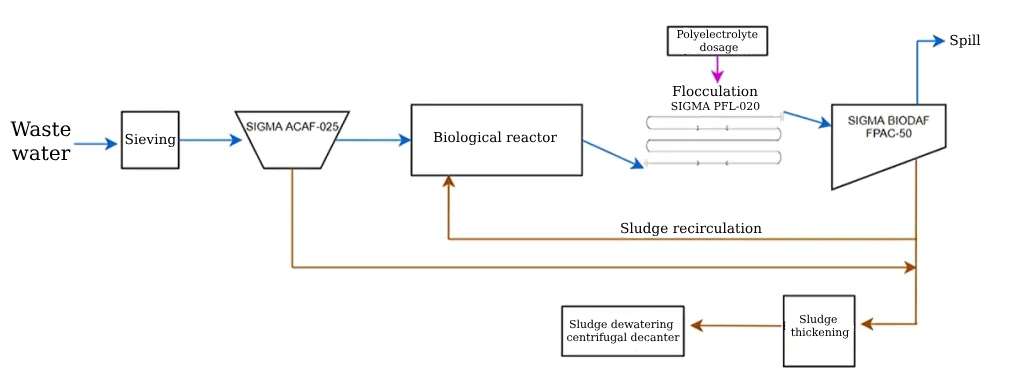
Coagulation-flocculation is carried out in a SIGMA PFL-020 equipment in which coagulant is incorporated to group the biomass generated and flocculant (polyelectrolyte) to agglomerate these biomass agglomerates into larger flocs.
Secondary clarification by dissolved air flotation (DAF) allows the separation of the flocs formed by micro-bubbles of dissolved air. The biomass flocs are separated by flotation with micro air bubbles in a SIGMA BIODAF FPAC-50.
The flotation clarification equipment of the SIGMA BIODAF range is a special equipment that offers greater reliability against spongy sludge with low sedimentation velocity, such as those typically generated in the treatment of industrial wastewater.
The sludge generated in both clarifications is treated jointly by thickening and dewatering with a centrifugal decanter type equipment. Dewatered sludge of 20% dry matter is obtained.
A pretreatment consisting of a screening system followed by a SIGMA ACAF-25 induced air cavitation flotation primary clarifier is installed. In this pre-treatment, the removal of larger solids, oils and grease is carried out. This is followed by the biological FBR treatment.
The FBR ('flotation bio-reactor') process consists of an anoxic-aerobic extended aeration activated sludge reactor where biological treatment is carried out in the presence of oxygen. This biological process consists of the elimination of organic matter by means of biological reactions with biomass. Microbial flocs are generated by adsorption and agglomeration. These biomass flocs are separated by coagulation, flocculation and secondary clarification by DAF flotation.
Wastewater characteristics
| COD | NTK | NH4+ | SST | Oils and fats |
|---|---|---|---|---|
| 6000 mg/L | 500 mg/L | 175 mg/L | 2000 mg/L | 500 mg/L |
Elimination yields
| COD | NTK | NH4+ | SST | Oils and fats |
|---|---|---|---|---|
| > 75% | > 82% | > 65% | > 85% | > 96% |
Process diagram
Are you interested in this solution?
BASIC INFORMATION CLAUSE
DATA CONTROLLER: SIGMADAF CLARIFIERS, S.L. PURPOSE: To respond to the user’s request. LEGAL BASIS: Consent of the data subject. DISCLOSURES: No disclosures are anticipated, except where required by law or court order. RIGHTS: Access, rectification, erasure, objection, restriction, data portability, and withdrawal of consent. If you believe that the processing of your data does not comply with the regulations, you may contact the Supervisory Authority (www.aepd.es). ADDITIONAL INFORMATION: For more information, please see our privacy policy.