
Wastewater treatment in the wine industry

- Wastewater in wine production
- 2. Effluent production in the wine industry
- 3. Treatment of wastewater generated during wine production
- 4. Waste recovery
- 5. Summary
Wastewater in wine production
The wastewater generated in wine cellars has a significant environmental impact due to the high water consumption of this industry and the high pollutant loads.
The plants for the treatment of wastewater generated in wine cellars require a high degree of customization, due to the variability of the discharges, their high COD load and the presence of complex organic compounds, which are sometimes difficult to treat.
The largest volume of wastewater is generated during the harvest season. These effluents must be properly treated to avoid environmental problems due to their high organic load, acidity and presence of phenolic compounds.
2. Effluent production in the wine industry
The characteristics of the effluents generated in a winery vary according to the production process, the type of wine produced and the time of year.
Water is contaminated during the following activities:
- Washing and cleaning of tanks and pipes.
- Washing of barrels and equipment.
- Bottle washing.
- Pressing and fermentation processes.
- Dumping of product waste or lees.
- Floor cleaning and sweeping.
- Losses of wine, must and by-products.
- Contaminated cooling water.
Most of the pollutants present in wine cellar wastewater are of the organic type, although we also encounter:
- Mineral remains
- Lands
- Fats
- Detergents and disinfectants
- Exogenous toxic contaminants located in grapes,
- Etc.
In addition to contaminants from cleaning operations, these effluents are characterized by a high contaminant load from the dry matter of the must or wine, or from microorganisms. These are mainly coloring matter, tannins, proteins, organic acids, carbohydrates and microorganisms (yeasts, lactic and acetic acid bacteria, fungi, etc.). Mineral residues usually consist of potassium tartrate that precipitates in the winemaking process.
The basic characteristics of these discharges are summarized as follows:
- High concentration of BOD5 and biodegradable COD.
- Acid pH in winery discharges and basic pH in bottling plant discharges.
- High concentration of total suspended solids (TSS), many of them in colloidal form.
- Low toxicity.
- Fats, oils and soil from the grape harvest, which are dragged by the processes and machines used for harvesting.
- Cleaning agents such as: inorganic acids, organic acids,
- There are also residues of phytosanitary products found in the grapes. These toxins are transferred to the must and wine, but most of them are eliminated in the different processes such as pressing, racking and wine stabilization.
The following table shows typical values for effluents generated in wine production:
| PARAMETER | UNIT | CONCENTRATION |
|---|---|---|
| pH | - | 3,5 - 6,5 |
| COD | mg/l | 2.000 - 12.000 |
| DBO5 | mg/l | 1.000 - 6.000 |
| SST | mg/l | 200 - 2.000 |
| Conductivity | µS/cm | 500 - 5.000 |
| Phenols | mg/l | 10 - 100 |
| Nutrients (N, P) | mg/l | Low concentrations |
Seasonality and discontinuity are two distinctive characteristics that have an impact on the volume and composition of these discharges. This influences variables such as:
- Frequency of raw material input.
- Technology used.
- Processed grape varieties.
- Cellar size, etc.
On the other hand, we have an annual seasonality that is marked by the grape harvest, which is the time of the year when a greater volume of wastewater is generated.
A clear example is the compliance with COD and Nitrogen limits when
3. Treatment of wastewater generated during wine production
First of all, it is essential to implement a strategy for separating and minimizing the effluents generated during the production process. The key points to consider are:
- Stream separation: It is crucial to separate clean water (such as uncontaminated rainwater or cooling water) from process and cleaning wastewater. This is because, in general, 80% of COD is concentrated in the latter. This approach allows for more efficient treatment by managing the effluents separately.
- Minimization of water consumption: The adoption of practices such as dry cleaning and the implementation of CIP (Clean-In-Place) systems helps to reduce both the volume of effluents and their pollutant load.
- Effluent homogenization: The use of homogenization tanks allows buffering peak flows and diluting high concentrations of pollutants, facilitating a more stable and efficient treatment.
In addition, the use of ecological filters and the valorization of by-products such as tartrates help to reduce the presence of polluting solids and liquids, thus reducing the organic load of wastewater.
The effluent management system can be structured in the following stages:
- First dry cleaning of equipment and surfaces.
- Final cleaning with pressurized water.
- Implementation of an action plan to prevent leaks and spills.
- Planning of discharges to avoid overloading the system.
- pH and COD monitoring as an efficient control tool.
Given the seasonal nature of wastewater generation in wineries, it is common to have two treatment lines in parallel or to design facilities with flexible operating capacity, adapting to variations in flow throughout the year.
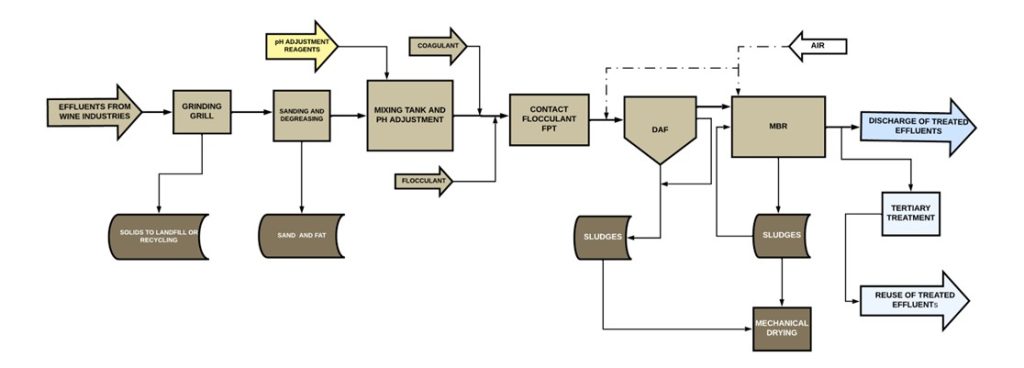
A common process for wastewater treatment in wineries is as follows:
3.1. Primary physical-chemical treatment
First of all, a physical separation of the larger contaminants is carried out, for this purpose:
- Screens or sieves, which retain coarse solids (grape debris, leaves, stems, pips). This phase of separation of solids and liquids is necessary to avoid any risk of clogging the pipes, pumps and other elements of the water treatment system.
- Desander / grease separator, which separates soil, dense solids and fats and oils.
- Homogenization in a regulation tank to adjust pH, while homogenizing flow rates and contaminant load.
- Coagulation-flocculation is a physicochemical process that consists of the controlled addition of coagulants (such as aluminum or iron salts) and flocculants (organic or inorganic polymers) to destabilize and agglomerate the colloidal particles and contaminants present in the wastewater. This treatment favors the formation of larger and denser flocs, which can then be separated by sedimentation or flotation, significantly improving the efficiency of the purification process.
- Dissolved air flotation (DAF), which achieves efficiencies greater than 95% in the removal of suspended solids, oils and grease, and a reduction of COD equal to or greater than 50%.
A dissolved air flotation system takes up less space than a settler and achieves higher yields, since the sludge separated by the DAF reaches a high concentration (3 - 4%) of dry matter, which facilitates its extraction and management.

3.2. Secondary treatment by biological reactor
Depending on the size of the winery and the organic load of the effluents, different technologies can be applied:
Aerobic Systems
In general, winery effluents are poor in nutrients (N,P,K), so salts rich in these elements are usually added:
- Activated sludge: It is a very efficient system since it deals with highly biodegradable effluents, but these reactors occupy a considerable space and sludge production is high.
- Sequential Biological Reactor (SBR): Very suitable for irregular flows, while reducing space by not requiring secondary settling, but its performance is not high.
- Membrane Biological Reactor (MBR): It offers an efficient treatment in the reduction of pollutants, which allows to obtain a high quality effluent, suitable for reuse. This system includes a filtration process by microfiltration or ultrafiltration membranes, which replace the classic secondary decanter with its sludge thickener.
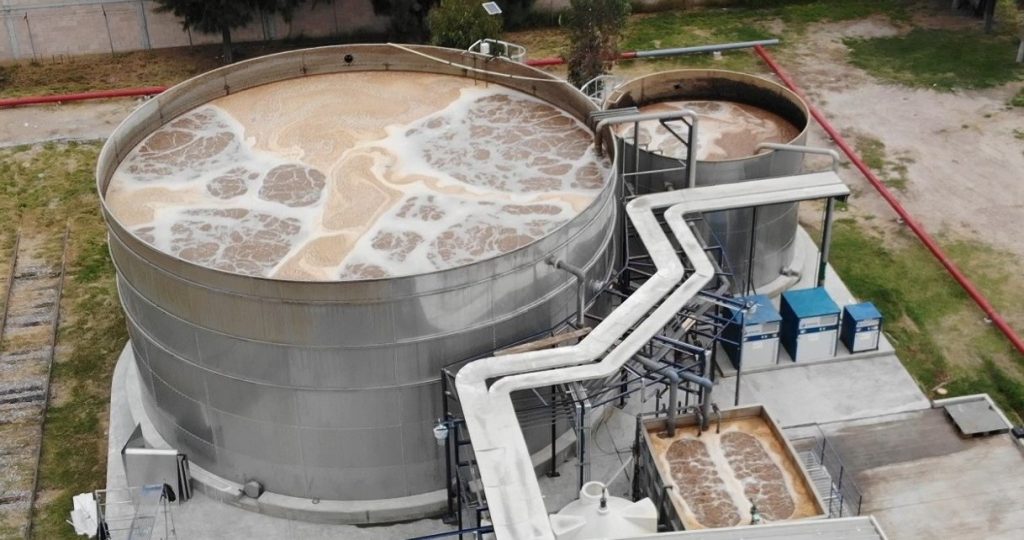
These are the main advantages of a membrane bioreactor:
- Lower volume in the biological reactor.
- Lower sludge production, around 50 - 60% with respect to treatment by low-load activated sludge.
- Improved quality of treated water.
- Compliance with strict environmental standards
Other technologies for secondary treatment
Moving Bed Biological Treatment (MBBR)
These are smaller reactors that achieve high yields. It consists of arranging different fillers (carriers) and purification stages, in which certain bacteria prevail over others in order to optimize biological purification. It will be necessary to install a clarifier for the extraction of the sludge produced.
Anaerobic Systems
Suitable for high organic loads. Although their performance is not very high (70 - 80%) because the water is not hot, they have a number of advantages:
- They require few nutrients (N, P).
- They take up little space.
- They produce hardly any sludge.
- They produce biogas with which energy can be generated.
The most frequent types are: UASB and EGSB.
3.3. Tertiary treatment
If it is desired to reuse the treated effluent, it may be necessary to carry out a tertiary treatment. The most commonly applied techniques are:
- Filtration on sand or other fillers (not necessary in case of MBR)
- Disinfection (UV, O3 or chlorine)
- Desalination by Nanofiltration (NF) or Reverse Osmosis (RO)
Sludge management
The sludge obtained in the physicochemical process reaches high concentrations (approximately 4 % dry matter) and can be valorized as a by-product in some cases.
Sludge generated in MBR (membrane bioreactor) treatment has lower concentrations of solids compared to primary sludge. However, it is possible to mix them together to treat them by means of a mechanical dewatering system, such as a filter press. This process makes it possible to achieve dryness levels of over 30%.
Due to its nature, this sludge can also be used for composting in agriculture.
4. Waste recovery
The wine industry generates significant quantities of by-products rich in bioactive compounds such as tannins, polyphenols, anthocyanins and plant fibers. These compounds, present in residues such as pomace, lees and wastewater, can be recovered through technologies that allow their extraction and valorization, thus contributing to a more sustainable and profitable production. These compounds can be used in the food, cosmetics, pharmaceutical and agricultural sectors.
In addition, it is also possible to reuse treated water for applications such as irrigation, flushing, service water, and even process water.
There are other options for the recovery of waste generated in wineries:
- Biogas production: Organic wastes (lees, sludge, fermentation residues) are highly biodegradable and suitable for anaerobic digestion and biogas generation, which can be used for process heating or electricity generation.
- Composting and agricultural application: Stabilized sludge and separated solids can be composted with pomace and other solid wastes, generating organic fertilizers for vineyards.
- Recovery of valuable compounds: Some processes allow the recovery of natural antioxidants from lees and liquid residues, which are useful in the cosmetic and food industry.
- Other valuable products that deserve special mention are:
| RESIDUE | APPLICATION |
|---|---|
| Tannins | Antioxidants, natural preservatives, tanning, cosmetics and feed additives. |
| Anthocyanins | Natural colorants in food and cosmetics |
| Flavonoids | Anti-inflammatory and nutraceutical supplements |
| Polysaccharides | Food stabilizers and beauty products. |
| Seed oil | Cosmetics and healthy food (rich in linoleic acid) |
5. Summary
The wine industry plays an important economic and nutritional role worldwide. Traditionally associated with European countries, in recent decades a highly competitive global market has emerged, driven by the rise of emerging countries. This growth has been influenced by changes in climate and advances in technical knowledge about harvesting, harvesting and production processes.
This industry is characterized by high water consumption, especially in the vinification and cleaning stages. As a result, it generates discharges with a high organic load (high COD) and a wide variety of pollutants, ranging from residues of cleaning products and phytosanitary products to residual sugars and tannins.
Conventional treatments often face difficulties in adapting to the seasonality, variability and instability of these effluents. In this context, the need arises to optimize production processes to minimize both the volume and the pollutant load of discharges. Likewise, segregation of more concentrated streams can facilitate their subsequent valorization.
The wine industry generates significant volumes of wastewater, mainly from equipment washing, fermentation, winemaking and facility cleaning. Proper management and valorization of these effluents not only reduces environmental impact and complies with current regulations, but also enables the recovery of valuable resources such as water, energy and by-products.
The adoption of sustainable strategies and advanced treatment technologies not only contributes to mitigating environmental impact, but also represents an opportunity for innovation and profitability. The transition to a circular economy model in the wine industry is technically and economically feasible, and is emerging as a key factor in maintaining its competitiveness in an increasingly environmentally demanding environment.
Bibliography and consultations
- Codorniu Group - Sustainability Report 2023.
- OIV (International Organisation of Vine and Wine) - Technical Manual on Sustainability.
- Ministerio para la Transición Ecológica - Guía de buenas prácticas ambientales en bodegas.
- Treatment and valorization of agro-industrial effluents.
- Water Engineering Journal, Vol. 29, No. 4, 2024.
Are you interested in this solution?
BASIC INFORMATION CLAUSE
DATA CONTROLLER: SIGMADAF CLARIFIERS, S.L. PURPOSE: To respond to the user’s request. LEGAL BASIS: Consent of the data subject. DISCLOSURES: No disclosures are anticipated, except where required by law or court order. RIGHTS: Access, rectification, erasure, objection, restriction, data portability, and withdrawal of consent. If you believe that the processing of your data does not comply with the regulations, you may contact the Supervisory Authority (www.aepd.es). ADDITIONAL INFORMATION: For more information, please see our privacy policy.