
Treatment of complex effluents by DAF and tangential filtration

1. Introduction
The purpose of wastewater treatment technologies is to separate those elements or compounds that contribute undesirable pollutants to the environment.
Although there are multiple technologies to treat wastewater (physicochemical, biological, oxidation, filtration, etc.), we will focus on those aimed at recovering the most valuable compounds, or separating those that are problematic due to their toxicity, low biodegradability, density, viscosity, extreme temperatures or pH.
Many wastewater treatment techniques are discarded due to their inefficiency in treating certain pollutants such as solvents, oils and greases, hydrocarbons, extremely acidic or alkaline discharges, effluents with high or low temperatures, etc.
On the other hand, there are other factors such as expected separation performance, energy consumption, water reuse, or resource recovery, which determine whether or not a technology is suitable for the solution to be implemented.
Two technologies offer excellent performance for handling a wide variety of contaminants:
- Dissolved Air Flotation (DAF)
- Separation by tangential filtration
These are two very different technologies that have applications for the treatment of a wide variety of effluents.
2. DAF and tangential filtration
These technologies are compatible for the treatment of some complex effluents, and their application, separately or in combination, will depend on the type and concentration of the pollutants to be separated and the desired treatment performance.
Dissolved air flotation (DAF) is a physicochemical process for wastewater clarification, which is highly efficient for treating discharges with suspended matter in general, and is particularly effective with those compounds that have low densities. This technology separates suspended matter and colloids contained in the effluent, which have been previously flocculated.
The process consists of injecting pressurized air into a part of the clarified water, which is recirculated and pressurized in a tank. This water is mixed with the effluent that enters the float, generating a dragging of the pollutants that are in suspension. When the injected air is depressurized, in the form of microbubbles of about 50 µm in size, it adheres to the flocculated particles and causes them to rise to the surface, where a supernatant mantle is formed and removed by a sweeper or a skimmer.
Effluent DAF Flotation Scheme

DAF systems are a common technology in industrial and municipal effluent treatment plants. It is used to remove suspended solids, oils and greases, and many other pollutants present in industrial wastewater (chemical, food, oil and gas, etc.).
In some applications, dissolved air flotation can be used to recover valuable products from some effluents, such as oils or proteins, given its low chemical affectation and the high concentration of the separated sludge (4 - 6 %).
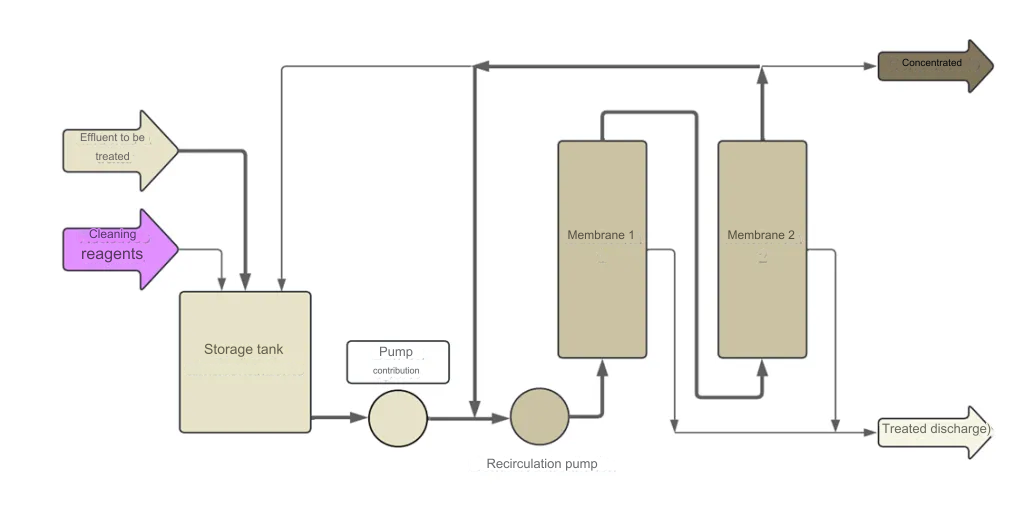
Tangential filtration is a physical process in which the feed fluid flows parallel to the surface of a membrane. In this process, insoluble solids, colloids, emulsions, molecules and ions present in the fluid are separated from the fluid, flowing at high velocity, which alleviates fouling of the membranes. This is a clear advantage over the frontal filtration process, which is much more sensitive to fouling and clogging.
There are three types of membranes used in tangential filtration systems:
- Spiral wound membranes that are wound around a central perforated manifold, forming spiral filtration modules. They are used in the dairy, food and pharmaceutical industries for clarification, concentration and purification of valuable ingredients.
- Hollow fiber membranes. They have a unique structure that allows easier control of flow and rejection during production and cleaning. They are used for ultrafiltration and microfiltration filtration.
- Tubular membranes. They consist of cylindrical shells containing a variable number of hollow fibers. The lateral flow of permeate occurs through the walls, while the concentrate is recovered at the end opposite the feed. ,
Ceramic membranes
It is a very efficient technology for the removal of oils, greases and micropollutants in general.
These membranes are characterized by their high hydrophilicity, attracting water and rejecting oil. This behavior offers excellent results in the filtration process, obtaining high quality treated water. It is a robust and compact technology, which produces water that can be reused directly, or treated again with reverse osmosis if it is desired to eliminate dissolved salts.
Permeate fluxes are significantly higher than those obtained with polymeric membranes, which are hydrophobic in nature. Also noteworthy is the high mechanical, thermal and chemical resistance of the ceramic material, which allows it to operate under extreme pH and temperature conditions (for example, in the treatment of degreasing baths). These characteristics also allow the application of cleaning protocols that obtain a more efficient regeneration.
Operability is measured by cycles (discontinuous regime), since the membranes become dirty and, every predetermined time, a chemical washing must be performed, which usually uses very aggressive reagents to restore the operating conditions of the system. In addition, since it is a tangential filtration system, it must work at very high recirculation flow rates to avoid clogging, which entails costly and energy-intensive installations.
Ceramic membranes are mainly made of tabular alumina (αAl 2O3) and silicon carbide (SiC), always at high sintering temperatures (1,800-2,000ºC). Although there are also flat membrane models for specific applications, these membranes are usually tubular in shape.
Ceramic membranes can be supplied in different configurations depending on the number of channels passing through them. Thus, for loaded or more viscous effluents, membranes with larger channels and fewer channels are usually used, while for more fluid and less loaded effluents, membranes with more channels and smaller size are used. Membranes with more channels have a larger equivalent filtration surface.
In order to guarantee a correct design of the installation, it is advisable to carry out tests or pilot tests with the liquid to be treated.
The membrane assembly is housed inside stainless steel housings with seals made of elastomers suitable for the medium and cleaning (usually viton or PTFE).
Ceramic Membrane Applications:
- Municipal Wastewater Treatment. Ceramic membranes are used for the filtration of suspended solids, bacteria and viruses in municipal wastewater. They are also applied in the removal of nutrients such as nitrogen and phosphorus.
- Industrial Wastewater Treatment. Ceramic membranes are used to treat complex industrial effluents, such as those generated by the chemical, pharmaceutical and food industries.
- They are useful for separating contaminants and recovering valuable products.
- Water Reuse. Ceramic membranes allow the safe reuse of treated water for irrigation and industrial processes.
Tangential effluent filtration scheme
3. Comparison of both technologies
Considering that we are dealing with a complex effluent, which offers significant difficulties to be treated by conventional physicochemical or biological procedures, we proceed to compare the performance and viability of DAF systems versus ceramic filtration.
DAF Flotation
Dissolved air flotation (DAF) offers the following advantages:
- Continuous process. Purging and separation of decanted and floating material is done simultaneously with the operation.
- High separation of oils and greases, and low density compounds such as solvents and hydrocarbons.
- High DM concentration in the separated sludge, since flots are separated and water entrainment is small. This high concentration facilitates the recovery of valuable products. If a subsequent evaporation or crystallization system is required, the cost and size of such an installation will be much lower.
- Low energy cost. The only significant consumptions are those of the recirculation pump and the compressor for air pressurization, but the flow to saturate is reduced (approx. 1/10 of the Q input).
- High operating loads and upward velocities, allowing operation with very high wastewater flow rates in a small space.
- Moderate installation and maintenance costs, especially when compared to ceramic membrane filtration technology.
As disadvantages, compared to the treatment with ceramic membranes, the following stand out:
- Moderate purification performances. Dissolved air flotation is considered as a primary treatment, while ceramic membranes are considered as a final treatment. The separation rate of a DAF system can be over 90%, while membranes easily exceed 99%.
- Sizes of escaping suspended solids. They will be variable and poorly controlled in a DAF system. It is not possible to speak of a cut-off size, as this is only attributable to a physical process of filtration at different levels. However, with a correct prior coagulation / flocculation system, a reduced SS leakage will be obtained which, depending on the customer's requirements, may be sufficient.
Ceramic Membranes
The main advantages of ceramic membranes are the following:
- Thermal stability. They can withstand high temperatures.
- Chemical compatibility. They are resistant to aggressive media.
- Mechanical resistance. They are made of ceramic materials such as corundum, so they have a high hardness and mechanical strength, which guarantee a long service life.
- High quality of treated water. This type of membranes allows to obtain high qualities of treated water, which allows, in many cases, its reuse or exploitation.
- Configuration. Ceramic membranes can have selective, intermediate and support layers, which allow different degrees of filtration.
As disadvantages, we should mention:
- Fragility. They have low resistance to thermal and mechanical shocks.
- High initial investment cost.
- High replacement cost. Ceramic membranes are relatively expensive, although they have a very long service life, so they do not need to be replaced frequently.
- High energy cost. The recirculation pumps of these membranes work with very high flow rates, which entails high energy consumption.
- Discontinuous operation. Membranes operate by fouling and cleaning cycles, which requires intermediate tanks and oversizing to allow continuity, or a stand-by line.
Comparative table of yields and benefits
| Process | Operation | SS separation (%) | Degree of separation (µm) | Water Q recovery (%) |
|---|---|---|---|---|
| DAF | Continuo | ≥ 90 | Approx. 100 | ≥99 |
| Ceramic tangential filtration | Discontinuous | ≥ 99 | ≤0,1 | ≥90 |
Comparative table of costs and consumption
| Process | Cost of installation | Reagent consumption | Energy consumption (kW/m3) | Flow range (m3/h) (*) |
|---|---|---|---|---|
| DAF | 1 | Coagulants + flocculants | ≤ 0,3 | 1 - 100 |
| Ceramic tangential filtration | 10 | Cleaning agents | ≤ 3 | 0,1 - 1 |
4. Summary
As a comparative basis between processes we can summarize that, while the tangential filtration is based on membranes to separate particles from the fluid, the DAF uses air microbubbles to separate particles suspended in the water.
These are two different processes that can be applied to complex effluents, such as oils, greases, hydrocarbons, solvents and highly toxic effluents, and can also be used to recover valuable materials in the pharmaceutical and precious metals industries, among others.
As can be seen from the above information, the two solutions have very different installation and operating costs, as do the degrees of efficiency they are capable of achieving.
In certain cases, a primary DAF flotation stage can be used, followed by an ultrafiltration system with tangential membranes, in order to combine the advantages of both technologies.
Bibliography and consultations
http://www.membranesamta.org/amta_media/pdfs/MFUF.pdf, junio 2006
AMERICAN MEMBRANE TECHNOLOGY ASSOCIATION.
DAF in Wastewater Treatment: Understanding its Importance and Operation | Instituto del Agua
Are you interested in this solution?
BASIC INFORMATION CLAUSE
DATA CONTROLLER: SIGMADAF CLARIFIERS, S.L. PURPOSE: To respond to the user’s request. LEGAL BASIS: Consent of the data subject. DISCLOSURES: No disclosures are anticipated, except where required by law or court order. RIGHTS: Access, rectification, erasure, objection, restriction, data portability, and withdrawal of consent. If you believe that the processing of your data does not comply with the regulations, you may contact the Supervisory Authority (www.aepd.es). ADDITIONAL INFORMATION: For more information, please see our privacy policy.