
Wastewater treatment and by-products recovery in seafood processing

1. Composition of wastewater from the fish and seafood industry
The fish and seafood production process is not uniform and varies substantially depending on the final product to be marketed. The most common processes are the following:
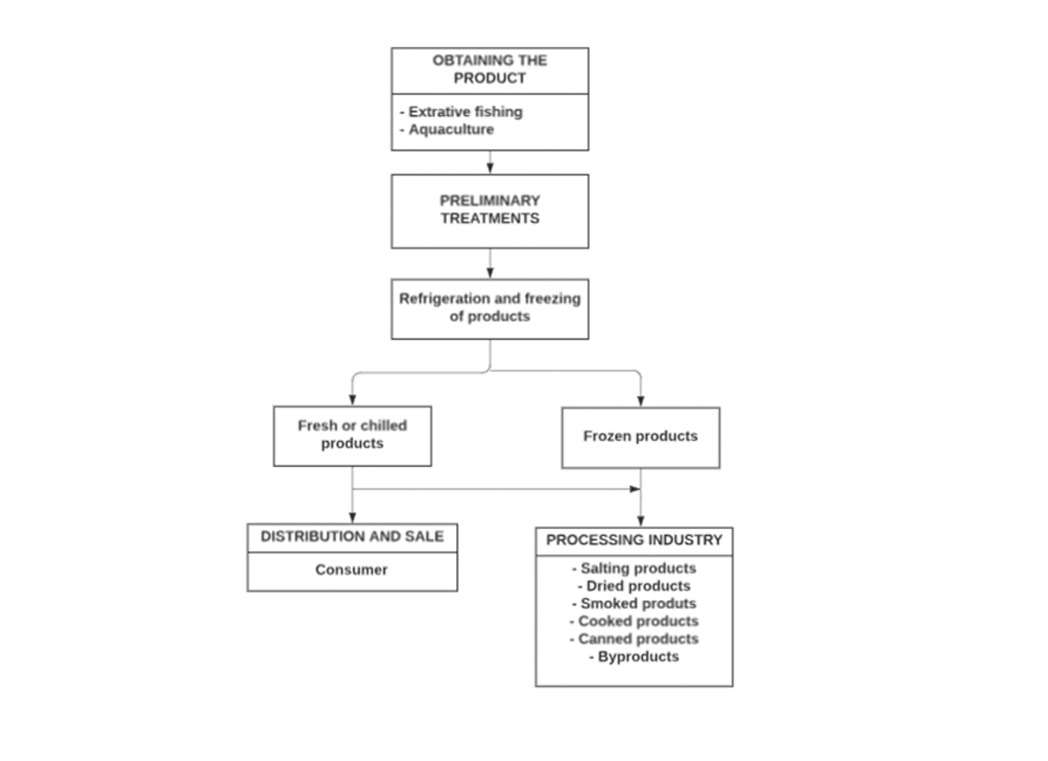
Each of these stages generates a certain type of wastewater, so the characteristics of the effluents produced in the fish and seafood industry vary greatly depending on the final product and the processes to which it has been subjected.
Fish destined for distribution and consumption will only undergo treatment consisting of washing, cleaning, storage and refrigeration processes. The effluent obtained is an effluent containing water, blood and residual fish solids.
In the case of processed products such as canned, salted, smoked, etc., the effluents will be rich in COD, COD, SS and oils and fats, in addition to containing the compounds used in their processing and preservation.
Effluents generated during the cleaning of industrial facilities, which contain suspended particles, oils and grease, in addition to the chemicals used in the cleaning process, should also be considered.
Wastewater from this industry can be characterized by its physicochemical, organic, nitrogen and phosphorus content parameters. The main variables to evaluate the level of contamination are:
- Biochemical Oxygen Demand (BOD5)
- Chemical oxygen demand (COD)
- Total suspended solids (TSS)
- Fats and oils
- pH.
The following table shows the usual ranges of contamination of wastewater generated in the production of fish and shellfish:
| pH | COD (mg/l) | BOD5 (mg/l) | TSS (mg/l) | Ac. and Fats (mg/l) |
|---|---|---|---|---|
| 5,5 - 9 | 2000 - 5000 | 800 - 2500 | 700 - 2000 | 100 - 1000 |
Despite their variability, it is evident that they are discharges with high loads of TSS, oils, grease, and biodegradable organic matter, which far exceed the limits established by wastewater regulations.
The oils and fats present in these effluents, which are the product of fish processing, tend to float on the surface, affecting the transfer of oxygen to the water. Nitrogen and phosphorus are nutrients that can cause algae blooms and affect aquatic life if their presence exceeds permitted limits.
The fish and seafood industry consumes a high volume of water, so it is essential to ensure that the treatments implemented are sufficient to comply with the discharge limits, and even to reuse part of the water in different processes and operations of the industrial factories themselves.
Wastewater treatment and by-product recovery in the seafood industry.
Wastewater generated in the fish and seafood industry is a rich source of a wide variety of chemical compounds of industrial interest, so its treatment pursues a dual objective:
- Separate pollutants that can have a negative impact on marine ecosystems.
- To recover some valuable resources present in the water such as oil, fat and certain types of solids, which will later be converted into fishmeal and other by-products.
Effluent pretreatment is essential for the subsequent recovery of these by-products. The most widely used technologies for this pretreatment phase are screening and dissolved air flotation, which can separate more than 90% of the solids and oils present.
The extracted proteins are subsequently concentrated by a variety of methods, the most common being ultrafiltration and vacuum evaporation.
Additionally, there are other technologies, such as membrane bioreactors, which in combination with other processes, allow the recovery of these by-products, while improving the nutritional, functional and biological qualities of the protein concentrates present in the wastewater, facilitating their reuse in the food, agrochemical and pharmaceutical industries.

A wastewater treatment plant for the seafood industry usually includes the following processes:
- Screening
- DAF System
- Aerobic activated sludge biological reactor, or MBR system
- Ultrafiltration, or vacuum evaporator
Dissolved air flotation (DAF) is an efficient wastewater clarification process. A DAF system efficiently separates suspended solids, oil, grease and other contaminants present in wastewater effluents. The solids adhere to microbubbles of blown air, and rise to the surface, where they float to form a sludge, which is removed from the equipment by mechanical sweeping systems.
After pretreatment by DAF, a significant part of the COD remains in solution in the wastewater and, at this point, it is difficult to treat it by physicochemical means. Neither is it convenient to apply directly a treatment by means of Micro and Ultrafiltration membranes, since only the largest molecules can be separated, and in addition the membranes can clog quickly due to the residual pollutant loads.
To treat the usual organic loads at this stage of the process and, based on the high biodegradability usually detected in these effluents, aerobic biological treatment using activated sludge is recommended. In this way, the organic matter molecules are oxidized, obtaining a high BOD reduction (approx. 90 %).
As is well known, the biological activated sludge process requires subsequent clarification, with recirculation of fresh sludge to the oxidation tank to maintain a balance in the system. Part of the recirculated sludge is removed as excess sludge for dewatering and disposal.
The concentration process of these sludges will be more costly the larger the volume of water to be dewatered, so DAF flotation is imposed over secondary sedimentation, since it offers a higher performance working at high loads, with the consequent smaller occupied space, and a substantial increase (4 or 5 times higher) of concentration in the separated sludge.
On the other hand, by obtaining water with a very low content of suspended solids and residual oils, it can be subjected to an ultrafiltration process for reuse.
Ultrafiltration is a membrane filtration process that removes suspended solids, bacteria and viruses. It also produces high quality water with low sediment density.
The ultrafiltered water can be reused, or if necessary due to the requirements of its application point, it can be subjected to additional purification by means of nanofiltration or reverse osmosis membranes.
Wastewater treatment with MBR
MBR systems are an excellent alternative to activated sludge systems, combining the biological degradation process with solid/liquid separation by membrane filtration. Membrane bioreactors offer excellent performance for the treatment of wastewater generated in fish and seafood production.
In many cases, depending on the available space and pollutant loads, the installation of an MBR system is the most efficient and cost-effective solution.
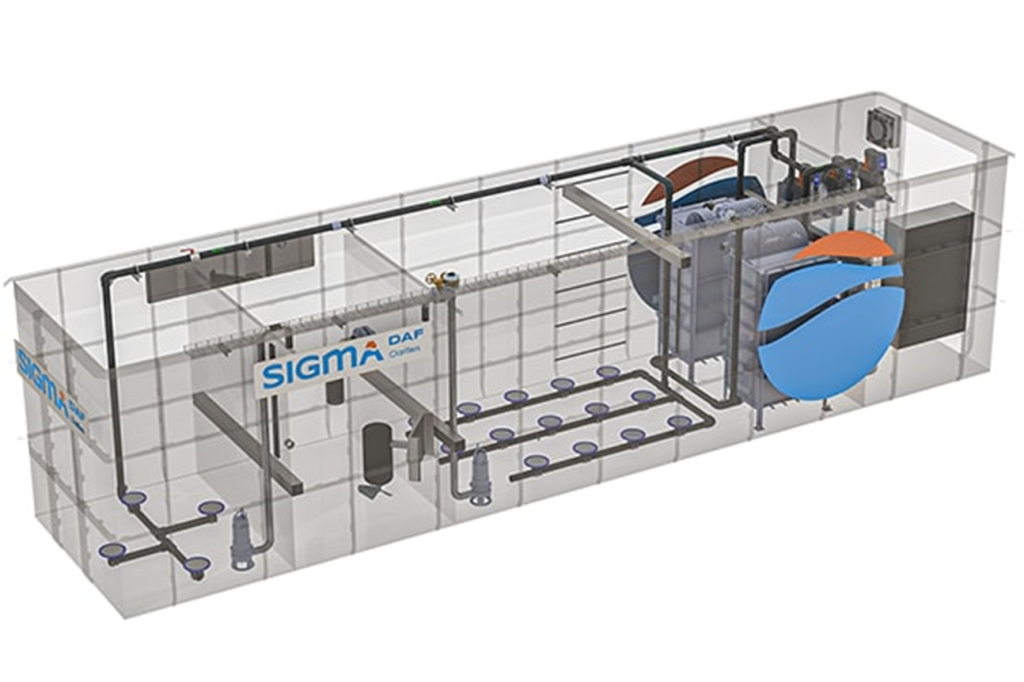
An MBR system consists of an aerobic bioreactor with aeration equipment and an ultrafiltration (UF) skid through which the biomass is recirculated.
Because the biomass is completely retained in the membrane and reintroduced into the reactor, very high concentrations are achieved in the reactor (5 times higher than in conventional systems). This is due to short residence times, extraordinary degradation capacity, minimal space requirements and outstanding permeate quality.
Another advantage of the higher biomass concentration is the possibility to buffer the impacts of the pollutant load without damaging it. Brief fluctuations of up to 10 g/l BOD at the reactor inlet have hardly any influence on the biomass concentration. This buffering capacity ensures a uniform permeate quality.
In an MBR system it is possible to reach 200 mg O2/l/h oxygenation rate, a value much higher than that obtained in conventional reactors. Thanks to the total suspension of the microorganisms (no floc formation) a large surface area is obtained, which allows the oxygen flowing in the medium to be absorbed by the microorganisms directly by the shortest route. This fact allows the bacteria a high metabolic rate.
Combination of DAF and MBR for wastewater treatment in seafood production
A complete treatment line to treat discharges from a fishing industry could be composed of a primary treatment by dissolved air flotation, and an MBR that could be considered as secondary + tertiary treatment. The water thus obtained can be reused in many processes of the industry itself, being also prepared to be purified by refining processes such as nanofiltration/reverse osmosis, or ion exchange.
As mentioned above, the wastewater is first screened, degreased and clarified by means of a DAF float.
From here the water enters the reactor, previously passing through the anoxic denitrification zone, if necessary, where the oxygenation of the organic substances is carried out through the introduction of air.
The mixing of the reactor volume is achieved by the aeration system. Of particular importance at this stage is the formation of small bubbles that are mixed with all the wastewater to be treated. In a submerged membrane system, the circulation of the reactor volume is carried out continuously through the membrane chamber (tank) attached to the aeration reactor, in which the ultrafiltration membranes are directly introduced into the biomass.
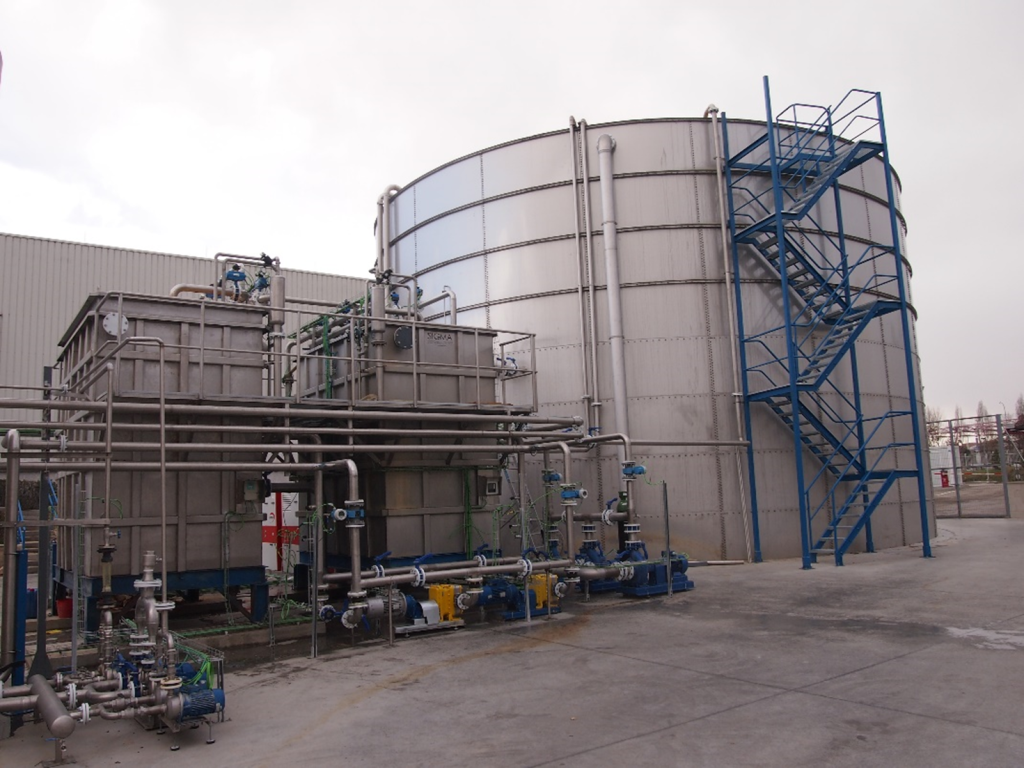
Membrane suction occurs with minimal energy input from a self-priming centrifugal pump. This separates the treated and purified biomass from the high molecular weight organic substances not yet degraded.
The purified water, consisting of water, salts and low molecular weight non-biodegradable substances, leaves the system as permeate through the inner part of the membranes by applying a vacuum. On the other hand, the sludge (biomass from the ultrafiltration tank) is reintroduced into the denitrification stage and the bioreactor.
At Sigmadaf we use both hollow fiber UF membranes with free top heads and newly designed parallel flat membranes, which are vertically immersed in the membrane container inside the biomass.
Air is blown from the bottom of the membranes into the vessel, which creates an overpressure of the medium in the membrane, while keeping the biomass in motion to prevent the formation of a clogging layer.
A pump continuously extracts the treated water (permeate) from inside the membrane.
The membrane surface can be cleaned, if necessary, in regular short cycles by rinsing the permeate return. This minimizes costly and time-consuming chemical cleaning and ensures a uniform flux. The advantageous modular construction of the membranes allows a very high assembly density.
The MBR process can be controlled so that the production of excess sludge can be reduced to 0.05 - 0.1 kg/kg BOD removed (values of 1-3 are normal in the conventional process).
A diagram of the described process is shown below.

Analytical analysis carried out on wastewater from the fishing industry, using an effluent treatment line with DAF and MBR.
| Concept | BOD5 (mg/l) 2050 40 98 | COD (mg/l) | TSS (mg/l) | Oils and Fats (mg/l) | pH |
|---|---|---|---|---|---|
| Raw Water | 2050 | 4275 | 1850 | 942 | 5,5 |
| Treated water | 40 | 128 | 9,3 | 41 | 6,5 |
| % Reduction | 98 | 97 | 99,5 | 95,6 |
4. Conclusion
Fish and seafood production is one of the pillars of the global food industry. From the capture of fish, shellfish and other marine animals, numerous products and by-products of growing consumption are processed. however, water consumption is high, as are the pollutants contained in the wastewater generated in its processes.
The treatment lines for these wastewaters are basically composed of a primary treatment with the inclusion of a DAF float, followed by an aerobic biological process and a UF membrane system with recirculation and sludge removal (MBR).
SIGMADAF's MBR system is an ideal solution for the treatment of wastewater from the fishing industry. It is a compact technology that requires little space for its implementation and operates with high efficiency, reducing installation and energy costs.
The reuse of part of the wastewater constitutes in itself a profitable wastewater treatment process. In addition, the recovery of proteins, fats and other by-products contained in the waste is a viable option, since these have a high content of proteins, oils and minerals of high commercial and nutritional value.
The use of waste effluents from the fishing industry as a source of bioactive compounds can help preserve other species or conventional sources and contribute to food security. In this way, the added value of the waste is increased and its environmental impact is minimized. The objective is to foster a culture of sustainable development, which at the same time will contribute to better wastewater treatment and reduce the costs involved.
Bibliography and consultations
Membrane bioreactor: process steps, advantages and comparison with conventional systems | iAgua
espesca.com/fisheries-industry
https://es.scribd.com/presentation/92333892/La-Industria-Pesquera-02-1
Are you interested in this solution?
BASIC INFORMATION CLAUSE
DATA CONTROLLER: SIGMADAF CLARIFIERS, S.L. PURPOSE: To respond to the user’s request. LEGAL BASIS: Consent of the data subject. DISCLOSURES: No disclosures are anticipated, except where required by law or court order. RIGHTS: Access, rectification, erasure, objection, restriction, data portability, and withdrawal of consent. If you believe that the processing of your data does not comply with the regulations, you may contact the Supervisory Authority (www.aepd.es). ADDITIONAL INFORMATION: For more information, please see our privacy policy.