
Sludge thickening systems for water treatment plants (DWTP)

- 1. The need for sludge reduction in a DWTP
- 2. DAF application for sludge thickening in DWTP.
- 3. SIGMALAB laboratory tests.
- 4. Piloting with SIGMADAF equipment.
- 5. Conclusions.
1. Sludge reduction at a drinking water treatment plant (DWTP)
The wastewater discharged by a DWTP (Drinking Water Treatment Plant) into the sewage system originates in the sludge treatment line, especially in the thickening, drying and dewatering stages.
Optimizing the efficiency of sludge thickening in a DWTP can reduce the volume of effluent by more than 50%.
In the case we are going to analyze, the operator of the DWTP is looking for a technical solution to reduce the pollutant load of the discharges to the sewage network and minimize their volume.
A sludge separation process is proposed using dissolved air flotation (DAF) with minimal addition of flocculant, which must be a starch-based product suitable for human consumption.
To test this process, we provide a laboratory pre-testing service and an industrial pilot test to demonstrate the effectiveness of one of our DAF systems for the treatment of sludge from the DWTP.
2. Dissolved air flotation systems for sludge thickening in DWTPs
DAF systems used for biosludge thickening include inclined plates and a specially designed scraper.
Our DAF systems achieve a sludge thickening with a dry matter content 3 to 4 times higher than that obtained by conventional systems.
These are the advantages that our DAF systems offer for sludge thickening:
- Increased thickening efficiency: a very high dry matter concentration of the dewatered sludge is achieved.
- The separation of the solid phase is very fast.
- DAF systems require less space than gravity or conventional thickeners.
3. SIGMALAB laboratory tests
The sludge sample is received from the DWTP. It is a sludge already flocculated, coming from the physicochemical treatment of the water line.
The customer wants to minimize the discharge of water from its sludge line to the sewage system. Let's remember that this sludge comes mainly from the thickening stage.
Therefore, a double objective is sought:
- To obtain the highest possible concentration of thickened sludge.
- Return as much clarified water as possible to the water line for further purification.
In order to establish the dose of starch-based flocculant, laboratory tests are carried out simulating the DAF flocculation and clarification process:
- Flocculation tests in a laboratory Jar-Test equipment.
- Flotation tests by microbubble injection to establish the flotation viability of the floc formed.
The flocculant used is a natural starch-based anionic polymer. This is the same polymer already used in the ETAP water line, which is approved for human consumption.
The flocculant is dosed on a portion of the wastewater sample and the behavior of the solids is observed. The following figure shows the formation of floccules for each of the doses tested for safe re-injection into the process.
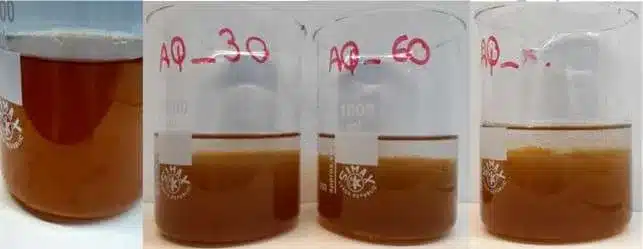
If no flocculant is applied, sedimentation is extremely slow. In the tests where flocculant is applied, it is observed that, as a greater quantity of polymer is dosed, the flocs form a spongy and more expanded structure.
The elimination of total suspended solids in the clarified product is practically the same, regardless of the dose of polymer used, being above 99%.
In terms of COD, there is a clear trend that as more polymer is dosed, the COD in the clarified product increases:
- At 30 ppm, 96.3% of COD is removed.
- At 60 ppm, 88.9% of the COD is eliminated.
- At 144 ppm, 74.1% of COD is removed.
This indicates that we are dosing in excess when we exceed 30 ppm of flocculant, i.e., part of the flocculant, which is the one that does not act on TSS, is being transferred to the liquid phase. Modified starch contributes COD so it is not recommended to use doses higher than 30 ppm of polymer.
The optimum dosage under laboratory conditions is 30 ppm of polymer. This dosage will be adjusted during industrial piloting and commissioning of industrial equipment.
It is observed that the floc presents a high flotation capacity and remains cohesive when air saturated with microbubbles is injected. The clarified product is totally transparent, with a turbidity of less than 10 NTU.

4. Piloting with SIGMADAF equipment
Once the feasibility of the physicochemical process has been demonstrated in the laboratory, a pilot test is carried out at the DWTP to validate the process on an industrial scale. The pilot test is carried out with a SIGMA DAF COMPACT.
SIGMADAF supplies a compact dissolved air flotation system, including all necessary components:
- The flocculator.
- The polyelectrolyte preparation tank.
- Pumps and control probes.
- Dissolved air flotation equipment.
Installation and commissioning is carried out, which includes:
- Tuning of the air saturation system.
- Adjustment of flow rates.
- Tests with and without polyelectrolyte.
- Optimization of the equipment for the sludge conditions of the DWTP.
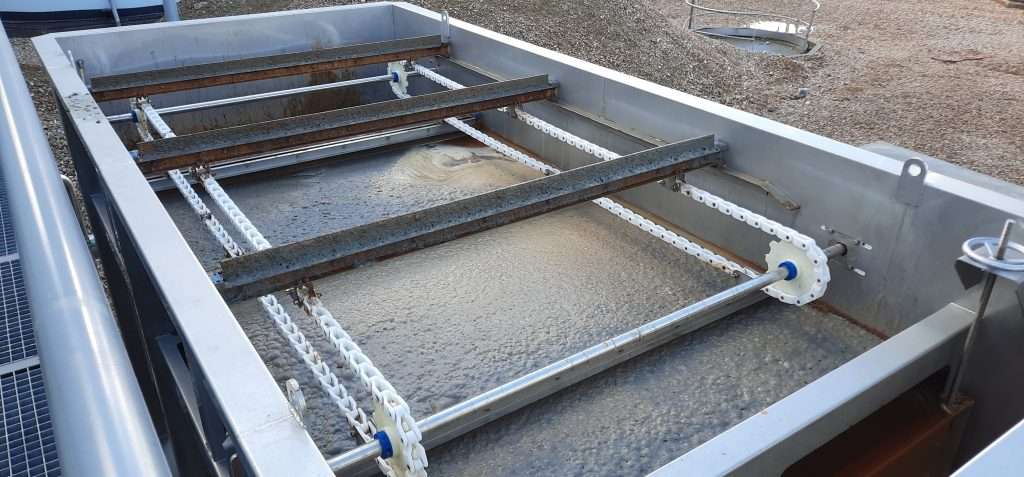
Without the addition of flocculant, the clarified sludge does not look good because it retains suspended solids, its turbidity is higher than 20 NTU, and the sludge does not cohere properly.
With doses of 30 ppm of polymer (similar to the optimal laboratory dose) a significant improvement in clarification is observed, with turbidity values below 5 NTU.
The dosage is further adjusted and the optimum range is determined to be between 35 and 45 ppm polymer (variable depending on slight variations in the inlet sludge). Samples of the concentrated sludge are taken for analysis.
The sludge thickened in the DAF system is much darker in color than the sludge from the DWTP, as it is denser and more compact. The turbidity of the clarified sludge, which is the water to be returned to the plant, is 3.99 NTU.
- The concentration of TSS in the sludge from the DWTP is 0.475 g/L.
- The TSS concentration in the thickened sludge in the DAF equipment is 17.8 g/L, when using between 35 and 45 ppm of starch polymer.
- The daily volume of concentrated sludge generated is reduced by more than 96%. This means that the amount of water that can be returned to the water line will be much greater and the flow discharged to the sewage system will be less.
5. Conclusions
The data obtained show that thickening the sludge in the water line by means of DAF flotation is an optimal solution, since it drastically reduces discharges to the sewage system and produces a clarified product that can be returned to the water line, since its turbidity is minimal.
The results indicate that the volume of clarified water exceeds 96% of the volume of sludge produced in the physicochemical treatment of the water line.
Under these conditions, discharge to the sewage system will be reduced by the same percentages and only discharges from the thickened sludge dewatering stage will occur.
Are you interested in this solution?
BASIC INFORMATION CLAUSE
DATA CONTROLLER: SIGMADAF CLARIFIERS, S.L. PURPOSE: To respond to the user’s request. LEGAL BASIS: Consent of the data subject. DISCLOSURES: No disclosures are anticipated, except where required by law or court order. RIGHTS: Access, rectification, erasure, objection, restriction, data portability, and withdrawal of consent. If you believe that the processing of your data does not comply with the regulations, you may contact the Supervisory Authority (www.aepd.es). ADDITIONAL INFORMATION: For more information, please see our privacy policy.