
Effluent treatment in cardboard packaging production

- 1. Wastewater in the production of packaging and cartonboard boxes
- 2. Application of dissolved air flotation systems in the cartonboard packaging industry.
- 3. Successful case
- 4. Pilot plant for the flooring and floor covering industry.
1. Wastewater in the production of packaging and cartonboard boxes
The effluents generated in the production of packaging and cardboard boxes are different from those generated in other activities in the paper and similar sectors. They can be summarized as follows:
- Lower volumes of water to be treated than in paper mills in general.
- Contaminant loads of variable nature and high concentration.
- Presence of toxic components such as inks, glues, solvents, etcetera.
Production plants produce wastewater flows that usually do not exceed 200 m3 per day, so it is common to apply batch treatments.
A batch process is carried out in the following phases:
- 1. reactor filling
- 2. dosing of reagents (if applicable) and mixing
- 3. sludge sedimentation
- 4. decanting
- 5. extraction of the clarified phase
- 6. extraction of settled sludge
If the water is treated continuously for 24 hours, a homogenization tank must be incorporated with the capacity to store the volume of water emitted while the process is in phases that do not admit the introduction of this volume of water.
One of the major difficulties of a batch process is to determine the appropriate duration of each phase and cycle, especially the decanting and extraction phases. The risks associated with a classical batch process can be summarized as follows:
Qualified operators are required to run this type of plant. The essential tasks are the adjustment of chemical doses, the timing of each phase and the control of effluent clarification and sludge purging.
Risks of errors in the batches, both in the time of each phase and in the dosing of reagents.
Long reaction times. In order to ensure adequate operation, there is a tendency to oversize the time of the critical phases of the cycle, which implies reactors with larger volumes.
Complexity in the control of parameters and adjustment of chemical doses, given the large volumes of the reactors.
Sedimentation or settling problems. Even with adequate flocculation and clarification quality, it is not guaranteed that the sedimentation of the sludge will allow the final clarification of the water in all cycles.
Problems with the delimitation and/or calculation of the clarified fraction. Since the volume of clarified water and settled sludge cannot be accurately determined, the position of the clarified drain valves is imprecise. To avoid this problem, floating or tilting extractors associated with turbidity or suspended solids sensors are used, resulting in more sophisticated and expensive systems.
To avoid a wrong chemical selection, poly-formulated or poly-functional reagents are usually used in high doses, which implies high OPEX and risks of chemical residues due to excess in the clarified water.
DAF systems: Efficient alternative to decanting systems
The alternative to traditional batch settling systems are dissolved air flotation (DAF) systems. dissolved air flotation (DAF) systems.. This solution offers a number of advantages, including:
- The main advantage is that DAF clarification equipment has a mechanism that forces the solid-liquid separation by continuous flotation. Thanks to this, the phases of a cycling process and thus the risk of failures disappear. In addition, residence times are shorter and therefore equipment volumes are reduced.
- Adjusting the chemical dosage is simple. A dosage appropriate to the effluent volume is determined and the control system is set up. The reagent dosing system itself then assigns the dosing rate of the dosing pump, ensuring a precise reaction.
- The risks of poor solid-liquid separation are eliminated because the DAF equipment forces the flocs to rise and ensures their separation. In addition, our DAF equipment is equipped with a sediment collection hopper that evacuates settleable solids on a timed basis.
- No special chemical reagents are needed, but common chemicals such as coagulants based on iron and/or aluminum salts and flocculants readily available on the market are applied.

SIGMADAF's dissolved air flotation (DAF) systems simplify treatment plants and take up much less space. They are designed with one homogenization tank, and no further large volume downstream reactors are required.
Another way to increase process reliability is to equip the plant with 2 equalization tanks of equal volume, since one tank treats the design volume, while the other tank collects the additional effluent.
2. Application of dissolved air flotation systems in the cartonboard packaging industry.
Our DAF systems work by means of a continuous saturation system to generate micro bubbles. The principle of air saturation is based on the introduction of an air stream into a water stream. This air stream is introduced at constant pressure at the point of maximum turbulence of the clarified recirculation. From this point the water will be saturated with air. This is achieved under the best conditions at a pressure of 6 bar and an air saturation rate of 10%.
Older systems use large reboilers (saturation vessels) where the recirculation pump must generate turbulence by projecting the water against static mechanical elements. These systems are difficult to manage as they are highly dependent on the water-air balance and the level inside the reboiler.
Our high saturation DAF equipment eliminates the use of a traditional boiler, using the pump itself as the point of maximum turbulence and injecting the air into it. This design has clear technical advantages:
- The equipment is more compact and has fewer mechanical elements.
- Automation of the system is possible.
- The pressure applied for aeration does not exceed 1 bar.
DAF equipment models available
| Product | Applications of decentralized STP | Capacity | Features |
|---|---|---|---|
| FPBC | Drinking water, power plants, MBBR clarifiers, meat industries and slaughterhouses (poultry, swine and cattle), fish processing, mining, petrochemical and paper, among others. | 5 - 175 m3/hr | Countercurrent flow system. Ideal for physical-chemical processes and waters with medium-high pollutant load, easy handling, low maintenance, compact machine, exclusive skimmer system. |
| FPAC | FBR (Biological Flotation Reactors), sludge thickeners, rendering, meat and slaughtering industries (poultry, swine and cattle), food, mining, petrochemical and paper industries, among others. | 5 - 160 m3/hr | Cross flow system. Ideal for pretreatment and very high solids loads. Static thickener, easy operation, low maintenance, exclusive skimmer system. |
| FPHF | Drinking water, FBR (Biological Flotation Reactors), MBBR clarifiers, general industries, textiles, oil refineries, dairy industry and paper industry. | 200 - 1000 m3/hr | Combination of counterflow and crossflow. Ideal for working with large volumes of water, easy handling, low maintenance, compact machine, exclusive skimming system. |
The following are success stories for the treatment of paper, cardboard and similar wastewater with SIGMADAF equipment.
3. Successful case
In this project, carried out in Portugal in 2021, a compact dissolved air flotation system, including the physical-chemical treatment unit, was installed.a compact dissolved air flotation system, including the physical-chemical treatment unit, was installed.
The following data are extracted from both the influent and clarified from the DAF system, as well as from the activated carbon polishing system. The data show the average concentration of contaminants since the steady state of the plant was reached. This plant includes an activated carbon filtration system as a micropollutant purifier.
The performance of the DAF system for TSS removal is 97% and for COD removal is 78%. The COD content still does not meet the discharge limits due to the strict regulations in force, so biological treatment is needed to remove organic contaminants and nutrients.
| Parameter | You | Influential | DAF Clarified | DAF performance | Effluent Activated Carbon |
|---|---|---|---|---|---|
| pH | - | 9,2 | 7,0 | 6,9 | |
| SST | mg/L | 1.495 | 45 | 97% | 34 |
| DOQ | mg/L | 3.688 | 817 | 78% | 673 |
| DBO5 | mg/L | #n/a | #n/a | 149 |
4. Pilot plant for the flooring and floor covering industry.
Effluents from the floor coating industry have many similarities with effluents from the paper and paperboard industry, due to the nature of the solids and particles contained in the liquid effluent matrix. The organic composition, inks and fiber content can be comparable to wastewater generated in the paper and paperboard industry.
This project, which is a pilot plant for a major French floor covering industry, includes a DAF system and a filter press for sludge dewatering. The main results obtained to date are shown below.
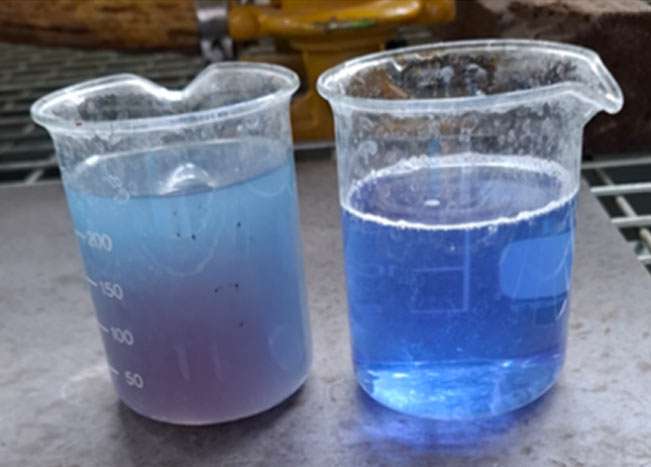
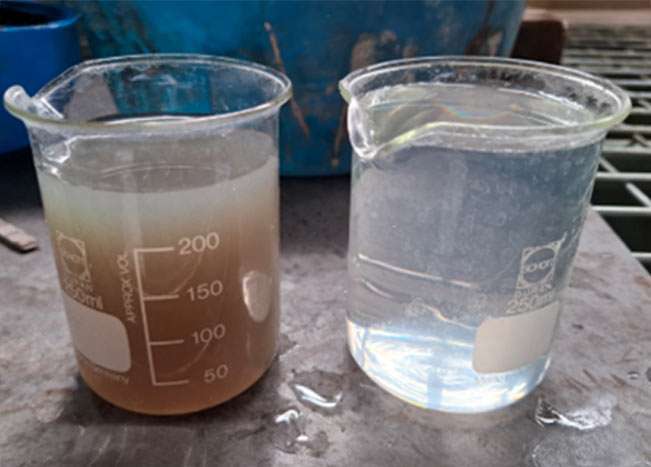
Before and after: Photo 1: 10/09/2024 - Photo 2: 17/09/2024
The following table shows the performance results for the best chemical sequences:
| Parameter | You | Influent | DAF Clarified | DAF performance |
|---|---|---|---|---|
| pH | - | 6,7 | 7,6 | |
| SST | mg/L | 420 | 36 | 92% |
| COD | mg/L | 2.767 | 1130 | 59% |
| DBO5 | mg/L | 420 | 180 | 57% |
- TSS removal is 92 %.
- COD removal is 59 %.
- Elimination of BOD5 is 57 %.
Indicators of organic contaminants (COD and BOD5) are above the statutory discharge limits, so biological treatment is needed to remove organic contaminants and nutrients.
For sludge dewatering, bench-testing of filter presses is carried out with the following results:
- The sludge flocculates effectively with a branched cationic polyelectrolyte, specific for filter presses.
- The flocculated sludge can be treated in a filter press equipped with a pressurized membrane system, obtaining a cake with 10.54% dry matter, easily handled as compact waste.
- The clarified water extracted from the press during dewatering has a turbidity of 138.3 NTU.
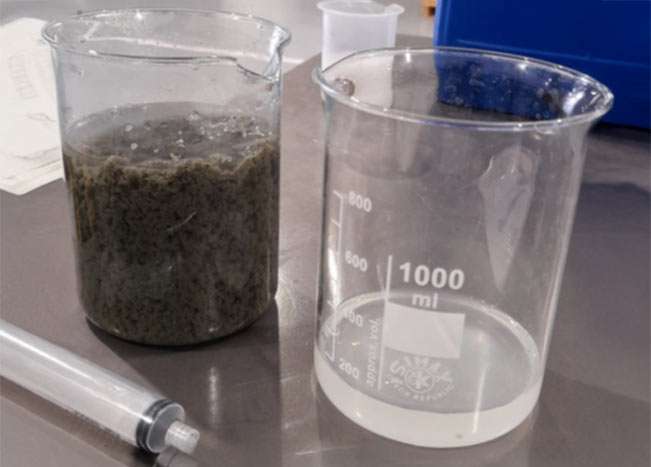
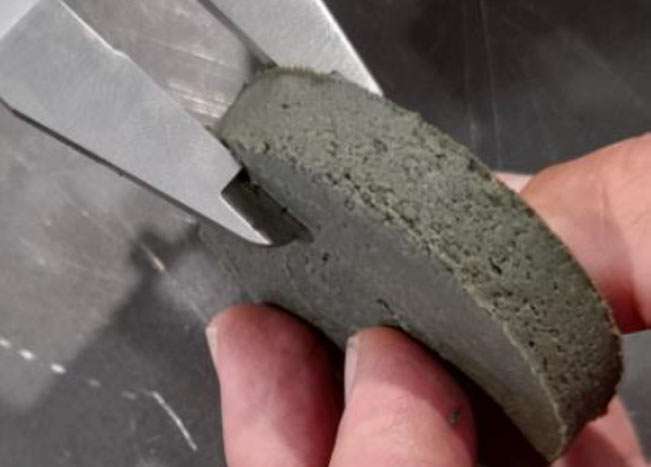
From left to right: flocculated sludge; clarified phase; filter press dewatered sludge cake.
Are you interested in this solution?
BASIC INFORMATION CLAUSE
DATA CONTROLLER: SIGMADAF CLARIFIERS, S.L. PURPOSE: To respond to the user’s request. LEGAL BASIS: Consent of the data subject. DISCLOSURES: No disclosures are anticipated, except where required by law or court order. RIGHTS: Access, rectification, erasure, objection, restriction, data portability, and withdrawal of consent. If you believe that the processing of your data does not comply with the regulations, you may contact the Supervisory Authority (www.aepd.es). ADDITIONAL INFORMATION: For more information, please see our privacy policy.