
Biological wastewater treatment with membranes and moving bed - MBR and MBBR

1. Membrane and Moving Bed Biological Treatment - MBR and MBBR
Industrial wastewater treatment requires sophisticated methods and processes that can be adapted to each specific discharge.
Unlike the wastewater found in urban wastewater treatment plants, in which pollutant loads move within relatively regular values and treatment lines are usually standardized, in industrial wastewater there is no standardizable pattern, since each sector and industry generates different discharges.
Likewise, in industrial environments it is common to find limited space available to locate water treatment plants, which has led to the evolution of technologies to reduce the required size and improve treatment efficiency.
In this sense, there are technologies that take up little space and allow a high degree of customization, as is the case of MBBR (Moving Bed Biofilm Reactor) reactors. MBBR reactors(Moving Bed Biofilm Reactor), which offer high performance.reactors, which offer high performance.
In an aerobic biological MBBR process the degradation of organic matter is carried out by aerobic bacteria inside a moving bed biological reactor.
The discharge from an MBBR reactor will contain, in addition to the non-biodegradable COD, the remains of the sludge that has not adhered to the walls of the backfill material that houses the bacteria in this process (excess sludge).
Another important factor to highlight is that aerobic biological treatment is complemented with sludge separation and recirculation systems, such as a secondary decanter, or with DAF flotation systems, which make it possible to obtain better quality effluents and higher concentration in the separated sludge.
On the other hand, compact biological systems, such as MBR(Membrane Biological Reactor) reactors, act as a secondary and tertiary treatment simultaneously, since they filter the wastewater treated by the MBBR with a set of ultrafiltration (UF) membranes. In this way, high quality treated water is obtained and a concentrate (sludge) that can be recirculated, or sent to dewatering for subsequent disposal to landfill, or for reuse in composting.
MBBR and MBR systems optimize the debugging system in relevant aspects such as efficiency and footprint.
MBBR biological treatment
MBBR technology has a high level of adaptability to different types of effluents, especially in industrial sectors.
Moving bed reactors use plastic carriers, which are coated with a biofilm and whose function is to decompose the organic waste with which they come into contact in the wastewater. These carriers, also known as carriers, are submerged in the biological reactor and, thanks to their movement, increase the performance and purification capacity of the MBBR system without the need to increase the size of the reactor.
The MBBR process works through the activity of microorganisms that attach themselves to large surface porous solids floating in the wastewater medium. Its function is to facilitate the growth of complex colonies composed of microorganisms and biomatter(biofilm).
The carriers, which have a density close to that of water, float and circulate freely inside the reactor thanks to the action of aeration bubbles (in aerobic chambers) or mechanical mixing (in anaerobic chambers). The circulation of carriers in the water regulates and stabilizes biofilm growth and reaction kinetics, which reduces the risk of bed clogging and avoids short circuits of the liquid within the useful volume.
MBBR systems are an excellent choice for facilities where space is limited, as the aeration chambers are smaller than in conventional activated sludge systems, while maintaining similar performance. It is also a flexible process, as the designer can vary the available surface area.
It is common for the effluent to undergo primary treatment before being incorporated into the MBBR reactor. A recommended process is coagulation / flocculation, followed by a DAF, as it removes most of the total suspended solids and colloidal material before the wastewater enters the MBBR reactor.
In addition to offering high separation efficiency, this primary treatment results in highly concentrated sludge (3 - 5 %), which greatly simplifies the sludge handling and drying process. In addition, oils and greases are almost completely separated, thus protecting the MBBR carriers from harmful fouling for their proper operation.
After the reactor, the biomass can be separated by a clarifier or other separating process, which must be selected according to the characteristics of the effluent and its destination. This ensures that the reactor always retains the microorganisms necessary for its operation inside, guaranteeing the efficiency and performance of this treatment system.

SIGMADAF 's moving bed bioreactors offer outstanding performance because all the microorganisms needed to remove the contaminant load are submerged in the reactor, attached to the plastic carriers. Thanks to this system, the only biomass to be removed from the system is that which has been detached from the carriers and that which is suspended in the treated waste effluent.
The most important advantages of the MBBR process are the following:
- They require little space for installation.
- Easy to operate, no need for sludge recirculation or cell residence time control.
- Elimination of bulking problems.
- Excellent effluent quality.
- Ability to withstand peak loads and flow variations.
- It is a continuous operation system, which does not require constant attention or interruption of treatment.

As mentioned above, an MBBR system is an activated sludge technology in which a floating polyethylene material is introduced to support biomass growth on its surface. This floating material provides an effective surface area for biofilm growth, increasing the volumetric concentration of biomass.
This forced growth of biomass on a floating element has a number of special characteristics:
- The MLSS concentration (biomass concentration inside the reactor) can be 1.5 to 2 times higher than that achieved with conventional activated sludge systems, and can be as high as 4000 - 8000 mg/L.
- Effective cell residence time is increased.
- The treatment capacity of the system is increased by the same volume.
Due to the increase in MLSS, there is no increase in the concentration of the sludge reaching the next process, but rather it is reduced, so that the dimensions of the next treatment stage are smaller than in conventional systems.
This MBBR reactor is composed of aerobic chambers (with oxygen injection) in which different types of carriers are introduced. The chambers communicate by means of a channel in which grids are installed to retain these carriers.
The MBBR process has been shown to be effective in removing up to 90% of COD and 95% of BOD, provided there is sufficient retention time. The performance of an MBBR reactor depends on factors such as:
- The percentage of media provided in the reactor.
- The surface area of the carriers.
- Dissolved oxygen.
- Organic load.
MBBR systems are a cost-effective, efficient, compact and easy-to-operate technology.
3. Wastewater treatment with MBR
MBR systems differ from other biological processes because they incorporate a tertiary filtration treatment that produces high quality treated water, which can be reused for certain applications.
MBR systems are commonly used for municipal, industrial, and even domestic wastewater treatment processes where water reuse is desired.
Membrane bioreactors (MBR) are a variant of moving bed and membrane systems used for wastewater treatment. In an MBR system, microorganisms break down the organic matter present in the wastewater, and then the treated water passes through a membrane filter to remove the remaining suspended solids and microorganisms. This results in treated water that is suitable for reuse or discharge to the environment.
The effluent entering the biological reactor contains a high concentration of activated sludge, which must be recirculated to maintain an adequate concentration during biological treatment. This sludge is filtered through a set of membranes and recirculated to the oxidation zone.
On the other hand, the remains of total suspended solids and bacteria (excess sludge) are also carried over, which must be purged from the system and evacuated periodically. This fraction is sent to dewatering in order to reduce its volume and make it manageable.
Membrane bioreactors (MBR) mainly use ultrafiltration membranes and microfiltration membranes. According to the physical shape, they can be divided into hollow fiber, flat sheet and tubular MBR membrane. The most commonly used materials for the manufacture of membranes are PVDF, PTFE, PE, PVC, ceramic, glass and composite materials.
The separation ranges of these membranes are as follows:
- Microfiltration from 100 to 1000 nm
- Ultrafiltration from 5 to 100 nm.
In some cases NF and OI are applied, but this configuration usually presents fouling problems.
As shown in the following diagram, the membranes can be installed submerged in the bioreactor or external to the system.

Advantages
The main advantages offered by MBR membrane bioreactors are:
- Increased efficiency: MBRs enable the removal of contaminants and the production of high quality water.
- Less space: MBRs require less space than conventional wastewater treatment systems.
- Greater flexibility: MBRs are more flexible than conventional wastewater treatment systems, allowing them to adapt to different types of wastewater and pollutant loads.
- Lower sludge production: MBRs produce less sludge than conventional wastewater treatment systems, which reduces sludge disposal costs.
Disadvantages
Some of the main disadvantages of membrane bioreactor (MBR) treatment are:
- Need for cleaning: The membranes used in membrane bioreactors require regular cleaning to avoid the accumulation of solids and microorganisms on their surface.
- Energy consumption: Membrane bioreactors consume more energy than conventional wastewater treatment systems due to the need to pump water through the membranes.
- Sensitivity to water quality: Membrane bioreactors are more sensitive to water quality than conventional wastewater treatment systems, which can affect their efficiency.
Comparison of efficiency offered by an MBR system vs. a conventional process
| Parameter | MBR | Conventional |
|---|---|---|
| DB05 | < 5 mg/l | 10 - 30 mg/l |
| SST | < 1 mg/l | 10 - 30 mg/l |
| MLSS | 8,000 - 25,000 mg/l | 2,000 - 3,000 mg/l |
| Turbidity | < 0.2 NTU | 5 - 20 NTU |
| Fecal Coliforms | < 10 | > 105 |
Membrane cleaning
Membrane cleaning in membrane bioreactors is performed by backflushing with permeate water and air, and in some cases, with the help of chemical solutions. The driving force through the membrane is achieved by pressurizing the tank, or by applying vacuum from the permeate side, favoring the passage of liquid through the membrane.
Chemical solutions such as sodium hypochlorite, hypochlorous acid or hydrogen peroxide are used to clean membranes in membrane bioreactors (MBRs). These chemical solutions are used to soak the membranes for a few minutes and then a front or back stream of water is applied which rinses off the contaminants. The choice of chemical solution depends on the type of contaminant to be removed and the nature of the membrane.

4. Wastewater treatment combining MBBR and MBR
Membrane biological wastewater treatment (MBR) and moving bed biological wastewater treatment (MBBR) is a process that combines both technologies (membranes and moving bed process) to treat wastewater.
The combination of these two technologies offers high efficiency in the removal of pollutants present in wastewater.
The efficiency of biological treatment with membranes and moving bed depends on several factors:
- Inlet wastewater quality
- Organic load
- Temperature
- Oxygen availability
- Presence of nutrients
The choice of support used in the moving bed process can also influence the treatment efficiency. Moving bed and membrane bioreactors that operate with a low hydraulic retention time ensure a high rate of contaminant removal.
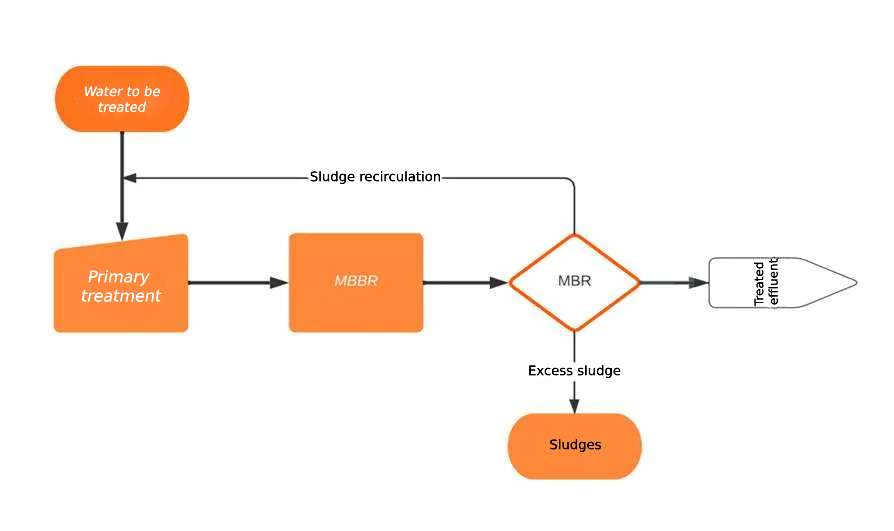
The sludge filtered by the MBR membranes will basically consist of the inert material that is released from the MBBR carriers. This inert material can be separated in the preceding primary treatment, so it can be returned to this part of the installation for separation together with the primary sludge. Another option is to purge it from the membranes and send it to dewatering for subsequent disposal.
The option of using submerged MBRs as a second step of a biological treatment is recommended to treat effluents that require the production of a higher quality water, or that have high NTK contents. In these cases it will be convenient to have a recirculation line at the inlet of the MBBR with a previous anoxic zone.
Among the advantages offered by this combination of processes it is worth mentioning:
- Flexibility in treatments.
- Improved system performance efficiency
- Less space occupied than with a sedimentation or flotation process after the biological process.
- Improved quality of treated water
5. Summary
The MBBR process has been gaining ground over other conventional biological treatments such as prolonged aeration, due to its advantages of flexibility and specialization in specific industrial discharges, as it can combine different types of bacteria colonies contained in different areas of the reactor. The purification performance is also increased by the fact that the colonies are housed in a set of plastic elements(carriers) that offer a large surface area for them to adhere and develop(biofilm), to which is added the mobility of the set due to air agitation (aerobic system) or mechanical agitation (in an anaerobic system). All this translates into high performance in the smallest space occupied.
MBR technology, on the other hand, replaces the secondary clarification system in order to separate the sludge that escapes from the biological treatment. In the case of an MBBR, these sludges are formed by the remains that are released from the carriers and, practically all of them, can be considered excess sludge. Accordingly, it is not necessary to recirculate the activated sludge before the MBBR, and once filtered by the MBR membranes, it can be sent directly for further dewatering or returned to the primary treatment.
Despite the advantages of space reduction, and its higher performance and efficiency compared to other common wastewater treatments, this combination of processes has the disadvantages of higher cost and complexity, which leads to the need for trained personnel.
Are you interested in this solution?
BASIC INFORMATION CLAUSE
DATA CONTROLLER: SIGMADAF CLARIFIERS, S.L. PURPOSE: To respond to the user’s request. LEGAL BASIS: Consent of the data subject. DISCLOSURES: No disclosures are anticipated, except where required by law or court order. RIGHTS: Access, rectification, erasure, objection, restriction, data portability, and withdrawal of consent. If you believe that the processing of your data does not comply with the regulations, you may contact the Supervisory Authority (www.aepd.es). ADDITIONAL INFORMATION: For more information, please see our privacy policy.