
Wastewater treatment and reuse in the textile industry

- 1. Water consumption and discharge in the Textile Industry
- Treatment and reuse of wastewater from the textile industry.
- 3. SIGMA Success Stories in the Textile Industry
- 4. Regulatory framework
- 5. References
1. Water consumption and discharge in the Textile Industry
It is estimated that the textile industry consumes between 80 and 150 liters per kilogram of fabric processed. The amount of water used in the manufacture of garments varies according to the type of fibers (cotton, wool, nylon, polyester, etc.) and the machinery used in each of the processes.
Wastewater from the textile industry is characterized by the large amount of reagents applied in its production processes, most of which are non-biodegradable and persistent in the medium, especially the aqueous medium.
The pigments used are highly contaminating agents as they are manufactured to offer high durability and resistance to biological degradation.
Up to 200,000 tons of pigments and colorants can be lost annually in the manufacturing process if the water is not efficiently treated. It is for this reason that it is increasingly important to implement circular economy solutions that enable the reuse of wastewater and the recovery of raw materials dissolved in effluents.
A correct design of a wastewater treatment system for the textile industry must meet the following objectives:
- Adapt the wastewater to the discharge limits.
- Reuse water in the different textile manufacturing processes (washing, dyeing, heat treatment), as well as for cleaning operations, irrigation, etc.
- To recover raw materials dissolved in the wastewater, such as pigments or dyes.
- Reduce operating costs of the production process.
- To reduce the environmental impact of business activities.
Which processes are the most efficient for treating wastewater generated in a textile production plant?
The plants for the treatment of wastewater generated in the textile industry involve various technologies, since the diversity of pollutants present in the effluent cannot be treated with a single technology.
The processes most commonly combined for the treatment of effluents generated in the textile industry are screening, homogenization, neutralization, physical-chemical processes, biological treatment and, additionally, filtration or evaporation technologies in cases where the treated water is to be reused for reincorporation into the production process.
The wastewater generated by the textile industry has the following characteristics:
- High variability of flow rate and contaminant load in each of the process lines.
- Color.
- Biodegradable and non-biodegradable or "refractory" organic compounds.
- Non-biodegradable inorganic compounds (reagents and additives added during the process): heavy metals, dyes, phenols, pesticides, surfactants, surfactants, surfactants, etc.
- Oils and fats.
- Total suspended solids (TSS).
- Chemical oxygen demand (COD).
- Biological oxygen demand (BOD5).
- High levels of total dissolved solids (TDS).
- Generally deficient in nutrients (nitrogen and phosphorus).
- Virtually free of pathogens.
- High chlorine and salinity content.
Dyes are the most polluting elements as they have a great impact on the environment:
- They reduce oxygen in water bodies by blocking light, causing septic conditions.
- They are mutagenic and carcinogenic agents for animals and humans.
- They are toxic to plants as they inhibit photosynthesis.
- High levels of TDS cause an increase in salinity, altering the natural pH of the water.
1.2. Typical composition of wastewater from the Textile Industry
The manufacture of textile products is carried out in different stages, each of which discharges wastewater with specific characteristics. In order to treat all the wastewater generated in an industry, the wastewater from all the process lines is homogenized.
The characteristics of the wastewater will depend on the type of fibers worked, the process stages and the machinery used.
The most common stages and the characteristics of the wastewater generated in each of them are shown in the following table:
Table 1. Characteristics of the water discharged in each of the stages. Generally, homogenization is carried out to treat all effluents together.
| Stage | Features | pH | Dissolved solids (mg/L) | Suspended solids (mg/L) | Color | BOD5 (mg/L) | COD (mg/L) | Chlorides (mg/L) | Sulfates (mg/L) |
|---|---|---|---|---|---|---|---|---|---|
| Washing | High BOD5, biocides, disinfectants, insecticides, soda, soaps, solvents. | 9-14 | 12000-30000 | 1000-2000 | - | 2500-3500 | 10000-20000 | - | - |
| Bleaching | Hydrogen peroxide, stabilizers, high basicity | 8-11 | 2500-11000 | 200-400 | - | 100-500 | 1200-1600 | - | - |
| Mercerized | High basicity, soda | 8-10 | 2000-2600 | 600-1900 | strong coloration | 50-120 | 250-400 | 350-2000 | 100 - 350 |
| Dyeing and finishing | Heavy metals, high salinity, surfactants, colorants, high organic load, solvents, acids and bases, suspended solids, waxes, resins. | 1-10 | 1500-4000 | 50-350 | strong coloration | 100-400 | 400-1400 | - | - |
Generally, the water coming from each stage of the production process is unified into a single effluent by means of a mixing and homogenization tank. In this way, a single effluent is obtained for which the treatment plant is designed.
Table 2. Indicative characteristics of unitized wastewater in the textile industry.
| Parameter | Value | Units |
|---|---|---|
| pH | 10 | - |
| Conductivity | 1380 | µS/cm |
| Temperature | 20 - 40 | ºC |
| COT | 620 | mg/L |
| SST | 160 | mg/L |
| COD | 1650 | mg/L |
| DBO5 | 460 | mg/L |
| Color | 2900 | Unid. Hazen |
| Total Phosphorus | 1,5 | mg/L |
| Total Nitrogen | 25 | mg/L |
| Chlorides | 1300 | mg/L |
Treatment and reuse of wastewater from the textile industry.
The two main objectives in the treatment of wastewater from the textile industry, whether for discharge or reuse, are:
- Elimination of organic matter.
- Color removal (representative of dyes and other pollutants).
The installation of an on-site treatment plant , or decentralized treatment, is an investment that ensures the operation and sustainability of the plant in the medium and long term.
The main advantages of decentralized processing are:
- Allows wastewater to be treated at the point of manufacture, saving on wastewater transportation costs and associated taxes.
- It allows the reuse of treated water in the production plant itself.
- Overexploitation of water resources is significantly reduced.
- It favors savings in surface water catchment infrastructures.
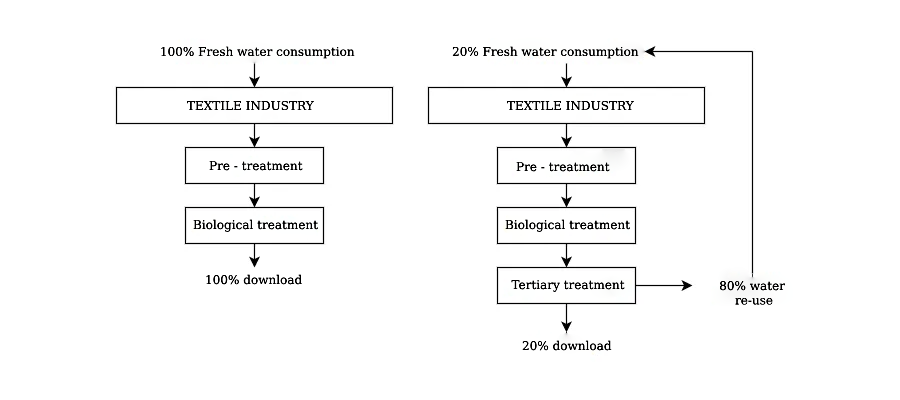
Although each case requires a study for the selection of the necessary technologies, the most common stages in the treatment of wastewater from the textile industry are the following:
- Screening for removal of large solids (fibers, lint, solid pieces, etc.).
- Elimination of oils and greases, especially in the effluents of the wool processing industry.
- Homogenization, which is essential to eliminate fluctuations in the flow rate and concentration of pollutants that exist between the effluents generated in the different stages of the production process. It also allows the cooling of the wastewater when it is received at high temperatures.
- Neutralization, which consists of adjusting the pH for the correct functioning of the subsequent stages.
- Physical-chemical treatment for the elimination of color, solids and grease. Coagulation-flocculation, oxidation and filtration technologies are applied.
- Biological treatment for the elimination of organic matter. Active sludge technologies are applied.
- Tertiary treatment for intensive removal of color and recalcitrant organic compounds. It allows water reuse. Membrane and filtration or evaporation technologies are applied.
2.1. Physical-chemical pretreatment: elimination of color, solids and grease.
The main objectives of pre-treatment are the following:
- Homogenization of flow rates and temperature reduction.
- Reduce the concentration of suspended solids.
- Grease and oil removal.
- pH adjustment.
Two types of technologies are generally applied:
- Chemical oxidation and advanced oxidation.
- Physical-chemical processes.
2.1.1. Chemical oxidation and advanced oxidation
Chemical oxidation and advanced oxidation technologies are ideal for water reuse, as they offer high performance for the removal of organic matter and color. They are easy to apply and allow the degradation of toxic agents.
Chemical oxidation processes use oxidizing agents such as ozone O3, or hydrogen peroxide H2O2. Advanced oxidation processes generate the hydroxyl radical -OH, which is a powerful oxidizing agent.
Table 3 shows the most effective chemical and advanced oxidation methods for wastewater treatment in the textile industry.
Table 3. Chemical oxidation and advanced oxidation processes used in the treatment of wastewater from the textile industry.
| Oxidation process | Performance |
|---|---|
| TiO2/UV/H2O2 | Color removal between 65 - 100%. 60% TOC removal. |
| Ozonation O3 | Removal of >95% of color. Removal of >60% of COD. |
| H2O2 in subcritical water (150 - 200ºC) | Total color removal. |
| Fenton Process (Fe(II) + H2O2) | Removal of >96% of color. Elimination of 40% of TOC. |
| Electro-Fenton | Total color removal. 89% COD removal. |
| Electrochemical oxidation (electrolytic cell) | Removal of >95% of color. Removal of >70% of COD. Removal of >95% of TOC. |
| Hypochlorite ClO- | Removal of >95% of color. Removal of >95% of COD. |
2.1.2. Physico-chemical processes
Coagulation-flocculation allows the removal of suspended and colloidal matter (up to 95%) and associated COD and BOD5 (between 60 - 80%). It also removes turbidity (above 70%) and color (above 90%).
The most effective coagulants for the textile industry are aluminum salts (including aluminum polychloride) and iron salts (generally ferric chloride).
After the coagulation and flocculation stage, dissolved air flotation (DAF) equipment is installed to separate the flocs formed.

Activated carbon filters are also used in the pre-treatment stage, as they allow the retention of colorants and toxic compounds so that they do not affect the subsequent biological treatment.
2.1.3. Dissolved Air Flotation
Sigmadaf is an expert in the design and construction of DAF systems, including compact "plug & play" equipment. We design each equipment according to the requirements and characteristics of the water to be treated:
Our wide range of models allows treating flow rates from 5 m3/h to 1,000 m3/h and pollutant loads up to 40 kg of solids perm2.
Our range of DAF systems includes the following models:
- SIGMA DAF FPAC: flow rates from 5 to 160 m3/hwith very high solids load. High performance cross-flow equipment.

SIGMA DAF FPBC: flow rates from 10 to 250 m3/h with low to medium solids loads. High performance countercurrent flow equipment.

SIGMA DAF FPHF: flow rates from 200 to 1000 m3/h with very high solids load. The equipment combines counterflow and crossflow.

COMPACT DAF: compact equipment including the coagulation-flocculation system and the flotation equipment. They are installed in a skid. Space and energy saving.

Advantages of SIGMA DAF equipment:
- High and constant quality of the clarified product.
- Fast start-up.
- Minimal sludge production (sludge concentrations up to 5%, much higher than those achieved by conventional settlers).
- Easy to operate with simple, adaptable and efficient control systems.
- Well-known, flexible and robust technology.
2.2. Biological treatment: removal of organic material
Biological treatment allows the elimination of organic matter and nutrients through the action of microorganisms under various oxygenation conditions.
There are multiple designs of biological reactors, with membrane bioreactors, also known as MBR systems, offering the best performance for the treatment of wastewater from the textile industry. MBR reactors combine the biological treatment process with ultrafiltration membranes.
Membrane bioreactors provide intensive biological treatment, which allows extending cell residence time and working at very high biomass concentrations, facilitating the elimination of slowly biodegradable products.
The biological process can be aerobic, anoxic or anaerobic. In the case of wastewater generated in the textile industry, aerobic treatment is commonly applied.
The use of ultrafiltration membranes allows reaching very high concentrations of biomass inside the reactor, between 6000 and 12000 mg/L MLSS (mixed liquor suspended solids), much higher than the concentration obtained with a conventional activated sludge system followed by a decanter. This leads to a high performance of the biological process, since it allows working at high volumetric loads, while presenting a minimum sludge production, much lower than that produced in conventional biological processes.
With an MBR system, COD and BOD5 removal can exceed 90% in the textile industry, although it always depends on the refractory nature of the dyes, which can be removed in a pre-treatment, or by means of a special tertiary treatment with filters or membranes.
The unique advantage of an MBR is that it combines biological treatment with membrane technology, allowing the removal of biodegradable and refractory COD. In addition, the membranes, acting as a tertiary treatment, allow immediate water reuse (permeate) and product recovery (retained). For a much more intensive purification, MBR can be complemented with Reverse Osmosis membrane technology as tertiary treatment.
Detailed information about this process can be found in the article "Application CAF, DAF, MBR and Reverse Osmosis in the treatment and reuse of wastewater from the cosmetics industry" in section "2.3. MBR Ultrafiltration Membrane Bioreactor".
Characteristics of Sigmadaf MBR reactors:
- Continuous discharge of clarified effluent.
- Complete sludge separation.
- Clarified completely free of suspended solids and particles.
- Elimination of organic load above 90%.
- Achievable biomass concentrations within the reactor very high: 6,000 - 12,000 mg/L MLSS.
- Reduced reactor volumes, which means space and energy savings.
- High resistance to oxidizing agents.
- Very high quality of the treated effluent, which is suitable for reuse.
- Minimized sludge generation.

Sigmadaf designs and builds modular MBR plants, which offer the possibility of adding extra membrane modules, and compact MBR plants, which include the reaction zone and the filtration zone in the same equipment.
The advantages of the SIGMA SMBR compact units are as follows:
- PLUG&PLAY solution.
- Highly reliable and durable equipment.
- An effluent of optimum and constant quality is obtained, suitable for reuse.
- Compact plant that allows the modular addition of ultrafiltration membranes.
- Simple operation and control systems.
- High resistance to oxidizing agents.
- SIGMA SMBR plants can treat flow rates between 20 - 100 m3/day.


2.3. Tertiary treatment: Intensive removal of color and recalcitrant organic compounds and water reuse.
Tertiary treatments can be adsorption/absorption or advanced membrane filtration. These processes allow the complete removal of color, turbidity and recalcitrant contaminants, producing water suitable for reuse.
Adsorption/absorption: sand filters and activated carbon filters.
Advanced membrane filtration: advanced membrane processes are combined with biological processes, or with coagulation-flocculation processes when the biological stage is not used. The sequence that has proven most effective is the application of ultrafiltration (membranes that are generally included in an MBR system) followed by reverse osmosis.
The application of reverse osmosis membranes generates a dye-free permeate suitable for reuse. On the other hand, the concentrate retains the dyes that can be recirculated to the industrial process and, therefore, cease to be a waste and become a consumable reagent again.
3. SIGMA Success Stories in the Textile Industry
At Sigmadaf we have extensive experience in the treatment of wastewater from the textile industry.
For more information about the solutions offered by Sigmadaf, please do not hesitate to contact us using the form on the right, or by sending an email to info@sigmadafclarifiers.com.
Two success stories are presented below.
Treatment and reuse of wastewater from the textile industry using DAF technology. ACAPERSA case.

Year: 2011
Project location: ACAPERSA Textile Company, Valencia.
Objectives: Design and installation of a wastewater treatment plant to obtain very high quality water for reuse and to ensure compliance with discharge directives.
Installed equipment:
- Physical-chemical coagulation and flocculation system.
- SIGMA DAF FPBC model CPF.
Capacity: 5 m3/h.
Table 4 . Wastewater characteristics and performance.
| COD (mg/L) | TSS (mg/L) | Turbidity (NTU) |
|---|---|---|
| 11630 | 470 | 2890 |
| COD | SST | Turbidity |
|---|---|---|
| 90% | 95% | 96% |
Wastewater from the textile industry is characterized by a high content of suspended solids, COD, color and turbidity.
In the case of ACAPERSA, Sigmadaf designs and builds the pretreatment of the waste effluent from the process. This pre-treatment includes a physical-chemical process, consisting of a coagulation and flocculation system, followed by a DAF FPBC CPF model.
The pre-treatment designed and installed by SIGMA achieves COD removal efficiencies of 90%, suspended solids removal of 95% and turbidity and color removal of 96%. These high performances are achieved thanks to the correct dosing of reagents and the special design of the FPBC-CPF equipment.
The dosage of reagents is established after Jar-Test tests with samples of the wastewater generated at the ACAPERSA plant. In this case, aluminum polychloride and a cationic polyelectrolyte with optimum affinity for suspended solids and particles present in the water are applied.
Our DAF systems offer the following features:
- High and constant quality of the clarified product.
- Fast start-up.
- Minimal sludge production (sludge concentrations up to 5%, much higher than those achieved by conventional settlers).
- Easy to operate with simple, adaptable and efficient control systems.
- Well-known, flexible and robust technology.
Treatment and reuse of wastewater from the textile industry by biological treatment, DAF system and tertiary treatment. COLORTEX case.

Year: 2008
Project location: COLORTEX Textile Company, Valencia.
Objectives: Design and installation of a wastewater treatment plant to obtain a very high quality water that can be reused in the production process, which also complies with the discharge regulations.
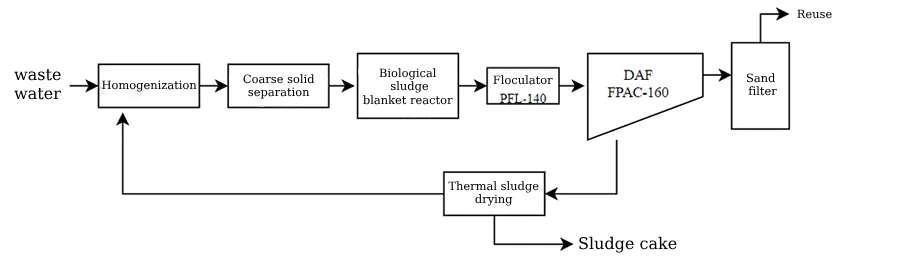
Installed equipment:
- Biological sludge blanket reactor.
- PFL-140 in-line flocculation equipment.
- SIGMA DAF FPAC-160 Clarifier.
- Sand bed filter (tertiary treatment).
- Thermal drying equipment (sludge treatment)
Capacity: 150 m3/hour.
Wastewater characteristics and performance of the COLORTEX Case Study.
| COD (mg/L) | TSS (mg/L) | Turbidity (NTU) |
|---|---|---|
| 4073 | 5000 | >500 |
| COD | SST | Turbidity |
|---|---|---|
| 95% | 95% | 90% |
The treatment consists of:
Biological sludge blanket reactor: the inverted cone-shaped design allows the formation of a sludge filter, and achieves a much more effective separation of sludge and water than that obtained with a common settler. Sludge blanket filtration allows the execution of all transformation processes in the same reactor: activation, nitrification, denitrification and dephosphorization. This reduces the space required and lowers operating and maintenance costs.
PFL-140 in-line flocculation equipment: this physicochemical system is applied on the effluent of the biological reactor. In the PFL system, the processes of coagulation, flocculation, de-emulsification, precipitation and pH control are carried out. All these operations take place under defined and extremely controlled conditions.
The reagent dosage is established by Jar-Test with samples of the water at the outlet of the biological reactor. In the case of COLORTEX, a cationic polyelectrolyte is applied.
Its advantages are:
- No maintenance cost.
- No moving parts.
- High quality materials and durability.
- No need for additional energy intake.
- Formation of uniform flocs.
- Compact equipment.
- Total control of process conditions.
SIGMA DAF FPAC-160 clarifier: this system is a cross-flow separator of reduced height, in which the injection of air micro bubbles allows the separation of the flocs formed in the flocculator and the obtaining of a clarified product free of suspended solids, turbidity and color.
The FPAC system allows the treatment of water with a high solids load. It is a compact system, which includes a unique sludge dewatering and separation system allowing a sludge concentration of up to 5%. It is low maintenance and easy to operate. These systems can be designed exclusively for each type of effluent.
Sand bed filter: applied as a tertiary treatment for the reuse of water in the production process. These filters allow obtaining treated water with sufficient quality for its reincorporation as raw material in the textile process. It is a robust, high resistance and high quality equipment, which includes a control panel that allows easy handling. This tertiary treatment achieves zero discharge and the conversion of waste into a resource.
Sludge treatment is also designed by thermal drying with a high efficiency cyclonic spiral system. This technology allows drying, condensation, dewatering and sterilization for absolute final dryness.
The treatment designed and installed by SIGMA achieves COD removal efficiencies of 95%, suspended solids removal of 95% and turbidity and color removal of 90%.
4. Regulatory framework
The following is a collection of the currently applicable European and Spanish wastewater discharge regulations and laws.
Both the wastewater issuing company and the engineering firm developing the treatment plant project must be familiar with these laws in order to establish the required scope and performance.
European legislation:
- Council Directive 91/271/EEC of 21 May 1991 concerning urban wastewater treatment.
- Directive 2010/75/EU of the European Parliament and of the Council of 24 November 2010 on industrial emissions (integrated pollution prevention and control).
Spanish legislation:
- Royal Decree-Law 11/1995, of December 28, 1995, establishing the standards applicable to the treatment of urban wastewater.
- Royal Decree 509/1996, of March 15, 1996, implementing Royal Decree-Law 11/1995, of December 28, 1995, establishing the standards applicable to the treatment of urban wastewater.
- Resolution of May 25, 1998, of the Secretary of State for Water and Coasts, declaring the "sensitive areas" in the intercommunity hydrographic basins.
- Royal Legislative Decree 1/2001, of July 20, 2001, approving the revised text of the Water Law.
- Resolution of July 1, 2006, of the General Secretariat for Territory and Biodiversity, declaring the Sensitive Areas in the Intercommunity Hydrographic Basins.
- Royal Decree 1620/2007, of December 7, 2007, which establishes the legal regime for the reuse of treated water.
- Order ARM/1312/2009, of May 20, 2009, which regulates the systems for the effective control of the volumes of water used by the water exploitations of the public hydraulic domain, of the returns to the public hydraulic domain and of the discharges to the same.
- Resolution of June 30, 2011, of the Secretary of State for Rural Affairs and Water, declaring the sensitive areas in the intercommunity basins.
- Order AAA/2056/2014, of October 27, approving the official models of authorization request and discharge declaration.
- Royal Decree 817/2015, of September 11, establishing the criteria for monitoring and evaluation of surface water status and environmental quality standards.
5. References
Altinbas U., Dokmeci S., Baristiran A. 1995. Treatability study of wastewater from textile industry. Environmental Technology. 16, 389 - 394.
Bolaños R.A. 2010. Proposal for the recovery of wastewater from the textile industry. Faculty of Engineering and Architecture. School of Chemical Engineering. University of El Salvador.
Buscio V. 2015. Treatment and reuse of textile industry effluents using membrane techniques. Department of Textile and Paper Engineering. Universitat Politècnica de Catalunya.
Ciardelli G., Corsi L., Marcucci M. 2000. Membrane separation for wastewater reuse in the textile industry. Resources, Conservation and Recycling. 31, 189 - 197.
Technological Notebook No. 18: Textile Industry Effluent Management. V. López and M. Crespi, 2015. Institute for Textile Research and Industrial Cooperation of the Polytechnic University of Catalonia.
Ergas S., Therriault B., Reckhow D. 2006. Evaluation of Water Reuse Technologies for the Textile Industry. Journal of Environmental Engineering. 132, 315 - 323.
Fluence News Team. 2019. Water Use and Treatment in the Textile Industry.
Are you interested in this solution?
BASIC INFORMATION CLAUSE
DATA CONTROLLER: SIGMADAF CLARIFIERS, S.L. PURPOSE: To respond to the user’s request. LEGAL BASIS: Consent of the data subject. DISCLOSURES: No disclosures are anticipated, except where required by law or court order. RIGHTS: Access, rectification, erasure, objection, restriction, data portability, and withdrawal of consent. If you believe that the processing of your data does not comply with the regulations, you may contact the Supervisory Authority (www.aepd.es). ADDITIONAL INFORMATION: For more information, please see our privacy policy.